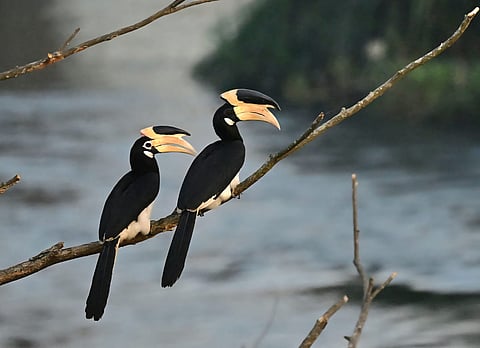

DANDELI(UTTARA KANNADA): There was a time when the Dandeli forests used to reverberate with the calls of Great Hornbills. Declared as Hornbill Conservation Reserve in 2011, the 52.5 sq kms stretching from the Dandeli wood depot to all along the river Kali up to Ganeshgudi now see very few flocks of the spectacular birds with large, yellow beaks.
Many blame it on eco tourism and water sports gaining prominence along the river Kali and in and around Dandeli forests.
Hornbill Conservation Reserve within the Kali Tiger Reserve is home to four of India’s nine species of hornbills—Great, Malabar Pied, Malabar Grey and Indian Grey.
Hornbills used to flock all along the Kali at Ambeli, Ilava, downstream of Supa Dam up to Bommanahalli backwaters. The birds were sighted in plenty until 2022, say local birdwatchers.
The post-Covid revival of tourism is a matter of great concern for wildlife lovers. “Water sports activities have increased over the last three years. The area has become noisy and the birds tend to avoid these places. It is clear that the birds have gone to new places,” says Rahul Bavaji, a wildlife enthusiast.
“There was a time when there were hornbills on almost all branches of trees. That has become a rare sight. These birds are prone to disturbances and tend to abandon the habitat,” says another wildlife enthusiast.

‘Majority of tree hole nests abandoned’
Oumkar Umesh, a wildlife enthusiast, says, “There are two jetties newly constructed near the Supa bridge across the Kali. Aveda and Ilava near Ganeshgudi were very good bird sites. Now hornbills have vanished from these places.”
“Most of these tree hole nests have been abandoned by the nesting pairs. Even if, 10 percent of the tree holes are converted to nesting, there would be a difference,” Umesh says. “The birds used to roost en masse in Gundh, Ambikanagar and other places. Most of these are part of the hornbill conservation reserves,” he adds.
In Ganeshgudi 12 jetties now cater to tourists, where once Malabar pied hornbills used to mud bath. “Photographers used to come in search of such places. Now too much disturbance has shooed the birds away,” says Oumkar.
Another haunt for hornbills was the Dandeli wood depot. Now the muddy areas have been tarred and turned into gleaming roads.
Some birdwatchers, however, retain optimism. “Indeed, there are fewer hornbills in Ganeshgudi due to new jetties. Very few birds come to Dandeli wood depot. But they have not gone too far. They have shifted to isolated patches nearby. Many of us are aware of it,” says Rajini, a birdwatcher in Dandeli. Birdwatchers say the state forest department has not initiated any specific programmes for conservation of hornbills. Experts say that fruiting trees and the climate of the region are ideal for hornbill conservation.
However there has been a massive felling of trees for a water pipeline project in Dandeli in recent years, adding to the vanishing of hornbills from the region, they recall ruefully.