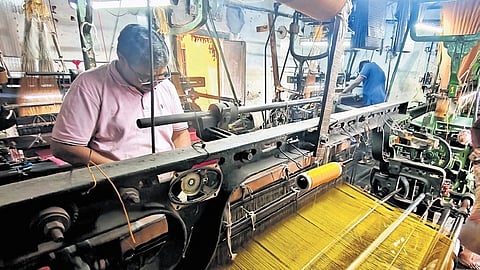

DODDABALLAPUR(BENGALURU RURAL): For over a century, thousands of weavers in and around Bengaluru Rural district’s Doddaballapur who depended solely on weaving silk for their livelihood, have now reached a dead end.
Shifting from handlooms to power looms, and from pure silk to semi-silk, they are struggling with an identity crisis as Gujarat-based mill owners produce Surat sarees mimicking Doddaballapur silk sarees, but at a much lower price. This has pushed traditional Doddaballapur sarees out of the market. As a result, many of the 40,000 loom owners in and around Doddaballapur town are now forced to take up piecemeal works for others, earning a daily wage of just Rs 100 to Rs 200.
The century-old weaving tradition was started by Devanga weavers community, whose population is considerably large in Doddaballapur, on handlooms. The silk sarees woven here were even exported. In 1948, the town got its power connection and the weavers slowly moved to power looms, enjoying high demand. Sarees would weigh 850gm to 1 kilo, with heavy zari borders, mostly preferred for weddings and auspicious occasions. These sarees were sold at Dharmavaram in Andhra Pradesh, besides Tamil Nadu and Telangana.
At weaver KC Dwarakish’s house, four looms greet visitors as they enter. “Our day begins at 6.30am and continues until 8.30pm. We are the owners as per records, be it the house, electricity bills, or power looms, all are in our names. Unlike earlier, we no longer weave sarees and sell them directly. Instead, we take up piecemeal work from agents. They provide raw material and we weave as per their instructions,” he says.

‘Our biggest market Chickpet is today filled with cheaper Surat sarees’
“For plain cloth weaving, we are paid Rs 13.50 per metre, and from one loom we weave 20 metres a day. For sarees, we are paid Rs 200 for 6.5 metres. We are like coolies with our own looms,” Dwarakish says, recalling that in 1988, when he was in college, he would earn Rs 100 per day, but even after 37 years, daily earnings have not increased.
“In those days, we would pay Rs 70 per day for construction labour. Today, they charge Rs 1,000 per day. We lie at the bottom.”
Srinath, another weaver, says earlier, in a year they would face a couple of months with few or no orders. But now, they receive orders only for two months in a year, leaving them jobless for the remaining ten months.
“The cost of silk thread has risen to Rs 6,500 per kilo, but when we actually use it, the weight comes to only 700gm after cleaning. We are third-generation weavers and we will be the last generation to carry this legacy,” he laments. He and his wife weave sarees, earning Rs 200 for a big-bordered saree and Rs 130 for a small-bordered saree per day.
BG Hemanth Raju, President of Weavers’ Rights Forum, Doddaballapur, says when the Handlooms (Reservation of Articles for Production) Act, 1985, was passed, the weavers here had already moved to power loom sarees with white and golden threads, and add colours when the saree was ready. They were not allowed to weave sarees with colourful silk thread. Over a period of time, Doddaballapur sarees shifted and they started weaving artificial silk sarees.
“Chickpet market in Bengaluru, which was our biggest market once, is today filled with Surat sarees, which look like our sarees, but are cheaper. This is because there are mills in Gujarat which make Doddaballapur look-alike sarees in large numbers. If our loom sarees take six hours per saree, their machines produce six sarees in 1.5 hours. We are an unorganised sector, but theirs is organised. They also get raw material locally. Their cost per saree is just Rs 600, while ours is over Rs 1,000. The borders of mill sarees is burnt, whereas ours is interlocked,” he explains.
There has been a demand from the weavers to control the flow of ‘Surat sarees’ and also enforce the Power Loom Reservation Act that restricts mills from copying power loom sarees.
The day is not far when the rhythmic sound of the looms would fall silent, burying a rich legacy that has been carried forward over generations.