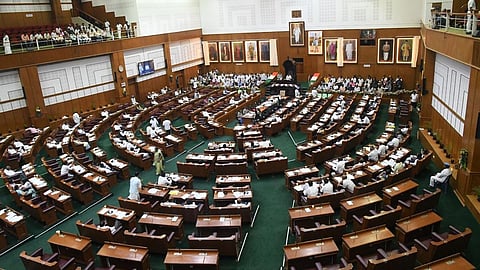

The State Government’s decision to take up a special discussion in the legislature on the economic and social impact of the Viksit Bharat-Guarantee for Rozgar and Ajeevika Mission Gramin (VB G-RAM G) Act appears to be more an act of political posturing against the Union Government. It is unclear if such a discussion would yield any tangible outcome for lakhs of poor citizens in rural areas who depend on the government scheme for employment and livelihood.
The legislative session, from January 22 to 31, could just end up being yet another political platform for ongoing public outreach efforts by Congress and the BJP-JDS. The Congress is vehemently opposing the new Act that replaced the UPA government’s flagship Mahatma Gandhi National Rural Employment Guarantee Act (MGNREGA).
The party has decided to launch a series of campaigns accusing the Union Government of depriving the rural poor of their employment opportunities, while the state government is attempting to send a message from the legislature and exploring possibilities for a legal battle to restore the MGNREGA.
Politically, it is a shrewd move by the Congress to up the ante on the issue with far-reaching implications for the rural economy and channelise public anger against the Union Government and the BJP. Clearly, the party is using all available opportunities and platforms to drive home its argument. The Congress’s key concerns revolve around the change in the funding pattern – from a 90:10 to 60:40 Centre-State sharing arrangement – which burdens already stretched state finances.
Another major concern expressed by Congress is that the powers vested with Gram Panchayats under 73rd Constitutional Amendment have been taken away, undermining federalism and local self-governance.
The grounds on which Congress is opposing the Central Act have been highlighted by the party leaders on several occasions on different platforms, including Chief Minister Siddaramaiah’s letter to Prime Minister Narendra Modi. A detailed discussion in the session could be part of a larger strategy to ensure that the message resonates more widely, attempting to pressure the Union Government to address the state’s concerns.
In the pre-budget meeting called by the Union Finance Minister this week, the state government stated that “to continue to provide livelihood security to the tune of 13 crore person-days, Karnataka would require approximately Rs. 2,000 crore, which is fiscally unsustainable. New cost-sharing has increased the state burden.” The state requested reconsideration of the scheme design, restoration of demand-driven employment, and adequate and uncapped Central funding.
Apart from Karnataka, a few other states – including Kerala and Tamil Nadu – have expressed concerns about the new Act. Congress leaders in Karnataka appear to be taking the lead in the fight against the new Act by planning a sustained campaign to back the party’s central leaders’ efforts at the national level. Much like the stand they had taken to back Rahul Gandhi’s allegations of electoral malpractices, the demand for a caste census or the Centre’s alleged bias against non-BJP-ruled states.
While the state government has the right to express its opinion on the issues that affect a large section of Karnataka’s people, some working closely with the government believe that the government can do little except pass a resolution.
Former CM and BJP MP Jagadish Shettar, who also served as Assembly Speaker, says it is meaningless to discuss an act of Parliament in the state assembly, as they cannot take any decision on it. However, the government has strongly defended its move by stating that it cannot be expected to remain quiet when a large number of people will be impacted.
Be that as it may, the aggressive stand on the issue has allowed Congress to some extent divert attention from the leadership issue that refuses to die down, even as it attempts to set a narrative against the BJP ahead of the crucial local body polls.
For the BJP-JDS combine, the session would put to test their leaders’ ability to counter the Congress’s spirited opposition to the central Act and effectively defend the NDA government’s decision. Apart from VB G-RAM G, the BJP will also be keen to raise several other issues, including the violent clash in Ballari where a Congress worker was allegedly killed by the bullet of a Congress leader’s gunman, and a ruling party leader in Chikkaballapur district threatening a woman officer.
Politics aside, people dependent on the scheme would be keen to know if the State Government implements VB G-RAM G or comes up with its own Act. Uncertainty will do no good for those who eagerly look up to the government, regardless of political parties, to provide them with employment.
Ramu Patil
Assistant Resident Editor
ramu@newindianexpress.com
