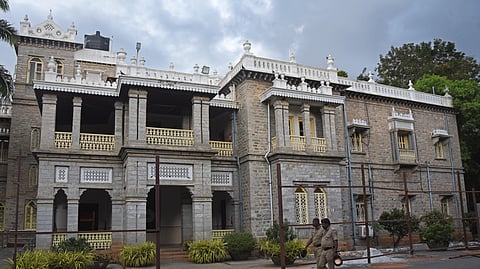

BENGALURU: For DK Shivakumar, none of the official residences traditionally associated with Karnataka chief ministers -- Krishna, Cauvery and Anugraha -- will do, as he has picked the historic Kumara Krupa bungalow to stay and conduct his official duties.
The 160 year-old heritage structure, among Bengaluru’s oldest surviving buildings, is currently undergoing renovation and is expected to be ready within two months. Located a short distance from the existing chief ministerial residences, the bungalow has till now functioned as a government guest house.
The sprawling building has 12 spacious rooms, large halls, a kitchen and other facilities. The Public Works Department’s renovation work includes flooring, electrical works, carpeting, painting and restoration. Age-old teakwood doors, windows, cabinets and almirahs give the building an old charm.

Photo | Vinod Kumar.T, EPS
East-facing bungalow aligns with Shivakumar’s Vaastu preference
The stone-clad exterior continues to stand out as an architectural landmark.
The east-facing bungalow is said to align with Shivakumar’s Vaastu preferences. His Vaastu advisers had earlier recommended changes to the seating arrangement in the chief minister’s chamber at Vidhana Soudha and got his chair turned to face East. Even while taking his oath, he faced east, which is considered auspicious.
Now, Deputy Speaker Rudrappa Lamani is staying in one of the rooms at the Kumara Krupa guesthouse. He will shift to the new Kumara Krupa guesthouse. Three rooms contain files related to the alleged scam during Covid, and those too will be shifted to Arogya Soudha off Magadi road.
Meanwhile, former chief minister Siddaramaiah is staying in Cauvery and is unlikely to vacate it. He may ask for its allotment to his son and minister Dr Yathindra, sources said. Officials are also considering demolishing a government building within the premises to construct a meeting hall.
Historian Suresh Moona said the bungalow was a private residence of Sir K Seshadri Iyer, the Dewan of Mysore who served under Maharajas Chamaraja Wadiyar and Krishnaraja Wadiyar IV between 1883 and 1901.
“At that time, this was Bengaluru outskirts and situated on an elevated ground. Seshadri Iyer was a progressive Dewan who laid the foundations for a modern Bengaluru. During his tenure, the city received electrified streetlights which was first in Asia. Also, water was being pumped from Hesaraghatta. Seshadripuram and Seshadri Road are named after him,” Moona said.
Seshadri Iyer was a devotee of Lord Kumaraswamy (Shanmukha) and hence named his residence Kumara Krupa.
“Given its historical significance, the building should ideally have been preserved as a memorial rather than converted into a residence,” he said.
The bungalow also carries historical value. Mahatma Gandhi stayed here during his visit to Bengaluru in 1927, and former chief minister S. Nijalingappa once made it his residence.
Many raised concerns over turning the heritage property into the chief minister’s residence. The lush green surroundings could face increased pressure due to security arrangements, VIP movement and rising vehicular traffic. In the coming years, there could be demands for additional parking and infrastructure. That may put some of the trees in the vicinity at risk, a source said.