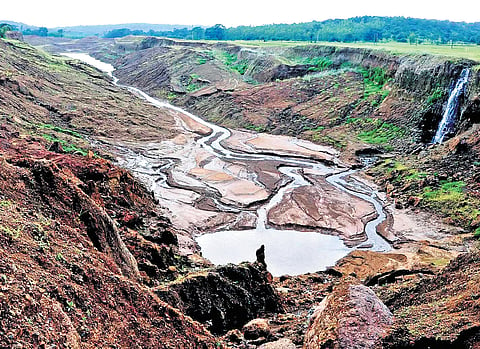

BELAGAVI: Nearly eight years after Karnataka secured its legal share of water from the Mahadayi Water Dispute Tribunal (MWDT), the much-awaited Mahadayi (Kalasa–Banduri) drinking project, projected as a lifeline for parched North Karnataka, remains trapped in a maze of environmental clearances, inter-state disputes and prolonged litigation, leaving lakhs of people still dependent on uncertain water supplies.
Despite repeated political assurances and tribunal victory, not a drop of Mahadayi water has yet reached the drought-hit districts it was meant to serve.
The MWDT, in its final award, allocated 13.42 tmc water to Karnataka, including 5.5 tmc exclusively for drinking purposes to benefit Belagavi, Dharwad, Gadag and Bagalkot districts.
The Centre officially notified the award in 2020, raising hopes that decades-long agitation in North Karnataka had finally succeeded. However, implementation has remained largely confined to files rather than field execution.
The proposed diversion of the Mahadayi through Kalasa and Banduri streams, located in the ecologically sensitive Western Ghats, requires final approval from the Union Ministry of Environment, Forest and Climate Change and the National Board for Wildlife. Clearances continue to face scrutiny over potential ecological impact, effectively halting major construction activity.
Officials admit that without final forest and wildlife approval, full-scale work cannot begin. Adding to delays, Goa has challenged aspects of the tribunal award before the Supreme Court, alleging ecological damage and downstream impact. Periodic objections and demands for joint inspections have ensured that the interstate dispute remains politically and legally active, slowing administrative momentum.
Once completed, the Mahadayi project is expected to supply drinking water to over 40 lakh people besides stabilising inflows to the Malaprabha reservoir and address recurring summer water crises in the Kittur Karnataka region.
Successive governments in the state across party lines have projected Mahadayi as a historic achievement.
But on the ground, the project stands caught between tribunal approval and environmental consent, turning one of Karnataka’s biggest water victories into its longest pending implementation challenge.
The state’s legal team, however, has criticised the Goa government for misleading the tribunal by contending that Mahadayi basin had merely 90 tmc of water while the tribunal clarified it was 188 tmc. On several occasions, the Goan top bureaucrats and ministers alleged Karnataka was illegally diverting water from Kalasa nala and strayed into the project site at Kankumbi breaking protocol.
As regards the stakeholder Maharashtra is concerned, out of the total demand of 7 tmc water, they have been granted only 1.33 tmc water i.e only for in basin use. As far as Tillari outside the basin diversion is concerned, the same has been rejected by the Tribunal. Furthermore, the contention of Maharashtra that 10 tmc of the Tillari project should also be included in the yield of the Mahadayi basin, the said contention has been rejected.
Save North Karnataka Citizens Alliance has released a report on the Mahadayi basin projects recently, saying allowing river diversion schemes in the region could damage the Western Ghats and lead to drying up of rivers in North Karnataka.
In a report on Banduri Nala Mahadayi river diversion project and the desertification of northern Karnataka, members of over 30 different organisations, that include environmentalists, social activists, retired officials, and writers, have cautioned against river diversion projects. They said that such projects could dry up northern Karnataka region. They have urged concerted efforts to protect the Western Ghats and its rivers.
