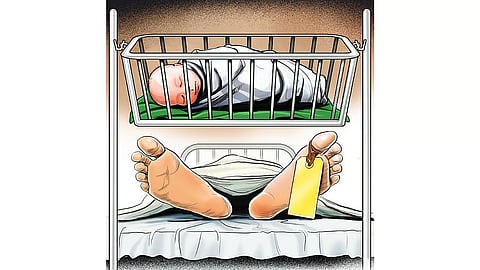

Karnataka occupies an awkward position in the South Indian health league table. Despite being a trailblazer in decentralisation and a long-stated commitment to health equity, the state continues to lag behind its neighbours. According to the latest Sample Registration System data, Karnataka’s Maternal Mortality Ratio stands at 63 per lakh live births, more than three times Kerala’s 20, and behind Tamil Nadu’s 49. Kerala’s community-based model, built on gram panchayat ownership of health and well-resourced community health workers, and Tamil Nadu’s nationally-cited centralised drug procurement system, both reflect deliberate, sustained investment in public health as a priority.
Regional inequalities
The inequities within Karnataka compound the picture. The north-south health divide remains stubbornly persistent. The latest report on regional imbalances, building on the landmark Nanjundappa Committee report, identifies over 170 taluks as backward in varying degrees; disaggregating to hobli levels reveals even sharper inequality.
Large cities like Bengaluru and Belagavi carry marked intra-city health gaps. Budget commitments are among the most important instruments through which the State can signal intent and direct resources to mitigate such inequities. But budget speeches are announcements of intent, and good intentions alone are insufficient. Everything depends on what gets implemented and how.
Which is why the announcement of a Public Health Cadre in the 2026-27 Budget is significant and long overdue. The Budget states this will be “implemented in a phased manner by ensuring objectivity in the appointment of District Health Officers, District Surgeons, and other administrative posts”.
As far back as 2001, the Taskforce on Health and Family Welfare chaired by Dr H Sudarshan, with widespread civil society involvement, had recommended precisely this reform. States like Odisha, Maharashtra and Tamil Nadu moved ahead; Karnataka waited 25 years.
The logic of the public health cadre is compelling: when administrative positions are filled by clinicians rotated without public health training,
public health evaporates with every transfer. A dedicated cadre of doctors trained in public health builds career progression for specialists and continuity in programme design and monitoring, and signals that population health is a discipline worthy of its own expertise. In an era of aggressive healthcare privatisation, strengthening state administrative capacity is the need of the hour.
Listening to Citizens
The budget’s commitment to filling 2,500 vacant posts in the health department is a direct response to citizen demands. The Sarvatrika Arogya Andolana (SAA-K), a statewide people’s campaign for universal health systems, conducted extensive public consultations across rural, Adivasi and marginalised communities before this budget. These hearings surfaced a damning paradox: even with Ayushman Bharat-Arogya Karnataka in place, patients in government hospitals are routinely prescribed medicines and diagnostics outside the public system, driving catastrophic out-of-pocket expenditure among those the scheme was designed to protect.
Vacancies among auxiliary nurse-midwives, Community Health Officers, and frontline workers who are the backbone of primary healthcare, were consistently flagged. The health minister attended SAA-K’s dissemination event, and this budget’s vacancy-filling commitment is a welcome acknowledgement. If delivered, it complements the action on social determinants of health such as women’s financial autonomy and mobility. Such commitments by the government, if realised, also address possible dichotomies about welfare schemes: they take away from core State functions, which demonstrably ought not to be the case.
Drop in Health Outlay
Several other announcements merit recognition: Nutrition Rehabilitation Centres extended to all remaining taluks, a Kerala-inspired palliative care programme and earmarked health funding for Kalyana Karnataka. However, the decline in health outlay is worrying. This year’s health expenditure has dropped to under 4% of the total budget, against 4.16% last year and 4.4% in 2024-25.
When both national and state governments are reducing their share of health spending, the structural reforms announced risk being underfunded. Overall, the focus on primary healthcare and structural reform points in the right direction. Whether it translates into well-functioning PHCs or fully-stocked medicines and diagnostics in our taluk/district hospitals will be the only verdict that matters.
