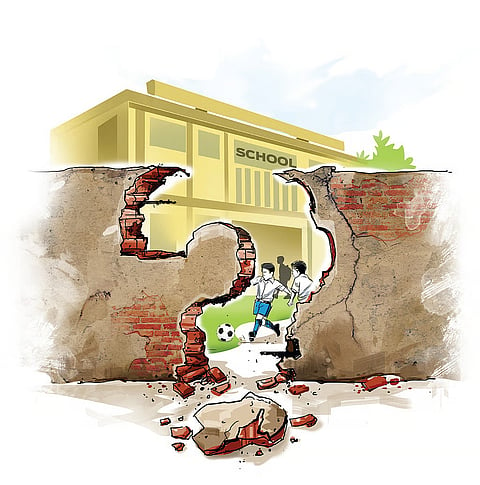

BENGALURU: The Government of Karnataka has allocated Rs 47,224 crore of a total of Rs 4,48,004 crore for education, which is 10 per cent of the budget. Though it is the same percentage as last year, around Rs 1,938 crore has been increased this year. However, it is not sufficient to improve school and college education system in the state.
More than 50 per cent of it goes towards salaries of schoolteachers and college lecturers. The budget for education should have been enhanced and at least 16% of the total budget dedicated for education (primary and higher).
In a significant development, the state government has announced upgrading around 800 schools into Karnataka Public Schools at a total cost of Rs 3,900 crore, comprising 500 schools under Asian Development Bank assistance, 200 schools under KKRDB funds and 100 schools under KMERC funds. This shouldn’t come at the cost of shutting down smaller schools that have good student strength in villages, taluks and districts.
Upgrading 800 schools is a good move but the total number of schools in the state is more than 41,000, and 800 is too small a number for upgradation. At least 5,000 schools must be considered for upgradation so that more children study in government schools.
Besides, the government has promised to fill 15,000 vacant posts of teachers in government schools in 2026-27. There are a total of 45,590 vacant post of teachers in government schools and more than 26,000 posts are vacant in Kalyana Karnataka region.
What is the point of developing infrastructure with no teachers in place to teach children? Dependency on guest teachers and lecturers may increase at a greater rate, which will impact the quality of teaching and learning.
In terms of providing knowledge related to booming Artificial Intelligence and cutting-edge technology, a personalised self-learning digital tutor facility using AI is to be set up in collaboration with IIT Dharwad for approximately 12.28 lakh school students for Rs 5 crore. This is a good step and the government must make sure to tie up with institutions like IITs, IISc and public universities to enhance AI skills at the school level itself.
On one side, the government is launching various digital programmes for school students, and on the other, they want to implement a social media ban for children under the age of 16. Who will be responsible for monitoring children? If not mobile, they might use laptops to create fake IDs and accounts on social media.
It may not be a feasible plan in the current scenario, where the world is connected globally on various platforms. With regard to higher education, the government has announced it will fill only 2,000 teaching posts in government first grade colleges, engineering colleges and 1,000 more teaching posts in public universities.
If the government wants to run institutions providing quality education, they must hire more lecturers on permanent basis than depend on teaching of guest faculty. Research projects will also be executed in a better way when there are permanent lecturers. Infrastructure without teachers is not a good sign, and a letdown for students who come from poor economic backgrounds to study in these colleges.
For the first time, female guest lecturers are given 90 days of maternity leave. They must be treated on par with permanent lecturers and maternity leave must be extended from 90 to 180 days.
Conducting student elections in colleges is another good move, because only when elections are conducted will the state be able to get leaders who are well-informed and can do better for society.
