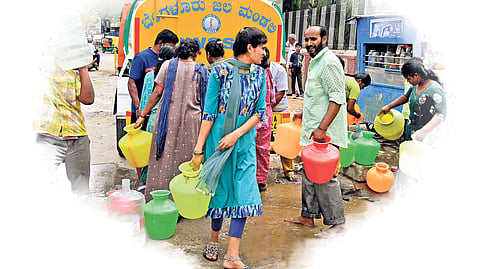

Bengaluru gearing up to meet water challenge
With copious rainfall in 2025, KRS and Kabini reservoirs currently hold comfortable water levels, easing concerns over water shortage. At the same time, the Bangalore Water Supply and Sewerage Board (BWSSB) has begun preparations for the summer. In January, the board requested Cauvery Neeravari Nigam Ltd to reserve 11 tmcft of water until July.
Bengaluru requires roughly 2 tmcft per month to meet the needs of its 1.5-crore population, officials said, noting that the onset of monsoon in June and possible summer showers should stabilise the situation. As of the second week of February, the reservoirs together stored 52.39 tmcft, with KRS at 117 ft against its full capacity of 124 ft, according to CCNL officials.
Authorities and Deputy Chief Minister DK Shivakumar, who is also water resources minister, have reviewed the preparedness. BWSSB has identified 65 water-stressed wards due to groundwater depletion and pipeline damage. Measures include mandatory use of treated water for construction, expanding tanker supply under Sanchari Cauvery, maintaining 60 water storage tanks with a capacity of 2,000 litre, providing new piped connections and fining those misusing drinking water, have been taken.
Mangaluru has reserves for 39 days only
Mangaluru city is staring at a potential drinking water crisis as forecasts point to an intense summer and a likely delay in the onset of monsoon. At present, the Thumbay vented dam has a reserve to meet the city’s demand for about 39 days. If inflows into the Netravathi declines further and rain is delayed, water rationing may be introduced across the city.
To manage the current situation, authorities plan to temporarily disconnect electricity supply to agricultural and horticultural pumpsets near the riverbed to prioritise drinking water needs, in coordination with MESCOM.
Additionally, around 50 MLD of water from the Adyar dam will be released daily to maintain levels at Thumbay. Provisions have also been made for back-pumping water from Adyar to Thumbay using 13 pumps, as was done in April and May 2023-24.
District in-charge Minister Dinesh Gundu Rao has directed officials to monitor reservoir levels and ensure minimal disruption in supplies. The Mangalore City Corporation has 140 borewells, with more being drilled. Cleaning and repair of open wells are under way, and around 15 tankers are supplying water to elevated areas.
Tankers already pressed into action in Dharwad
Despite having enough water reserves in both Malaprabha and Neersagar reservoirs, Hubballi-Dharwad twin cities and other parts of the district always face a drinking water problem during summer. This year too, authorities have organised a series of meetings to rejuvenate borewells, fill lakes and arrange tankers to supply water. People are facing water scarcity due to the ongoing 24x7 supply network project, as there are a lot of complaints about its implementation.
Deputy Commissioner Snehal R said the data is being collected, and as of now, over 50 tankers have been pressed to supply water to areas facing problems, and borewells are being flushed out. Officials are keeping tabs and updating higher-ups on the drinking water status. The district requires 245 MLD, while the availability is around 222 MLD. The shortage of 40-plus MLD will be the challenge.
Administration remains upbeat in Shivamogga
Shivamogga district is expected to manage the drinking water supply situation. Zilla Panchayat CEO Hemanth said that a few villages are expected to face drinking water scarcity, but still, they are in a manageable state.
Gram panchayat funds of the 15th Finance Commission and their own tax collection are used to drill borewells, reflush or redrill the old ones, based on the gravity of the situation, he added.
He said the first pre-monsoon shower in March will help analyse the summer situation for the next two months. “We can easily manage drinking water up to April-end. If rainfall commences from May, there will not be any drinking water shortage in any village.
Out of 1,530 villages in the district, a maximum of 30 villages may face drinking water shortage, which is also a 0.001 percent possibility, which is manageable,” he added.
Concern over contamination of water bodies in Udupi
Even after evaporation of water in water bodies across the district , the situation seems to be manageable in Udupi district.
Udupi CMC Commissioner Mahantesh Hangaragi said drinking water would be available till May-end. Since additional water comes from the Varahi river to Udupi city, the situation can be managed till June-end. “We are reducing the intake from the Baje dam so that we can save it beyond June,” he said.
Zilla Panchayat CEO Prateek Bayal said that as of now, there is no shortage of water in rural parts of the district. “We have done the vulnerability mapping and are giving it a final touch. We will be able to manage the situation,” he said.
In 2025, though water scarcity was witnessed in parts of the district by mid-April, rainfall in May solved the shortage issue.
Meanwhile, concerns are expressed over contamination of open wells due to mindless discharge of wastewater in Udupi city. Several wells in Nittur, Bailakere, Beedinagudde, Kalmady bridge area, Shivapady, among other places, are contaminated in the absence of a proper underground drainage (UGD) system in the city.
Vijayapura unlikely to face scarcity
With adequate water available in the Almatti dam, implementation of the Multi Village Scheme (MVS), Jala Dhare and filling up of tanks, the district is not expected to face any drinking water scarcity this year.
Additional Deputy Commissioner Dr Audra said, “We have received no demand for water from tankers. An adequate water reserve is available in the Almatti dam, which is being used to supply all drinking water projects in urban and rural areas. |We will not face water shortage till the beginning of June when the monsoon enters the district.”
The district has over 640 villages, connected with various water supply schemes such as MVS and Jala Dhare. Officials said no village will face scarcity so severe that they will have to depend on tankers.
Soaring mercury level a concern in Kalaburagi
Though the district received excess rainfall last monsoon, some villages and a few wards in Kalaburagi city could face drinking water problems, because demand might increase with the sharp increase in mercury levels during summer.
Officials said that of 918 villages in the district, 286 may face drinking water scarcity. More than half the villages in Aland and Afzalpur taluks might face drinking water problems. Of 136 villages in Aland taluk, 72 villages and of 93 villages in Afzalpur taluk, 60 might face drinking water crisis. Of the 143 villages in Kalaburagi taluk, 53 might face drinking water crises.
Sources said the district administration has made arrangements to tackle the crisis. Of the total 1,227 borewells in the district, 754 are functioning, and 308 new ones could be drilled.
KUIDFC Superintending Engineering RP Jadhav said that one water tanker each has been kept in reserve for all the 56 wards of Kalaburagi Mahanagara Palike.
Precautionary measures in place in Ballari
As many as 83 villages in Ballari district are likely to face acute drinking water shortages if rain fails, prompting the district administration to initiate emergency preventive measures. In a recent meeting to review the situation, Deputy Commissioner Nagendra Prasad K directed officials to ensure that there is no scarcity of drinking water in the coming months.
The DC said officers are directed to take steps immediately to ensure an uninterrupted drinking water supply in all vulnerable villages and to identify government borewells in water-stressed areas and carry out repairs wherever required. Private borewells are being mapped and kept ready for emergency use. In cases where no viable water sources exist, priority would be given to drilling new borewells.
The district currently has 504 RO plants, of which 454 are functional. The remaining 54 units will be made functional soon. Water tankers in both urban and rural areas will be kept on standby to handle emergencies. The condition of tankers must also be reviewed to ensure operational readiness, he added.
24x7 scheme not bringing respite in Gadag
Facing paucity of drinking water is a regular phenomenon in Gadag district. Despite implementing the 24x7 drinking water project, a large number of houses in Gadag town have not got connection. Though water is drawn from the Tungabhadra dam, constraints in the supply have bothered people. Gadag-Betageri areas get water once every 12 days.
Tanks in Ron and Gajendragad taluk will soon be filled with water. While nearly 20 lakes have already been filled with water, six will be filled this week. Water is being lifted from the Malaprabha reservoir in Savadatti and water shortage is unlikely this year. In Naragund taluk, residents will not have any problem as they get water from Malaprabha too.
But some areas in Gadag town, like Gangimadi and other extensions, are still dependent on tankers. Gadag Betageri Municipal Council officials said they will solve the issue as soon as possible. Irrigation
Department officials said, “Since there is no technicalissue in lifting bulk water from the river, there will be no issue related to drinking water supply to Gadag Betageri residents”.
No immediate challenge in Belagavi
Officials clarified that there is no immediate drinking water shortage in Belagavi district. Minor disruptions in some areas are due to pipeline works under the 24x7 drinking water project in the city and Jal Jeevan Mission in rural areas. Authorities said the water supply will be streamlined soon, and no tanker supply has been required so far.
Meanwhile, a recent leakage at the Hippargi Barrage caused a loss of nearly 3 tmcft of water, leaving about 2 tmcft in storage. Officials fear water shortage in Athani and Raibag taluks after April 15 if negotiations are not done with officials of Maharashtra to release additional water from their storage.
Hassan city requires 40.5 million litre per day
Residents of Hassan city and Arsikere, Channarayapatna, Holenarasipur and Belur towns get drinking water supply through Atal mission for rejuvenation and urban transformation (AMRUTH) and Jal Jeevan Mission (JJM) schemes. Hassan city requires 40.5 million litre per day (MLD) and over 95 percent of it is supplied by Hemavathi water in Hassan city. Approximately, one lakh people depend on borewell water.
Sources said the Karnataka urban water supply department has appointed a company for the maintenance of AMRUTH scheme. Unfortunately, poor maintenance of motors to pump water and frequent short-circuits in 750 KV generators lead to poor water supply for many wards in Hassan city. An official in the Hassan City Corporation said it sent a proposal recently for Rs 2 crore to provide surface drinking water to the Hassan City Corporation limits and also some 25 adjacent villages.
Hemavathi, Cauvery and Yagachi rivers are the water sources for Jal Jeevan Mission in the district. Under JJM, every citizen will get 55 litres of water per day and it has been completed in Holenarasipur, Arasikere, Belur, Channarayapatna, Alur and Arkalgud taluks. Chief Executive Officer BR Poornima said a task force has been formed to tackle the drinking water crisis in summer.
Dammaningala, Kalenahalli and Janivara villages in Channarayapatna taluk and four villages in Belur taluk may face acute shortage of drinking water. Private borewells have been hired to tackle the situation. All the 4,35,244 rural households are expected to get tap connections by 2026-end, she said.
(With inputs from Mohammed Yacoob in Bengaluru, Vincent D’Souza in Mangaluru, Mallikarjun Hiremath in Dharwad, Arpitha I in Shivamogga, Prakash Samaga in Udupi, Firoz Rozindar in Vijayapura, Ramkrishna Badseshi in Kalaburagi, Kiran Balannanvar in Ballari, Raghu Koppar in Gadag, Sunil Patil in Belagavi and BR Udaya Kumar in Hassan)
