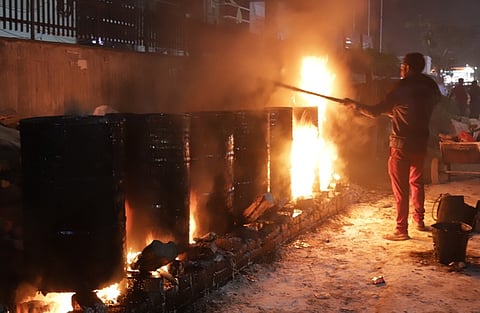

BENGALURU: A shortage of bitumen has disrupted road repair works in Bengaluru, with contractors and engineers across the city’s five corporations reporting difficulties in procuring the essential road making material.
The situation has also renewed focus among scientists and researchers on finding affordable alternatives to bitumen amid global uncertainties affecting crude oil supply.
Contractors working with the Greater Bengaluru Authority said supplies of tar and bitumen have been inconsistent over the past few days, delaying scheduled maintenance works.
Venkata Chalapathy, a contractor appointed by the Greater Bengaluru Authority to supply bitumen, said they had not received any supplies in the past two days.
Orders for 50 tonnes were placed a week ago and a payment of Rs 50 lakh was also made. However, officials informed them that there was a short supply at the Karwar, Mangaluru and Chennai ports, from where materials are usually distributed to southern states.
He added that the cost of supply has also escalated sharply. Earlier, contractors were paying Rs 49,000 per tonne to procure bitumen, but in the last few days the price has increased to Rs 61,000 per tonne. “We have been told it will take around 20 days to supply the materials,” he said.
Pommala Sunil Kumar, Bengaluru North City Corporation Commissioner, said that since the plant is located in the northern part of the city, the supply of materials is managed by their office.
He added that there has been a deficit in supply due to the shortage of raw materials and that a detailed report has been sought.
Explaining the requirement for road works, an engineer with the Greater Bengaluru Authority said around 250 tonnes of bitumen is required to undertake a month long repair programme.
To lay a kilometre long stretch of road, around 5 to 8 per cent bitumen is required along with aggregates including stones. Depending on the thickness of the road, the quantity of bitumen is determined.
“In this situation, white topped roads are the best alternative solution,” the engineer added.
However, experts said the shortage has also brought renewed attention to long term solutions for road construction materials.
In the wake of global war crises affecting crude oil supplies, researchers said the time has come to accelerate the search for affordable and sustainable alternatives to bitumen, a key raw material used in road construction.
While scientists had earlier been working independently on possible substitutes, the current global concern has brought researchers together to exchange knowledge and explore solutions that can be applied across regions and climatic conditions.
“Renewable alternatives to bitumen are being studied. Bio asphalts are being tried as irrespective of the present situation, alternatives to crude oil are needed. Many countries and experts are studying alternatives,” said Satyavati Komaragiri, Assistant Professor and pavement expert from the Civil Engineering Department at IISc.
Experts at the Council of Scientific and Industrial Research Central Road Research Institute are also examining multiple options. They are collaborating with the Indian Institute of Technology Roorkee to explore the use of molasses derived from sugarcane as a substitute material. Researchers at IISc are also studying the potential of recycling existing road materials while relaying roads.
According to experts, collaborative research is also being conducted in Europe to modify the properties of micro algae for use in road construction. In the United States, researchers are examining the possibility of using engine oil as an alternative.
“Plastic is not an alternative to bitumen, but it can be used as a modifier in bio asphalt that will help the alternative to bitumen in better binding. Wet waste, which is generated in abundance in India, can be used as an alternative but only after treatment. It can be combined with plastic to improve longevity. However, a lot of studies still need to be done,” said an expert from the Central Road Research Institute, requesting anonymity.
In some areas, authorities are also experimenting with paver block roads, which can help recharge the groundwater table.
“Ideally, when a road has to be laid, the existing stretch comprising bitumen and aggregates should be scrapped. But that is not done. Now, in the wake of the shortage in the coming years, these materials should be scrapped and reused by improving the elasticity of bitumen. In India, this works as an easily available and affordable alternative. This is because bitumen’s properties are not consistent; they change depending on temperature, heating, vehicular movement and the number of years since it was laid,” said an expert from IISc working with the government, seeking anonymity.
Prof Ashish Verma, mobility expert from IISc, said the government should not mislead citizens on road construction practices.
“White and black topped roads have their own pros and cons. The Indian Road Congress has detailed the standard methods for laying roads. If they are followed, then black topped roads will last for 5 to 10 years. Studies have shown riding experience is more comfortable on black topped roads compared to concrete roads,” he said.
Prof TV Ramachandra from the Centre for Ecological Sciences at IISc added that concrete roads also raise environmental concerns.
“Compared to black topped roads, concrete roads absorb and radiate more heat due to thermal conductivity. They are now one of the biggest contributors to urban heating and heat islands,” he said.
Prof Ananth Ramaswamy, Chairman of the Civil Engineering Department at IISc, said that a good road depends on multiple factors including underground drainage, the binding of asphalt and other materials, the quality of aggregates and the base course.
“Bitumen is a binding material and it can be changed. Concrete roads are not the solution,” he said.
