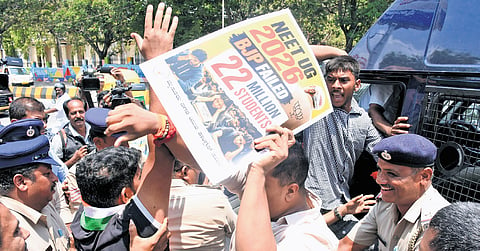

BENGALURU: As the dust refuses to settle a day after the cancellation of the National Eligibility cum Entrance Test (NEET-UG) 2026, experts believe the centralisation of such an examination makes leaks an almost inevitable consequence. They also argue that the model decontextualises education and prevents students from accessing knowledge holistically.
Prof Niranjanaradhya VP, a development educationist, said any examination conducted on such a massive scale would inevitably invite the possibility of leaks and malpractices because of its geographical spread and the number of applicants.
“Centrally held examinations are prone to leaks because it is difficult to maintain confidentiality at this scale. It is bound to happen,” he said.
He added that education must remain contextual and argued that state-level examinations, with each State setting its own question paper, would ensure the necessary pedagogical “diversity”.
“There is no need for one question paper to apply pan-India. If States conduct their own examinations, a leak in one State would be restricted to that State, preserving the sanctity of examinations elsewhere,” he said.
Several educationists, including PB Prince Gajendra Babu, argued that the National Testing Agency (NTA) is not a competent body to conduct examinations of this scale.
“Examinations should be conducted by an educational body; the NTA is only an agency. I do not know of any part of the world where an agency without pedagogical expertise is entrusted with conducting an examination,” he said. He also noted that “no punishment has been meted out to anyone at the NTA, only students have been punished.”
Prof Niranjanaradhya called for the resignation of Union Education Minister Dharmendra Pradhan on ethical grounds. Another alternative gaining traction is not merely a return to State-level entrance examinations, but the possibility of doing away with such tests altogether. While supporting institute-specific entrance tests where necessary, he favoured the earlier system in which board examination marks were the sole criterion for admission to higher education.
Dr R Chandrashekhara, former Vice-Chancellor of Rajiv Gandhi University of Health Sciences, suggested that a 1:1 weightage between board examination scores and entrance examination marks could be a feasible compromise.
