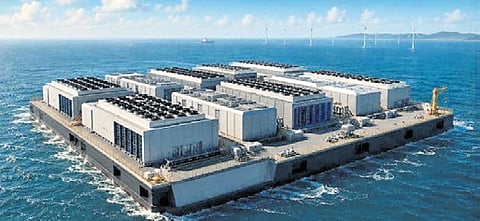

BENGALURU: As farmers struggle with drought awaiting intervention from the Centre, with no guarantee that next year’s monsoon will be any better, the state government is pushing for data centres in the state. While floating data centres have been put forward as an alternative practice involving cooling without cutting water supply to farmlands and civic use, their implementation might not be a magic fix, according to experts at the Indian Institute of Science (IISc).
A floating data centre is situated on a body of water, ideally in coastal areas. It can use saltwater from seas or oceans to cool its infrastructure, reducing pressure on water-scarce land. Countries like Japan, the US, and the Netherlands are in the process of testing data centres marooned offshore, with their long-term viability still up for debate.
As per data shared by an independent data centre tracking website, Karnataka has 40 data centres currently operational, while the state government data, as of October 2026, puts the number at 32. The IT/BT Department has recognised Electronics City, Whitefield and Devanahalli as key areas where the centres are situated, showing a disproportionate stress on Bengaluru compared to the rest of the state.
Thulasi Raman, Chief Technology Officer at the IISC’s Foundation for Science Innovation and Development, said that for a water-scarce state like Karnataka, the first question should be whether a data centre belongs somewhere at all, before we ask how it is cooled.
With all data centres, floating or otherwise, a key issue remains the unverifiability and unaccountability of water usage, with data centre operators often at the liberty of misrepresenting their water usage. “Karnataka’s Sustainable Data Centre Policy is a progressive step. Data centres will be monitored through Power Usage Effectiveness (PUE) and Water Usage Effectiveness (WUE) measures and incentives tied to performance give operators a real reason to report honestly. The same applies to floating data centres. Moving onto water doesn’t answer the question if they draw on the same reservoir that serves drinking water and irrigation, or discharge heated water,” said Raman.
While Raman believes in the possibility of floating data centres being a better alternative for Karnataka than those erected on solid ground, he warns that they are not a comprehensive solution. “Floating isn’t a magic fix. A platform needs a stable, deep body of water, and many of Karnataka’s lakes and rivers don’t have that for most of the year.
Putting one on a shrinking reservoir that also serves farms and towns would only move the problem, which is why I wouldn’t float anything there. The more realistic picture is a mix. Facilities near Bengaluru, where most of the city’s data centres already sit in water-stressed areas, need is to rely on closed-loop or air-based cooling and treated wastewater, not fresh supply.
For floating, the sensible place to look is the coast, where seawater cooling doesn’t compete with drinking or irrigation water. At the FSID, we’d want to see the water case proven site by site, with real numbers, before any build begins,” said Raman.
As for the coast, Mangaluru is the most feasible option, as far as FSID Chief of Staff Sandeep Sehgal is concerned. “Seawater cooling is different because it doesn’t compete with anyone’s tap or field.
Of the three planned data centre parks in the state, under the Sustainable Data Centre policy, only Mangaluru is coastal, and the policy picked it for land availability, port-linked infrastructure and potential Cable Landing Station infrastructure. I’d call Mangaluru feasible as a pilot, not yet at scale.
A facility can post good PUE and WUE figures and still draw more water and put out more heat as it grows, so we would want absolute water use and discharge temperatures published, with independent audits and results shared with regulators and local communities,” said Sehgal.
There is no course of action more sustainable than holding data centre operators accountable for treating their discharge, by mandating the concurrent setting up of water treatment plants beside the data centres themselves.
“It’s very feasible, and it’s probably the most practical step on the table. Building treatment capacity alongside the facility, instead of bolting it on years later, is far cheaper and easier to get right. Karnataka’s new policy links support to treated water use, reimbursing the charges for procuring it, and the planned Hoskote park is set to receive 60 megalitres per day of treated water.
There are two honest caveats, though. Treating run-off doesn’t remove the water lost to evaporation, and recycling doesn’t eliminate the heat problem that drives water demand, so the goal should be treating and reusing as much water as possible, and not ‘zero impact’,” Raman warned.
