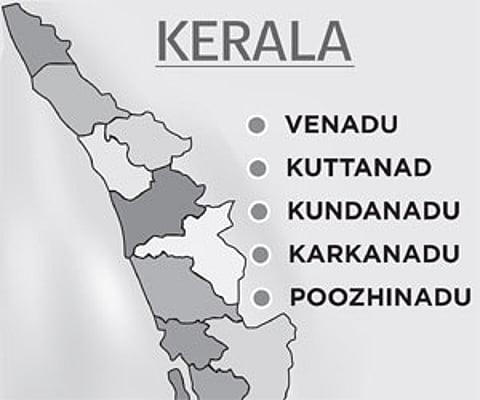

THIRUVANANTHAPURAM: A unique map showing Kerala as it existed centuries ago, with names of places that were in use then and have since passed into oblivion, is in the making.
The Place Name Society (PLANS), a Thiruvananthapuram-based forum of historians and toponymists, is planning a map that will throw light on the early history of Kerala, with an emphasis on old, discarded place names. A series of seminars planned across the State from October 2009 through October 2010 is expected to throw up a wealth of material on the subject.
“Place names are important in the study of history. ‘Perunna’, for example, is a shortened version of ‘Perunneythal’.
You won’t find that in any revenue records today,” says historian and Society president Puthussery Ramachandran: “Where place names are concerned, we plan to travel as far back as we can”.
Instead of the current 14 revenue districts, the map will feature 18 older ‘Nadus’ such as Venadu, Kuttanad, Kudanadu, Karkanadu and Poozhinadu. PLANS faces the mammoth task of re-discovering the ancient boundaries that separated each of them. The mapping project, the Society hopes, will shed light on the nature of early settlements in the region.
Successive cultures down the ages, left their stamp on place names. Many of these simply disappeared over time, others were discarded and replaced with new ones.
Some have passed down to us in corrupted forms.
An oft-cited example is the affix ‘-palli.’ “It is a historical pointer to the Jain and Buddhist cultures that flourished here.
In later centuries, of course, ‘palli’ came to have a Christian connection,” says Society secretary and Kerala Bhasha Institute former assistant director Dr Vilakkudi Rajendran: “Words like ‘Ooru’, ‘Kaavu’, ‘Mala’, ‘Kode’ and ‘Kulam’, also go a long way back”.
Many of the Buddhist and Jain place names were either lost or corrupted during the subsequent Brahminical resurgence. “Many of the visible Buddhist, Jain symbols - in architecture for example - were razed.
The place names were Sanskritised.
‘Mangalam’ is a Brahmin contribution,” says Ramachandran.
In later centuries, the Portuguese, Dutch and British left their mark on place names.
The earliest references to Kerala and its place names probably exist in Tamil literature of the Sangam period and the ‘Tolkkapiyam’ - an ancient treatise on Tamil grammar.
Geographical features played an important role in the early naming of places.
In Sangam literature, for instance, five ‘Thina’ or topographical divisions are cited - ‘Mullai’, ‘Marutham’, ‘Palai’, ‘Neythal’ and ‘Kurinchi. Maruthamkuzhi in Thiruvananthapuram and Mullaperiyar in Idukki are examples.
PLANS was launched on October 15, 1983 with the aim of making toponymy, the study of place names, a thoroughly scientific pursuit and to link it with linguistics, anthropology, sociology and epigraphy.