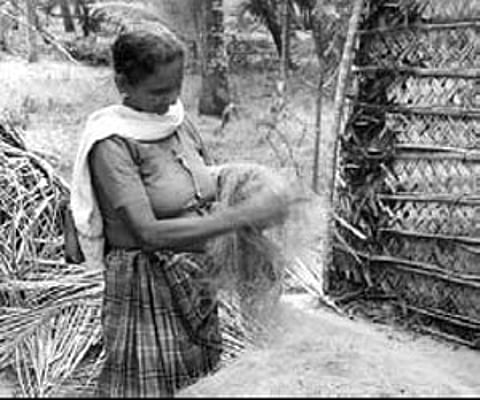

IN a desolate tile-thatched shack that everyone calls a factory, sits Ciciliyamma. Against a shaft of afternoon light, puffs of goldhued bristle fibres keep falling all around her from the mill shredder above. Ciciliyamma disentangles the fibre from the heap, to be spun on the ratt. The state made Rs 592.88 crore last year thanks to the back-breaking labour of Ciciliyamma and five lakh coir workers.
But, as the western wind from the lands of financial meltdown sweeps the shores of Alappuzha, Kollam, and Kozhikode, Ciciliyamma and her comrades are left to wonder how would they survive in the months ahead, as the orders for the coir products keep dropping at an alarming pace. The arresting visual of those falling fibre puffs was metaphorical enough. It almost spoke about lakhs of lives similarly being shredded away.
Kerala, which accounts for more than 85% of the coir products made in the country, is home to 75,471 coir centres of which nearly 98% are home-based units, according to Kochi-based Centre for Science and Environment Studies. Kerala began exporting coir to the West from 1860. But US, the current market leader with 37 percent of coir going there, is saying ‘no’ to our coir products since last November.
The 2,000 crore traditional industry was already rich with troubles: an old and rusting technology, poor product diversification, middlemen and more. Lack of sufficient raw material had brought down the coir jobs for just about 200 days a year. A 1988 survey had found that extremely poor wages had already driven away around two lakh workers from the industry to other jobs or even joblessness. Saroja Narayanan, who works in another small traditional household spinning unit at Chirayinkeezhu cannot hold back her fears: “My mother, my daughter, and I spin coir all the days when we get work and that’s how we run our family. I keep postponing even a visit to the doctor to treat my rheumatic complaints, fearing the medical bills. If we are going to lose even this wage, we would all be better dead.” Talking about wages, what Saroja and the spinners take home is Rs 60 after a long-day’s job that starts at about seven in the morning. As orders for coir products fall, spinning days will be cut short accordingly. If that is the case, workers like Saroja and Ciciliyamma say they would have nothing to eat at their homes.
It is a crisis of staggering proportions.
Last year, the US, the single largest market for coir, took 37 percent of total exports from the state. The European countries bought 41 percent of the products. The Centre for Development Studies (CDS) in Thiruvanathapuram team expects a minimum 20 percent drop in the export of coir and coir products in the coming months.
The CDS study says this may cause a loss of direct employment to about 32,000 persons.
“The actual reduction could be higher if we consider the plausible decline in domestic demand and other indirect effects,” the report warns. The value of exports had earlier fallen to Rs 592.88 crore from Rs. 605. 16 crore in 2006-07. The current Coir Board estimates show a fall in exports by 9.72 percent in volume and 15.14 percent in value. Industry sources say payments are delayed and even existing rates are being forcefully re-negotiated.
And if Co-operation Minister G Sudhakaran is to be believed, the export of coir products will further fall by 30 to 40 percent.
A fortnight ago, in a written reply in the state Assembly, Sudhakaran said that “four major companies that bought coir in the US had gone bankrupt and this will badly affect our coir export prospects”. Ciciliyamma and Saroja are yet to hear the news.
MORAL: "The TV project, initiated by former industries minister, labour minister T V Thomas had set up 600 primary cooperative units. But the Centre removed the Minimum Export Price and stopped the support schemes to Coir Fed, thereby deflating the mechanism.If we don’t resurrect the TV project and find fresh markets within the country, we will have among us a few lakh dead people” : P V Sathyanesan, general secretary, Thiruvathamkur Coir Factory Workers’ Union.