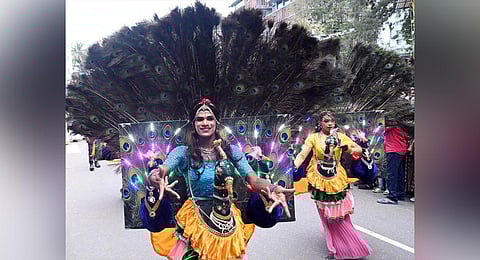

Organised by the state tourism department, the week-long Onam ‘Varaghosham’ is a spectacular melange of classical, folk, and ethnic art forms held every year in Thiruvananthapuram. This year, too, the celebrations based on the theme ‘Onam – the symphony of harmony’ held across 30 venues was a grand affair.
Events concluded last weekend with a fantastic procession featuring floats and the diverse artistic heritage of Kerala. Over 3,000 artists participated in the pageantry as 148 art forms and 64 floats enthralled thousands of people. It was a befitting comeback after the pandemic lull.
“The Varaghosham programme is one such annual event where tourists and people from other parts of the state gather in the capital city,” notes tourism official Abhilash. “Therefore, for the artists, it is a prestigious platform to showcase their art form to a large crowd.”
This year, however, some folk artists were left disillusioned. Some art forms were, apparently, dropped from the list. Compared with last year’s event list, the folk art forms that were missing included:
Mudiyettu: a traditional ritualistic artform based on the battle between the Goddess Bhadrakali and the demon Darika Thottam Pattu, the ballad sung before Theyyam ritual Kurathi Nritham, which narrates the story of Kuravan and Kurathi (Lord Siva and Parvathi in disguise)
Nokkuvidya Pavakali, a form of puppetry in which the artist sits on a mat balancing the puppet at the end of a nearly 2ft-long stick placed on the artist’s philtrum Arjuna Nritham, a dying art that was once a prominent practice in the Bhagvathy temples of south Kerala Velkali, a ritualistic martial art form performed by men in some of the temples of south Kerala, Alamikali, an art form performed by ‘Tipu’s army’ to commemorate the Karbala war.
“Only 30 folk art forms were shortlisted this year,” says 62-year-old Nadesan Palamoottil who has been striving to revive Arjuna Nritham through a ‘kalalayam’ in Kurichy. “We have been part of the Varagosham programme since its inception. It was disheartening that we were excluded. We had sent an application months ago, and were waiting for the event with a lot of excitement.”
An unexpected exclusion was Mudiyettu. Notably, in 2010, Mudiyettu became the second art form from Kerala to enter Unesco’s Representative List of the Intangible Cultural Heritage of Humanity. Pazhoor Bindu, who plays Kali, is one of the few women to perform Mudiyettu.”We had been part of the event for three years,” she says.

“It was painful when we came to know that we were excluded this year. My objection is not about excluding me, but over dropping the art form from the list. Mudiyettu needs to be preserved. The government and its cultural bodies aren’t doing much to sustain the art form. And now, it has been sidelined from the Onam Varaghosham, too.”
Bindu adds that venues like the Onam celebrations serve as a big boost for dying art forms. “Getting a platform is our utmost priority. Due to a lack of opportunities, many have left the art form in search of other professions,” she rues.
Selection process
“We received about 1,600 applications. Some art forms may have been excluded as they had not sent applications,” says a tourism official. “The programme committee and the several sub-committees decide the events that are listed. The tourism department is in charge of only organising the event; we do not interfere in the programme selection process.”
It is learnt that a panel including Kerala Folklore Akademi, Sangeetha Nataka Akademi, Bharat Bhavan, Kalamandalam and some individual experts finalise the list every year. According to Folklore Akademi chairman O S Unnikrishnan, some folk art forms had to be dropped so as to accommodate new entrants.
Vedan Theyyam, Kaalidharikavesham, Cycle yagnam, Vedan kettu, Sheepothikali, Thalikakali, Kariyilamadan, Gothrathaalam, Nadodinirtham, Perannirtham, and Karadikali were some of the new art forms.
The transgender community, too, got representation with art forms such as Ardhanari Nirtham, Mayurabal Nirtham, Karakatta Nritham, Pallivaal Nirtham, and Kurathiyatta Nirtham. Well, shouldn’t it be a case of the more, the merrier? Why drop one to accommodate another? “Kerala has around 1,040 folklore art forms. There are many underrepresented art forms,” notes Unnikrishnan.
“Some people hailing from poor backgrounds wait for such opportunities to take their art to a larger audience. The art forms that got excluded this year have been staging performances at the Varaghosham programme for some years now. It does hurt to exclude art forms, but certain situations leave us with no choice.”
Unnikrishnan and tourism officials highlight “fund shortage” as the primary issue for excluding certain performances. “In general, folk art performances would have at least 10 artists on stage. One act as a whole would be paid Rs 10,000 to Rs 20,000. Most of the folk art forms are from Palakkad, Thrissur, and north Kerala,” notes Unnikrishnan.
“Considering the distance they have to travel, the pay varies. This year, we went for more artists from Thiruvananthapuram and Kollam districts. That’s how we managed the funds.” According to a tourism official there is a set budget and the “amount is not supposed to go beyond that”. Since folk art forms are more in number, it’s not possible to accommodate all of them, he reasons.
“However, the tourism department conducts the annual ‘Ulsavam’ fest,” adds the official. “This provides a stage for artists from all the districts. The event will be held in December or January, and nearly 200 folk art forms will be featured.”
Value addition
The list of 30 folk art forms featured this year included Vedan Kettu, Kaalan Kettu, and Sheepothikali. “Though these artforms are native and limited to a few places, they deserve to be popularised across the state,” Akhilesh P M, member of Nadanakala Gaveshana Kendram that performed these art forms.
He is grateful that the Folklore Academy and District Tourism Promotion Council for including the forementioned art forms. “Such exposure will help popularise the art forms and inspire the younger generation to them up,” he adds.
Vedan Pattu, which is performed in the beginning of the Karkidakam month, is believed to ward off evil and bring prosperity to households. On the 14th day of Karkidakam, Kaalan Kettu is performed, followed by Sheepothikali (Sree Bhagavathy) on the 30th day.
This year, the Varaghosham programme also witnessed art forms staged by trans people. Organised by Sai Kalasamithi, in association with Travancore Welfare and Cultural Society and Oasis Cultural Society in Thiruvananthapuram, over 70 trans people performed Ardhanari Nritham, Mayurabala Nritham, Karakatta Nritham, Pallival Nritham, and Kurthiyatta Nritham.
“Though we were a part of other cultural activities in the Varaghosha programmes, this is the first time our community got represention in the procession,” says Keerthy Kishore, 48, a transwoman who works at a stitching unit in Thiruvananthapuram. “It is of great joy that we could perform revered folk art forms. This is a big boost for our community.”
Sai Kalasamithi director Suku Chirayinkil says trans performers were earlier confined to stage shows and temple festival programmes. “They had always been treated as outcasts when it came to major events like Varaghosham,” he adds. “It is great to see a positive change, and people acknowledging them as artists.”