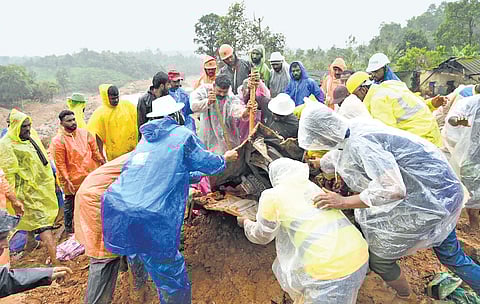

THIRUVANANTHAPURAM : With most of scientific studies identifying districts such as Malappuram, Kozhikode, Idukki, Ernakulam and Kottayam, besides Wayanad, as landslide hotspots, there have been renewed demands to invoke strict provisions of the Disaster Management Act, as it was done in Wayanad in 2022, to place curbs on soil cutting and extraction in all landslide-prone districts.
A landmark order of the Wayanad district administration in 2022 is cited as a model to rein in rampant alterations to the natural topography that aggravate the impact of natural disasters such as landslides. The order was issued by then district collector A Geetha in her capacity as chairperson of the district disaster management authority.
The order stipulated that strict compliance with soil extraction and building rules were mandatory for issuance of permits by local bodies for development of land or construction. It also directed secretaries of the local bodies concerned to ensure that approved engineers and supervisors submit building plans only after fulfilling the stringent conditions related to soil extraction. The district geologist has been directed to ensure compliance with the order while considering applications for mineral transit pass.
“Local bodies have been strict in issuing permits over the past year-and-a-half and have rejected many plans where soil was indiscriminately or unscientifically removed,” Wayanad ADM K Devaki said. However, minor violations along the sparsely populated forest fringes in the district have been noted, she added.
According to former District Soil Conservator of Wayanad P U Das, the order holds special significance in areas where the depth of the top soil is high, making the location prone to landslips. “In Wayanad, the porous nature of the top soil, along with presence of laterite, clay and stone fragments, make it susceptible to landslides,” he explained.
“However, the guidelines laid down in the order for soil cutting, especially in areas with a slope of over 45 degrees, is applicable to all landslide prone areas and will mitigate the impact of landslides if strictly followed,” Das added.
Praveen Sakalya, former project scientist with the Union Ministry of Earth Sciences, said periodic field studies of high altitude areas was necessary along with stricter implementation of rules relating to soil cutting. “Periodic in-depth observations of landslide prone areas at least twice a year and detailed analysis of the soil profile are necessary to assess the instability posed by rapid alterations to topography,” he said.
