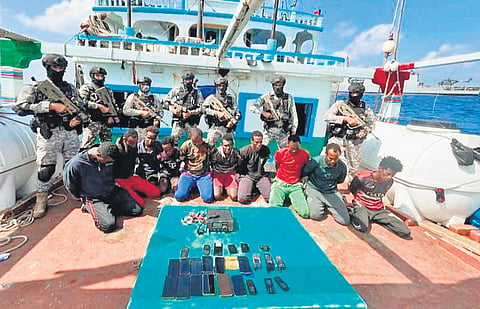

KOCHI: In a daring rescue mission straight out of a Hollywood thriller, Indian Navy’s Marine Commandos (MARCOS) parachuted down from an Indian Air Force C 17 Globemaster aircraft and stormed MV Ruen, a Maltese-flagged merchant vessel, which was hijacked by Somalian pirates in December 2023.
All 35 pirates were detained, while the 17 crew members of the vessel were safely evacuated. The high-adrenaline action in the South Indian Ocean Region, around 2,600km from the Indian mainland, served as a testament to India’s resolve to combat piracy while asserting the country’s prominence and demonstrating military prowess on the world stage.
As part of the anti-piracy operations, Indian Navy vessels regularly escort merchant vessels and patrol the Gulf of Aden region. Indian Naval ships have also participated in joint Exclusive Economic Zone (EEZ) surveillance of Maldives, Seychelles, Mauritius, Tanzania and Mozambique; reinforcing its commitment to enhance maritime security in the region.
With its headquarters in Kochi, Southern Naval Command administers the 32 Naval Training Units spread across seven coastal states and trains over 13,000 personnel every year. As a preferred training destination for Friendly Foreign Countries, the Indian Navy has trained around 21,000 foreign personnel from over 47 foreign countries over the years.
Over the last year, more than 500 international trainees from 27 countries have undergone training at Naval training schools.
Indian Navy’s footprint in the international training fora was further enhanced with the training of cadets from King Fahd Academy of Royal Saudi Naval Force in the last two years. Training of officers from friendly nations also helps the Indian Navy foster inter-operability in operations.

“The growing credentials of the Indian Navy as the ‘Preferred Security Partner’ by the maritime littoral neighbours in terms of maritime exercises, capacity and capability building have been one of the key enablers of regional stability. Our ships and aircraft deployed on operational missions across the Indian Ocean have acted as true ambassadors of the country. The Navy has always been in the forefront, demonstrating the ability and willingness to be the first responder during the crisis in the neighbourhood and beyond,” said Vice Admiral V Srinivas, flag officer commanding-in-chief, Southern Naval Command.
The region from the west coast of Africa to the western Pacific, where 64% of the population lives has been the geo-political arena, commanding 62% of the world’s GDP, facilitating 50% of the world’s maritime trade and 40% of the oil trade. This zone is also the world’s hazard belt accounting for the maximum number of natural disasters ranging from cyclones, earthquakes, volcanic eruptions, tsunamis and even famine.
In many instances, the geographic expanse of EEZs of many littoral nations is disproportionally larger than their land masses and economic capacities.
To overcome the obstacles, the Indian Navy has provided fast interceptor boats/ craft for harbour defence and gifted more than 30 fast attack craft (FAC) and offshore patrol vessels (OPVs) to friendly foreign countries towards capacity building.
Several Indian-made aircraft have been provisioned to some of the littoral states. Indian Navy personnel have been operating the air assets based on requests from host nations. Maritime patrol aircraft (MPA), and unmanned aerial vehicles (UAVs) of the Navy have also been operating in the Indian Ocean.
The Navy has installed a series of Coastal Radar Systems and Automatic Identification System (AIS) chains in friendly countries to develop integral surveillance capacities of that nation. The capacity building of naval ships or aircraft has been done either through short-term transfers, leases, or deployments of naval assets. Grants have been provided to economically weaker countries, mostly through lines of credit which are essentially low-interest financial loans through the Exim Bank.
Many of the littoral countries have availed the opportunity to repair and refit their vessels in Indian Naval dockyards. Indian Naval technical experts have also been positioned in littoral countries on request.
Information Fusion Centre - Indian Ocean Region (IFC - IOR), the maritime security centre hosted by the Indian Navy has been developing a composite maritime picture cooperating with several Navies to promote White Shipping Information sharing, through appropriate agreements.
Currently, there are International Liaison Officers (ILOs) from 12 foreign countries positioned at the Indian IFC-IOR with more to join soon. Partnering with over 50 agencies and 25 countries facilitates smooth information flow.
The Indian Navy has been routinely deputing Mobile Training Teams to nearly a dozen countries. Customised training is delivered in the host nation by Indian Naval instructors for over six to eight weeks, utilising the host nation’s infrastructure.
The Navy has been routinely conducting joint surveillance with friendly navies. In most cases, personnel from the littoral nation seeking the EEZ surveillance embark our ships and where feasible, the aircraft.
These surveillance efforts have been effective in curbing maritime crimes. In addition, this domain of cooperation has concurrently provided live SAR actions on multiple occasions. The Indian Navy’s remotely piloted aircraft flown from Indian soil has supported patrolling activities of small littorals in the region.
In January 2024, a Sri Lankan-flagged multi-day fishing trawler was hijacked east of Mogadishu in Somalia by pirates. Seychelles Coast Guard Ship Topaz interdicted the hijacked fishing boat, rescued the fishermen and arrested the pirates. SCGS Topaz was gifted by the Indian Navy to Seychelles in 2005.
The crew of Topaz from Seychelles have been undergoing training in India for many years. The International Liaison Officers from the Sri Lankan Navy and from the Seychelles Coast Guard were operating from the IFC - IOR at Gurugram, coordinating with their national agencies to ensure the success of this operation.