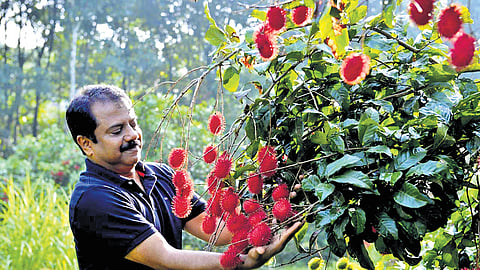

THRISSUR: With the state government pushing for a policy change to allow limited cultivation of fruits on plantations, farmers keen on cultivating exotic fruits are smelling an opportunity.
Until a decade ago, fruits for most Malayalis meant banana, mango, jackfruit, papaya, pineapple, etc., but challenges wrought by climate change and market demand have seen more and more growers turning to exotic fruits such as dragon fruit, rambutan, mangosteen, and avocado.
Deviating from traditional farming, some fruit farmers have scripted success with exotic fruits, providing an impetus for those seeking to experiment with crop varieties.
“Changing climatic conditions have proved to be a major challenge for native farmers of traditional crops. Exotic fruits, which are in high demand in domestic and international markets, can be a saviour in such circumstances,” says Jyothi Bhaskar, professor and head of the Fruits Crops Research Station (FCRS), Kerala Agriculture University (KAU).
She points out that exotic fruits are increasingly being adopted all over the state, but large-scale farming is yet to take root. “Avocado is currently being cultivated over a large area in the high ranges. Dragon fruit is popular due to the fact that it can be grown on even dry or rocky land. Mangosteen and rambutan cultivation have made inroads in various pockets with some growers even exporting their produce,” says Jyothi.
Good yield, better returns
According to farmers, good yield and better returns have inspired them to embrace exotic fruits. “The initial cost of farming dragon fruit is relatively higher. But break-even can be achieved within two years. As people turn to more healthier food options, exotic and native fruits rich in nutrients can prove promising for farmers,” stressed Keerthana Sethunath, who is pursuing a PhD in fruit sciences at KAU’s College of Agriculture.
According to Jyothi, growing demand for a variety of fruits rich in antioxidants and other crucial nutrients is as a sign to diversify fruit farming in Kerala. To tap the potential of exotic fruits, FCRS has set up a farm in Mannuthy of approximately 80 varieties of fruits that can be recommended for cultivation in the state. These include durian, longan, variegated guava, miracle fruit, jujube fruit (elantha pazham), abiu, etc. “Saplings will soon be made available for sale,” she added.

“A major challenge is the shelf life of fruits when production increases. We have initiated research in developing value-added products from exotic fruits,” adds Jyothi.
Meanwhile, those growing exotic fruits are seeking effective interventions on the part of the state government to promote the sector. “If the state government encourages fruit farming with the right assistance and research work, Kerala can be turned into a major exporter of exotic fruits in the next 15 years,” stresses Ahmed Kutty, a mangosteen farmer in Kozhikode. He added that the market for exotic fruits already exists and the right intervention is required to grab the opportunity.
Ruling roost with rambutan
Shortage of labour for tapping work and decline in prices forced Kanjirapally native Renny Jacob to think of alternate crops for his rubber plantation. After several experiments, Renny decided to go with rambutan, which has proved to be a fruit that can be cultivated over a wide area, assuring steady income.
Renny first experimented with rambutan in 2004. But other crops like cocoa took most of his attention. In 2008, however, he took to large-scale planting of rambutan saplings, which in five years started yielding handsome earnings. “Rambutan is a fruit that is suited to our climate and is low maintenance. Since it is harvested just once a year, it is also more convenient,” he shared. From four acres, Renny generates fair income from the yield and the sale of saplings. He has a collection of around 12 varieties of rambutan.
Renny’s passion for farming is evident from the fact that he started Homegrown-Biotech, a company involved in research and development of exotic fruit saplings.
“It’s important for farmers to scale up cultivation to be successful. Outdated regulation restricting plantations to seven crops is the dampener. Although the government has taken the stand to review it, nothing has been forthcoming in the last four years,” he adds.
Blazing path with dragon fruit
In 2016, Jose ventured into growing dragon fruit on his land in Aikkad, Pathanamthitta. From his three acres, he has earned good profits, largely due to the demand for the the fruit.
The facility to grow dragon fruit initially cost around Rs 6-7 lakh. “The plants started to flower the very next year. Low maintenance is an advantage. Propagation of the plant is also easy, ensuring demand for saplings,” he said.
“Until recently, dragon fruit farming was very profitable. We sell directly to customers at Rs 200/kg. Wholesale dealers bring in Rs 150 to Rs 200. A fungal disease has proved to be a concern and we need support to avoid its spread,” remarks Jose. Jose also cultivates plantain and vegetables
Mangosteen farmer’s way forward
Ahmed Kutty and his siblings have been running a mangosteen farm on 20 acres of their ancestral land in Kozhikode for the past several years.
“It takes about five years for a mangosteen plant to bear fruit on a regular basis. Once the yield improves, farmers can be assured of a good, steady income. There are even farmers who export mangosteen from Kerala,” says Ahmed Kutty. He added that only few people would have tasted mangosteen in Kerala, which in itself is an indication of the fruit’s growth potential in the state.
Betting on avocado
When the reality of declining income from rubber struck, Eapen Thomas and Varkey George from Kanjirappally, in Kottayam district, decided to try avocado farming on a seven-acre plot. “We planted the saplings around two-and-a-half years back. We chose avocado as its rich nutrient content had started generating good demand. From making smoothies to ice-creams to being used as a key ingredient in food recipes, avocado was becoming popular in many parts of the world,” Eapen said.
Varkey also grows longan and grapes in Kambam, Tamil Nadu. “There are no restrictions as such for large-scale fruit farming in Tamil Nadu. Our products have been well received in all major cities in the country,” says Varkey, adding that longan could be a great crop in Kerala as well.