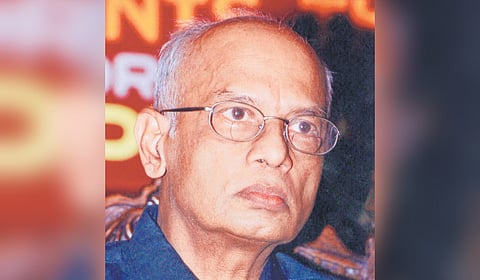

This morning, I received news that Dr M S Valiathan had passed away a day earlier in Manipal. Dr Sanjay Behari, director of the Sree Chitra Tirunal Institute for Medical Sciences & Technology (SCTIMST), in Thiruvananthapuram, called me to convey the news, and to also invite me for a memorial meeting at SCTIMST.
I first met Dr Valiathan in March 1983 in his spacious office at the SCTIMST hospital wing. I was then 30 years old, and in the IAS. I had visited the institute for a walk-through as a friend had told me about the interesting work happening there. I listened to Dr Valiathan, who was then director, speak animatedly about the vision behind the setting up of the institution.
Even then, I felt an inexplicable bond beginning to form with this handsome dapper of man behind his desk in a wood-panelled office adorned with just two photographs. Noticing my wandering eyes, he explained that they were Dr Charles Hufnagel and Dr Vincent Gott, his teachers.
Answering C Achutha Menon’s call to return to Kerala and set up an advanced institute for medical sciences, he played a pioneering role in establishing SCTIMST, ushering in modern cardiac and neuro surgery in the country in a public hospital. He then went on to set up the bio-medical technology (BMT) wing on a large campus across the city, that went on to become the only institute of its kind in India and Asia, and one of a few in the world.
As fate would have it, I was so stirred by his vision that I went to the BMT wing and met A V Ramani, who headed the research campus. These two meetings greatly inspired my epiphany! Till then, I was a young guy who was doing well in his IAS career, and had not given much thought to the rest of his life. I resolved by the end of the day to quit my job, and set up a venture to commercialise the blood bag know-how that had been developed at SCTIMST and was ready for technology transfer.
Against great odds and confounding the pundits, my small startup succeeded, and went on to become the largest maker of high-quality blood bag systems in the world! Although my father did not live to see this happen (my mother fortunately did), I was most gratified when Dr Valiathan spoke about me and Penpol in the warmest terms, going so far as to say that it was this venture that established the SCTIMST as an institute for translational technology development in the medical domain.
Dr Valiathan will be remembered for many accomplishments during his long and illustrious career. He went on to be the vice chancellor of the Manipal Academy of Higher Education, president of the Indian National Science Academy, besides holding other key positions. He received many prestigious awards and fellowships from leading global bodies connected with medical science. He was awarded the Padma Vibhushan in the early 2000s.
I will always remember him for inspiring a young man to take a huge risk and venture out on strange seas, propelled by a vision he set before me. RIP, Dr Valiathan, surgeon extraordinaire, great scientist and institution builder, and inspiring leader.
The author is a former chairman of the board of Federal Bank Ltd. His Penpol Ltd venture — later a joint venture with Terumo Corp of Japan — grew into the largest maker of blood-bag systems in the world, before he sold his stake in the company

End of an era
Dr M S Valiathan played a pivotal role in establishing the Sree Chitra Tirunal Institute for Medical Sciences and Technology (SCTIMST), where he served as the founding director
His groundbreaking work included innovations such as the disposable blood bag, oxygenerators, vascular grafts, and the tilting disc heart valve, known as the ‘Chitra valve’
He set up the Sree Chitra Tirunal Institute of Medical Science two years after the then CM
C Achutha Menon invited him to return to Kerala
As Sree Chitra grew, it received support from the then prime minister Morarji Desai and was notified as ‘An Institution of National Importance’ by an Act of Parliament within four years of Dr Valiathan’s leadership
After serving SCTIMST as its director for two decades he went on to become the first vice-chancellor of the Manipal Academy of Higher Education (MAHE) in 1993, a post he held until 1999
He had a keen interest in ayurveda and wrote three books on the subject after learning Sanskrit
Valiathan received numerous accolades, including the Padma Vibhushan, the Padma Shri
A graduate of the first batch of Thiruvananthapuram Medical College, he pursued further studies in the UK