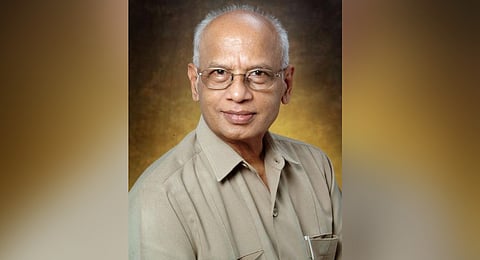

THIRUVANANTHAPURAM: Behind his gentle demeanour was a person with a steely resolve, akin to a ‘karma yogi’ as his admirers would describe him. He defied convention to realise his visionary models, and earned the respect of even his critics.
Eminent cardiac surgeon Dr M S Valiathan, who passed away at 90 late Wednesday night in Manipal, reshaped the landscape of therapy during his illustrious career.
A renowned institution builder, he persuaded authorities to allocate land and resources for institutions while setting high standards of care. The outpouring of condolences upon his passing is a testament to how he touched hearts across diverse ideologies.
Having travelled extensively and acquired new medical knowledge, he took a pivotal decision in the early 1970s to relocate to Thiruvananthapuram when his senior backed out.
Under his stewardship, the Sree Chitra Tirunal Institute for Medical Sciences & Technology (SCTIMST), initially conceived as an extension of the Medical College Hospital in Thiruvananthapuram, and in four years became an Institution of National Importance.
Valiathan’s vast experience enabled Kerala to embrace SCTIMST with cutting-edge technology, a legacy that endures. The institution pioneered open-heart surgery with heart-lung machines and established a cardiac catheterisation lab, significantly enhancing healthcare options at a time when they were scarce.
“Valiathan demonstrated that a public hospital could deliver advanced medical care using the latest technology, all while conducting quality research without compromising hospital operations,” observed Dr V Ramankutty, a former colleague and emeritus professor of SCTIMST.
Valiathan championed indigenous innovation
His focus was not on glamorous bypass surgeries but rather on correcting congenital anomalies, particularly among economically disadvantaged children. This approach, though less lucrative, significantly contributed to improving the state’s infant mortality rates. He leaves behind a legacy of training young doctors in vascular and congenital heart surgery.
Even as SCTIMST led in patient care, Dr Valiathan remained committed to advancing medical devices, and championed indigenous innovation. Securing Satelmond Palace, Poojapura for the Biomedical Technology wing stands as a testament to his leadership.
Historian Manu S Pillai highlighted how Valiathan navigated legal disputes between royal factions to transform the palace into a biomedical research hub, yielding groundbreaking products like the ‘Chitra Valve’, disposable blood bags, oxygenerators, and vascular grafts. He also established an ethics committee, pioneering for its time in Kerala, overseeing the testing of artificial valves. His ability to persuade skeptics extended to convincing the then prime minister Morarji Desai to grant SCTIMST national importance status.
Even in retirement, Valiathan continued to pursue knowledge across diverse fields including general surgery, cardiac surgery, biomedical engineering, Sanskrit, Ayurveda, and classical music. His deep interest in Ayurveda led him to study Sanskrit under renowned practitioner Raghavan Thirumulpad.
