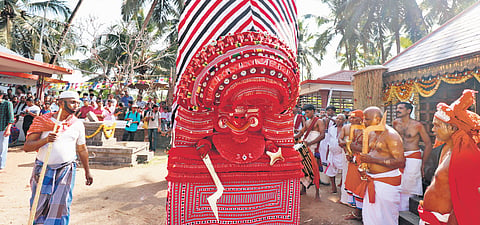

KOZHIKODE: As midnight falls, amidst the rumble of the chenda, a mesmerising ritual steeped in centuries of tradition and cultural richness unfolds in Kasaragod. A theyyam artist — donning a white vest, checkered lungi, and skull cap — offers a resounding call of the azan, and then performs namaz.
This sacred moment marks the beginning of a Mappila Theyyam, a unique tradition upheld by artists from the Mavilan, Koppalan, and Vannan communities. It is viewed as a reaffirmation of the pluralistic nature of Kerala society and a celebration of secular values.
The artist playing a Muslim imam of yore – Mukri Pokker – transforms into a divine figure, and bestows blessings upon devotees and onlookers.
Each year, during the Malayalam month of Thulam (October), Kamballur Kottayil Tharavadu, a Nair mansion in Kasaragod, turns into a stage for a Mappila Theyyam in which the ‘Mukri’ is joined by Goddess Karinchamundi, a deity of a sacred grove in the region.
This unique performance captures a centuries-old bond between the Kamballur Kottayil family and the nearby Pulingome mosque. “We share a profound connection with the mosque. My ancestors were once landlords in the northern Malabar region. It was our family that donated the land for the mosque’s construction in Cherupuzha. Since then, our festivals have been intertwined,” shares Divakaran Nambiar, a member of Kamballur Kottayil family.
“The mosque committee visits our home to extend invitations to their Uroos celebrations. They also participate in our theyyam festivities.”
Divakaran underscores the significance of Mappila Theyyams at a time when there is friction along communal fault lines. “I have come across discussions about a film that triggered communal debates in Kerala. The Mappila Theyyams are a testimony to secularism, and can dispel notions of distrust,” he says.
“The Mukri-Karinchamundi Theyyam unfolds before a diverse audience. Believers from various communities gather to witness the spectacle. The Mukri kolam is enacted by a Hindu individual. This tradition has never triggered tensions,” he added.
Notably, there are several Mappila Theyyams in the Malabar region. Ashraf Thuneri, a journalist based in Qatar, sheds light on this unique cultural aspect of Kerala in his documentary Mukri with Chamundi: The Saga of Harmony in Theyyam Art. “A few years ago, I came across a small article about Mukri Pokker Theyyam in a newspaper. The concept of Mappila Theyyam intrigued me,” he recalls.
Divakaran said further,“I delved into the subject, and that research eventually led to this documentary. The most interesting part is that Mappila Theyyams are mostly performed in places where the Muslim population is relatively low. So the majority of spectators comprises members of the Hindu community. This is evidence of how religion becomes insignificant in the case of Theyyam."
Ramachandran Panicker, a theyyam artist in Kannur, elucidates the cultural significance of the ritualistic art form as a unifying force transcending religious boundaries. “No matter what religion we belong to, what we all bleed is blood,” he says, citing the poignant lines ‘ningale kothyalum chorayalle chovvare, njangale kothyalum chorayalle chovvare’ that are often rendered during Pottan Theyyam performances.
Going beyond Mappila Theyyam, he offers more examples. “In Malabar, Muslims contribute sugar for some temple rituals during the festival season. The Vishnumurthi Theyyam enters a mosque to illustrate the interfaith harmony. There is no discrimination based on religion or caste during the divine act,” he says.

The lone female performer
In Kerala’s vibrant Theyyam tradition, comprising about 400 distinctive forms predominantly enacted by men, Devakoothu stands out as a singular piece performed by a female artist. And, M V Ambujakshi, hailing from the Malayan community in Kannur, has been the sole woman performing the divine art form. Ambujakshi took up Devakoothu in 2012, at the age of 45. The mantle, as part of the custom, was passed on to her after her relative K P Lakshmi Amma withdrew from Devakoothu due to declining health. Devakoothu has wrought significant changes in Ambujakshi’s life. “Being a female Theyyam artist itself is a huge honour, a rare privilege,” she says.
“Embodying a goddess fills me with pride. Before I took up Devakoothu, I was just an ordinary woman. Now, people have begun to respect me. They perceive a divine power within me. People who addressed me as ‘chechi (sister)’ now call me ‘amma (mother)’,”she added.
Devakoothu is performed in December at Cherukunnu Thekkumbad Koolom Thayankavu temple in Kannur. Before the Theyyam, Ambujakshi undergoes a rigorous 45-day fasting, mastering the manifold rites, rituals, and shlokas.
Bappiriyan Theyyam
It portrays Lord Hanuman’s quest for Sita devi in Lanka. The Bappiriyan Theyyam performers climb coconut trees during the ritual, symbolising Hanuman’s attempts to scan faraway lands from vantage points. Driven by frustration at his unsuccessful search, Bappiriyan vents his anger by kicking the tree, causing coconuts to fall.
Kandakkoran Theyyam
The narrative revolves around a young man from a marginalised caste who died after falling from a coconut tree. He is said to have attained divinity thereafter. To honour this legend, the Kandakkoran Theyyam re-enacts the tale by climbing a coconut tree, plucking the fruit, and descending in a posture mirroring the fatal fall.
Police Theyyam
This annual spectacle, enacted at Padannakkad near Kanhangad in the Kasaragod district, portrays the story of Padaveeran, a soldier of yesteryear. The artist dons the police uniform and would admonish members of the audience about illegal activities, including smoking in public.
Ummachi Theyyam
This Mappila Theyyam of Kasaragod is linked to the saga of Yogyar Nambadi, an army chief of the Nileswaram dynasty, who killed a Muslim woman for eating a handful of rice while at work. To placate her spirit, the woman was accorded divine status.
Panniyum Makkalum Theyyam
This representation of Pulaya culture delves into the complex dynamics of man-wildlife relationship. Here, the spirits of a boar, sow, and their offspring, having transcended mortality, bestow blessings upon people.
WhatsApp groups
Social media platforms and instant messaging services such as WhatsApp and Telegram have been connecting theyyam enthusiasts across the world. Many groups in WhatsApp, for instance, provide regular updates on theyyam performance at various sacred groves (kaavu) in north Kerala. One of the most popular one is the Theyyam-Thira Calendar WhatsApp group, which has around 3,500 members. “The group was formed after a Polish tourist shared an experience. A tourist guide took her to a kaavu, saying that there would be a rare theyyam performance. Later, she realised that it was a regular theyyam,” says Prabhakaran Kovoor, one of the group’s admins.
“We decided to start a group that provides authentic info to theyyam enthusiasts in various corners of the world. Our updates help people plan their trips better,” he added.
Padma glory
January 2024 marked a historic moment as, for the first time ever, a Theyyam artist was honoured with the Padma Shri award. At the age of 68, Narayanan Peruvannan was bestowed with this accolade in recognition of his lifelong dedication to the ritualistic art form.
For Narayanan, the Padma Shri is not just a personal honour, but a validation of the entire community of Theyyam performers.
“It’s been 64 years since I embarked on this journey. The entire Theyyam community rejoiced at the award. All my achievements are the blessings of my ancestors and gurus,” he says.
Renowned among Theyyam enthusiasts, Narayanan commenced his divine journey at the age of four with the ‘Vedan Theyyam’. Over six decades later, he is one of Kerala’s senior-most Theyyam artists, having embodied deities such as Muchilottu Bhagavathy, Kathivanoor Veeran, and Baali.
Hailing from Taliparamba, Narayanan is the son of Panakkattu Othayana Peruvannan and Mambayil Panchu. Narayanan underwent comprehensive training in kalaripayattu, thotampaattu, mukhathezhuthu, weaving, and music under the gurukula system, mentored by Kadarkulangara Krishnan Peruvannan from the age of 14.
“My most significant achievement has been performing the Baali Theyyam for 50 consecutive years at Keezhattoor Vechiyoot Kavu,” says Narayanan.
Besides the divinity aspect, Theyyam, he adds, will forever be a powerful motif of “resistance against caste discrimination and social injustice”.
“Our community has endured socio-political discrimination. For some, Theyyam serves as a livelihood, but for others, it embodies our resilience,” he says.
Besides the Padma Shri, Narayanan has been honoured with several other accolades, including the Kerala Folklore Academy’s Guru Pooja Award in 2009, and the Kerala Folklore Academy’s Fellowship in 2018.