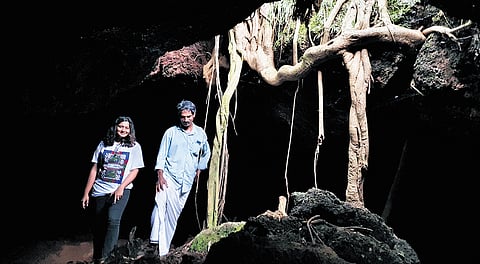

KASARGOD: A vast cave showcasing traces of human settlement dating back centuries has been discovered in Kundera, in Kasaragod’s Madikkai panchayat.
Covering more than 5,000 square yards, the naturally occurring cave is about 20ft deep, with holes in the ceiling, reminiscent of the many rock-cut chambers found in the region, probably to facilitate air circulation and entry of sunlight. The cave features a rectangular opening that is around 2m high and 8m wide.
According to Nandakumar Koroth, an assistant professor of history at Nehru Arts and Science College Kanhangad, “The cave is large enough to host approximately a hundred people. The holes in the ceiling suggest provision for natural lighting, indicating its use as a place of dwelling. Due to soil deposits, many parts of the cave are now inaccessible, making it difficult to uncover its full extent and history.”
There are markings that seem to have been made using work tools. In addition to the main cave, there are several smaller chambers, many of which have suffered damage over time. A structure resembling an altar is also carved into the wall at the centre of the cave.
Nandakumar added that studies by the archaeology department will help determine whether the Madikkai cave was inhabited during the Stone Age or the Mesolithic period.
