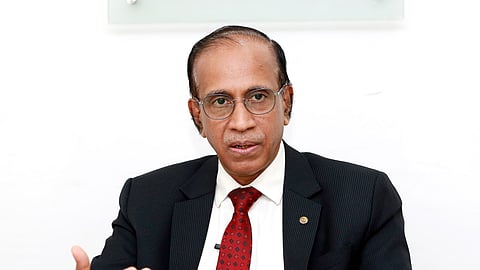

The past few years have been busy for Madhu S Nair, the affable CMD of Cochin Shipyard Ltd (CSL). Under his stewardship, the central PSU launched its initial share sale, and delivered India’s first indigenously built aircraft carrier, the INS Vikrant, to the Navy. In conversation with TNIE, Nair, who began his journey as an executive trainee back in 1988, outlines his big vision for the shipbuilder.
Could you please explain Cochin Shipyard’s journey over the years, and how it has now transformed into an international shipbuilder?
Cochin Shipyard has now completed 52 years of its existence. The transformation that you are talking about came about out of necessity. It happened in the early 2000s. We had a lot of problems. There were no orders, and our finances were becoming delicate. We were largely an organisation that was focusing on domestic projects. There was a feeling that this was not going to take us forward. It was at that time, in February 2002, that I returned from my studies in Japan. India was opening up. That was the trigger.
In the 1990s, the slogan was ‘Save our Shipyard’, as our net worth was being wiped out. And in the mid-1990s, we did a restructuring. That did not help much. We strongly felt that we should look outside India for orders. When I returned from Japan, the shipyard had just clinched its first international order, from NPCC, an Abu Dhabi-based government company. The order value was $8.2 million.
Several Malayalis in Abu Dhabi worked to ensure that the order went to the Shipyard. I was placed in the marketing and business development department at that point. Despite our confidence being shaky, we decided to further explore overseas. Then we received another contract from Saudi Arabia. It was not the friendliest of places to do business with; it was a difficult contract. Again, Malayalis working there backed us. Despite the stiff pricing we went for the contract, and delivered the project. After that, there was a feel-good factor within the company.

Subsequently, I pushed for contracts in the West. The narrative then was unless we do business with the West, we will not be accepted. That is how we went to Europe. The first big break came through London-based shipping magnate John Frederickson, who gave us an initial order for four vessels. We executed the project through a public-private partnership in 2003-2004.
Earlier, we used to take more than four years to complete a ship. However, we completed the first vessel in 24 months and the rest, one every five months. When we took this contract up, many people told us that we would fail. By the time of the sixth vessel, we were 135 days ahead, and they gave us a $2 million bonus. Today, Cochin Shipyard is a trusted name globally.
You have been a driving force of transforming an Indian PSU into a professional team. How could you pull it off? Especially considering issues such as trade union protests...
A culture of integrity runs deep in the shipyard. We got it from our previous generations. We call them three batches of naval architects. They were the best engineers from the best engineering colleges. IIT Madras started the (shipbuilding) course. Then we had a Japanese collaboration. At the same time, we had a set of people who joined the shipyard for ‘retired life’. There were difficulties. But, the youngsters and the workers who joined us in the later years were hardcore shipyard people. Their integrity was strong, and that is what we carry forward now.
Our workforce is one of the best. The thought process of our trade unions has also evolved. There might be disagreements, but none would harm the company. Because once we were in the street with a begging bowl. There is mutual respect. Over the past 36 years, the company has not lost a single day due to strikes by the permanent employees. We had a one-day symbolic strike when the company went public. Some viewed it as the first step towards privatisation, an ideological issue. I consider this a democratic right. Trade unions play a vital role, and our highly skilled workers are our strength.
You mentioned CSL’s impressive order book and profitability. What’s next for the company?
Our order book and profits look promising, but I remain cautious. We can’t afford complacency. While consolidating our current position, we are setting the stage for the next growth phase. In 2017-18, the Boston Consulting Group conducted a study for us. We are now building on those findings to target `10,000-`12,000 crore turnover by 2030-31. Over the past few years, we have expanded geographically. From a single unit in Kochi, we now operate six to seven units across Kolkata, Andamans, and other locations, including three ship repairing units and a new shipbuilding unit in Willingdon Island.
Our shipbuilding will be evenly split between defence and private sectors. We had two divisions — ship building and ship repair. We have now created a third, a knowledge division (CSL Strategic Advanced Solutions). Our expectation is that this division will contribute at least 10% of our turnover.
By 2030, I envision CSL as a `12,000 crore company with adequate profits. Beyond financials, our focus is on becoming a knowledge-driven company. CSL is making an ESG (environmental, social and governance) framework as well.
Are you building the next aircraft carrier? And will you incorporate technologies like the aircraft catapult?
The decision on constructing another aircraft carrier has to be taken at the highest level. The Indian Navy has expressed interest in a repeat aircraft carrier, aligning with their philosophy of maintaining at least three carriers. When the decision is made, CSL will be at the forefront.
Regarding technology, the platform will largely remain the same, as redesigning it would require substantial time and engineering efforts. A carrier’s design depends on the type of aircraft it would carry. The current carrier was designed for MiG-29s. Future decisions on aircraft type and technology will be strategic and made at the highest level.
Has CSL considered submarine development?
We are not directly involved. The submarine programme is currently dominated by two active players, and the technology is concentrated in their hands. It’s a long-term investment, and having too many players wouldn’t be practical.
Did CSL construct the largest dry dock in Southeast Asia with the expectation of repairing large ships?
Our dry dock serves a dual purpose, catering to both shipbuilding and repair needs. It’s designed to accommodate large aircraft carriers, fuel carriers like Suezmax, oil rigs, and LNG ships. India aims to become one of the world’s top shipbuilders. Shipbuilding has a significant cascading effect on the economy. Notably, Japan’s post-war revival was driven by shipbuilding and maritime industries. Companies like Mitsubishi, Hitachi, Toshiba, Samsung, Daewoo, and Hyundai started as shipbuilders and became prominent heavy industries.
The ship-building sector is dominated by three countries — China, Korea and Japan. These countries account for around 85% of ship-building. Korea and Japan face demographic challenges and don’t have the kind of people to sustain the industry. The youngsters there don’t want to come into these industries. But India will be good till 2070. One thought is whether India will be able to attract Korea or Japan to translocate a part of the business to the country. Establishments like Cochin Shipyard can play its part in this thought process.
So, is CSL looking to cash in on this opportunity?
We are done with our current set of capex cycles. In the past five years we have invested around `3,200 crore. We are considering acquisition of one more fairly big ship repair firm in Gujarat. We would need about `1,000 crore for that. Kochi would be one of our key ship repair clusters, where we would need further investment. We want to keep our eyes and ears open for a potentially large play. It is a big cycle.
Does it mean that you are open for more acquisitions?
Now there is really nothing much to acquire in India. We want to do some specific things, like establishing a design and engineering wing. There is an EV (electric vehicle) movement happening, and we would like to be part of it. In Kochi, we will be pushing ship repair in a big way. In the western cluster, Vadala in Gujarat, we will team up with the Kandla port. For something bigger, we will have to wait and see. As India moves forward, we definitely don’t want to be a mere spectator.
The state government has plans to develop a ship-repair facility as part of Kollam port. Do you think we have the potential to evolve as a ship repair hub with the opening of Vizhinjam port?
We are not really excited about Vizhinjam Port. Our preliminary exploration at Poovar some time ago found that there was no viability.
The port, no doubt, will change Kerala like never before. If the port is run commercially, there will be a lot of economic activity. Theoretically we can build a shipyard. But it will be so expensive that it will be difficult to create viability. A shipyard should come up inside a port ecosystem. There should be a breakwater, which is terribly costly. In Kochi, the shipyard is inside the port. Vizhinjam does not have the possibility of a shipyard inside the port. As per our assessment, it will be extremely costly.
What’s the plan in Kochi for ship repair?
We have an International Ship Repair Facility (ISRF). We will make further investments in the sector. It should be backed up by a maritime cluster. The Kerala government should develop the maritime cluster under the [Centre’s] Sagarmala project. We have done our part by developing a small maritime park on Willingdon Island with a 23-unit facility, which is seeing huge traction. We have created one shiplift facility with six workstations at an investment of `970 crore. We are trying to get a global partner, and the tenders are open now.
Are you planning to develop the second International Ship Repair Facility as a joint venture?
The shiplift will remain the same. Once the six work stations start working, we plan to develop another 10 workstations in the second phase at an investment of `1,500 crore. The Cochin Port may lease out the land, which will be developed by Kinfra or the state government directly. We have conveyed that the Cochin Shipyard will not implement the project, as there is a large role to be played by a real estate developer. We, however, are ready to chip in with 5% equity to trigger the project. Kochi is one of the best places in India to be developed as a maritime city.
What is the share of ship repair in CSL’s total turnover?
Last year, about 30% of the turnover was from ship repair. We are planning to maintain it in the range of 25% to 30%.
Has the ISRF started taking up projects?
Yes, we have already taken four vessels for repair. In ship repair, we have signed the Master Ship Repair Agreement (MSRA) with the US navy. We are getting inquiries from them. This is part of India’s strategic alliance with the US. Hopefully, early next year, we should be taking in the first US Navy vessel.
Could you share the experience of building India’s first indigenous aircraft carrier (IAC)?
While Cochin Shipyard is extremely happy to be known as the builder of INS Vikrant, I feel it is actually more about the country. It is the Indian Navy that built the aircraft carrier. They conceived it, created the basic things. Then, there were a lot of large, medium and small organisations involved in the project. INS Vikrant is the result of a combined effort. It was a long project. Many people sarcastically inquired why the project had got delayed. It was a first of its type, and an evolving project. A part of the contract was held as a fixed-time, fixed-price project, while the second part was a floating and expandable one. That was to catch the best in technology at that point in time.
The most challenging part was the planning and continual realignment. Cochin Shipyard was holding the central part but large integrators such as Bharat Electronics Ltd, Larsen and Toubro, Tata Advanced Power Systems were involved, and they were also doing it for the first time. For example, the airconditioning and ventilation system had gone through changes 13 times.
As chairman, I had the privilege of making this project a top priority. Decision-making was extremely fast. This wasn’t just about a ship — it became a nation-building project. Everyone wanted to be part of that journey, and no one wanted to fail. That sense of collective responsibility was truly remarkable. Vikrant is a testament to belief. Naval officials from the UK and Australia remarked on the exceptional quality of the product. Producing something of such high quality instils national pride, much like the feeling during the launch of Chandrayaan. Even during the pandemic, we did not stop the work.
So many MSMEs were involved in the Vikrant project. Now that the project is over, are their services now going untapped?
We are doing another 14 ships of the Navy, and they involve high-end technologies. Many of the MSMEs are involved in these projects as well.
Innovative startups are emerging in shipbuilding and solar boat technology. How do you view this?
We recently developed India’s first hydrogen-powered ferry, a hydrogen-fuel cell catamaran, which was relocated to Varanasi in July 2024. Hopefully, it will be operational soon. I expect more hydrogen-powered vessels will be developed. Solar vessels are effective in certain situations as well.
Cochin Shipyard is a big ship maker… there are murmurs that it is competing to build the water metro boats...
We heard this allegation earlier too. Kochi Water Metro is not about a few boats. There is high-end engineering involved. There is global business potential here. The vessel may be small. But the technology involved is huge. We are fine with smaller companies trying to do things. And when they do things, teaming up will also be possible.
Kerala seems to be in a lot of distress regarding the lack of money with the government to invest in public infrastructure. How do we improve the situation?
I think the easiest and most fruitful step will be to cut waste. I have a feeling that we are doing a lot of inefficient things. We also need to be clear that creating wealth is a necessity. We all take great pride in the Kerala model, but there should be appropriate changes for the creation of wealth. We need to bring in professional management in state PSUs. Central PSUs are examples. I am not saying that all Central PSUs have been doing great. But there is a professional system. State PSUs must do much more. For example, Keltron is a great organisation. It should soar. There are big opportunities for state PSUs. There are industries that do not require large space. We are now concentrating on certain sectors like medical equipment. Our industrial parks and estates should not be just a real estate business that someone else is running.
Kerala should attract more investments. We must reach out for it with the right intent. I can see that a few ministers are trying to do this. But I believe much more should be done. Our institutions like KSEB and KSRTC should be led from an entirely different point of view. We should move into the EV transition. We are speaking about the hydrogen economy, but our initiative is not enough. The hydrogen economy is a mind-boggling concept. We should come out of our comfort zones.
Your thoughts on our colleges?
I studied at Maharaja’s College, Ernakulam. There was a time in the college when all kinds of discourse could be conducted. We have lost a little bit of that fabric.
Do you believe our children are migrating to other countries because something is missing in the state’s higher education sector?
There is a little bit of disbelief. And this phenomenon is not just confined to Kerala. Other states in the country also see many students migrating to foreign shores. However, I think the number of students going outside is on the higher side in Kerala. Everyone wants good things. Who doesn’t?
What needs to be done?
The need is for the main higher education institutions to bring industries into our campuses. They need to work more towards it.
You have been a Kochiite for a long time. What do you think Kochi can do to stand out as a global city?
Kochi is truly a global city. And people who visit Kochi do like it. However, the first thing that we need to do is become a little bit more clean. Kochi and other cities in the state are not clean. I also feel we have lost our open spaces. For bringing about positive changes in such areas, we need dialogues and discourses.
How do you unwind? Do you read a lot?
I am happy with the work I am doing. I want to read but am not able to do so. But I try to stay abreast of the latest happenings. I am a continual learner. I don’t prefer the commonly used Malayalam word vayasan for the elderly. I am more inclined to the word vrudhan, which means a person who has gained wisdom.