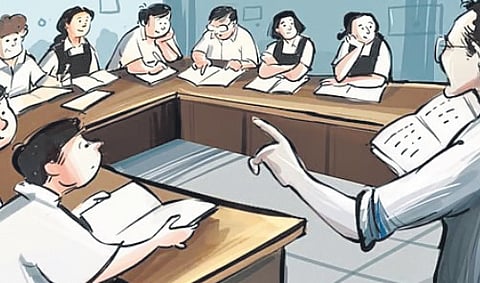

THIRUVANANTHAPURAM: As part of doing away with the concept of ‘backbenchers’, the government is considering a proposal to change the seating arrangement in school classrooms from the conventional rows to a U-shape model. The proposal, announced by General Education Minister V Sivankutty through a Facebook post, came a week after he kick-started a public debate on changing the academic year-end vacation from April-May to June-July.
The minister pointed out that being branded a ‘backbencher’ could impact a student’s confidence and learning. “No child should be left behind,” he said, adding that equal opportunities should be ensured for all children. He added that a committee of experts will be constituted to suggest the best seating pattern suitable for the state’s education system. A final decision will be taken after examining the committee’s report, he said.
The minister’s proposal is based on an idea from a Malayalam film ‘Sthanarthi Sreekuttan’ in which a school student proposes a change in the conventional seating pattern after being humiliated for being a ‘backbencher’ in the class. A few states have already implemented the semi-circular seating arrangement, drawing inspiration from the movie.
A section of academics has welcomed the proposal as it would enable the teacher to give equal attention to all students.
J Prasad, former director of the State Council for Educational Research and Training (SCERT) , said the semi-circular seating arrangement has already been informally implemented in schools where classrooms have been built according to the latest infrastructure standards.
“Such a seating arrangement ensures that teachers have direct eye contact, proximity towards the student and two-way engagement, making the classroom sessions more vibrant,” Prasad said.
However, education experts have expressed doubts over how superficial changes to classroom seating could improve the teaching-learning process.
"There are no scientific studies establishing the efficacy of a semi-circular seating arrangement. If the teacher is well aware of the socio-cultural background and requirements of each student, physical proximity with them does hold much significance," opined Prof Armruth G Kumar, Department of Education, Central University of Kerala.
According to Prof Amruth, modern educational theories suggest that teachers have to carry out two types of preparation - one about the content to be taught and the other about each student's learning abilities and limitations.
"Fanciful ideas such as semi-circular seating arrangement should be seen only as an excuse to bypass these two important requirements," he said.
