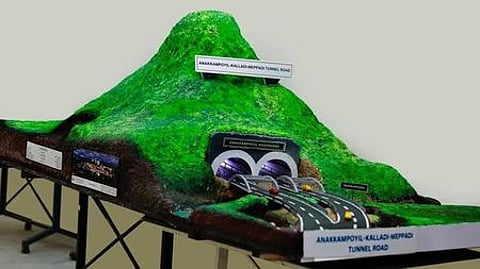

KALPETTA: Work on the ambitious Wayanad-Kozhikode twin tunnel road will begin on August 31, with Chief Minister Pinarayi Vijayan set to inaugurate it.
The Rs 2,043.74-crore project, touted as a transformative step for Kerala’s transport infrastructure, involves an 8.753-km twin-tube unidirectional tunnel with four-lane approaches, bypassing the winding and congested Thamarassery ghat section of NH 766.
The tunnel road — which will be India’s third largest once completed — is also expected to slash the travel time between Kozhikode and Bengaluru, besides giving tourism initiatives a push and improving Wayanad residents’ access to hospitals, markets, and schools.
The positives notwithstanding, the project is facing severe criticism from various corners. The Wayanad Prakrithi Samrakshana Samithi has filed a PIL at the High Court, claiming the tunnel passes through the ecologically sensitive areas of Thiruvambady (in Kozhikode) and Vellarimala (in Wayanad), zones identified by both Gadgil and Kasturirangan committees as highly vulnerable.
The real concern is that the tunnel ends at Kalladi which is part of the Nilgiris-Wayanad-Coorg biodiversity corridor where both Puthumala and Chooralmala -- the sites of two major landslides in six years — are located. Experts warn that tunnelling and blasting could destabilise slopes, especially during the monsoon season.
The state and union-level expert appraisal committees too have raised concerns about the potential disruption of elephant migration routes, which could push wildlife into villages and lead to more frequent conflicts.

The petitioners in High Court have questioned the validity of the environmental impact assessment (EIA) report prepared by the Konkan Railway Corporation, pointing out that the corporation is neither accredited by the Quality Council of India nor authorised to conduct EIAs for large infrastructure projects.
“The proposal submitted by the state government for environmental clearance is full of fake data,” alleged N Badhusha, president of the Samithi.
“The area is home to numerous species, including the critically endangered Banasura Laughingthrush. Chembra Peak and several elephant corridors also lie above the proposed route. Any construction activity, including excavation using heavy machinery, is banned in the area.”
To address the risks, the environmental clearance granted earlier this year came with more than two dozen conditions. These include detailed mapping of landslide hazards, installation of automated weather and vibration monitoring systems, strict adherence to blasting safety guidelines, and the creation of wildlife corridors.
The monitoring of rare and endemic species such as the Banasura Laughingthrush has been mandated, along with regular environmental audits. Opponents say the Forest Rights Act of 2006 has not been fully complied with and warn of irreversible damage to biodiversity.
Vishnu Das, director of the Wayanad-based Hume Centre for Ecology and Wildlife Biology, pointed out that widening the ghat road would have been a better solution.
“The tunnel road construction will inevitably have ecological impacts. The government has promised to use advanced drilling machinery to minimise the damage, but accessibility issues should also be considered. Our suggestion was to widen the ghat road to ease traffic,” he said.
At the same time, the project promises to benefit the local populace dependent on tourism.
“Accessibility constraints have largely affected Wayanad’s overall development. At Meppadi, where the tunnel road ends, people depend on tourism for livelihood,” Wayanad Tourism Association secretary Saifulla K Hassan said.
Public Works Minister P A Mohamed Riyas, in a recent Facebook post, had described the project as a “bright path for Wayanad” and “the direction towards the future of Kerala”.