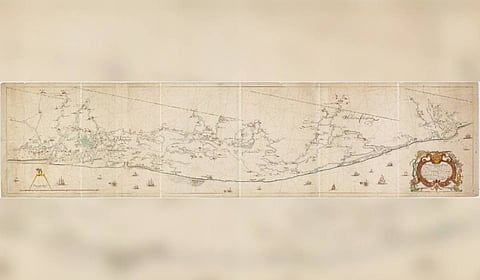

KOCHI: As Fort Kochi hosts the first Cosmos Malabaricus Summer School, from August 11 to 14, it will mark a crucial step in the Kerala Council for Historical Research's (KCHR) journey to expand Indian Ocean studies, challenge colonial historiographies and foster international academic collaborations -- through the Cosmos Malabaricus project. The summer school aims to create an active platform for scholarly exchange, archival engagement, and field-based learning.
Providing a peek into how the Cosmos Malabaricus project was born, Venu Rajamony, former ambassador of India to the Netherlands, said “Only a few people are aware that there exists a large collection of manuscripts written in Dutch in the Ernakulam archives. When the Dutch made away for the British in the subcontinent, many of these manuscripts were moved to Chennai. Today they are part of the Madras state archives.”
He pointed out that a larger collection of such manuscripts is in the national archives of the Netherlands. “These manuscripts, written in medieval Dutch, are a treasure trove of information on 17th and 18th century Kerala,” he told TNIE.
He highlighted how the Dutch government and experts helped Madras archives digitise the manuscripts, with the aim to make them available to scholars all over the world. “They wanted to do the same here. Discussions were held with experts from Leiden University, dubbed the Oxford of the Netherlands. However, it was felt that digitising the manuscripts alone won’t serve the purpose. Hence, it was decided that the manuscripts would also be translated,” said Dr Ganesh K N, chairperson, KCHR.
The language in which the records were written is different from modern Dutch, he said. “It was decided to translate, interpret and study them in the context of other information sourced from countries that also had a presence here, in addition to local sources.”
Venu said the state government gave approval to the seven-year project that would see KCHR and state archives -- in association with the Dutch archives and Leiden University -- research these records to learn about 17th and 18th century Kerala.
“The MoU was signed in 2022. A key outcome of the project has been the training of four Indian Cosmos Fellows, who have undergone intensive archival and paleographic training at the National Archives of the Netherlands and Leiden University. These early-career scholars participated in mentorship programmes that included sessions in archival science, cartography, and transcription techniques. These scholars are trained in classical Dutch. Six researchers from the Netherlands were part of the project. One of the four Indian researchers even has a PhD,” said Dr Ganesh.
He highlighted that summer school is a step forward in disseminating knowledge. “The school will see the participation of 30-odd research scholars. Six scholars have arrived from the Netherlands. It will follow a class format,” he said.
“The Cosmos Malabaricus Summer School promises an intensive and practice-based learning experience that will see scholars being taken on a tour based on maps made by the Dutch, who made significant contributions in cartography, developing innovative mapping techniques and producing influential atlases and navigation charts. Though a lot of changes have happened over the century, still an idea of the Dutch presence and their history in Kerala can be gleaned from the tour. It will be short journey starting from Fort Kochi that will also cover Vypeen, Bolgatty, and Varapuzha,” Venu said
