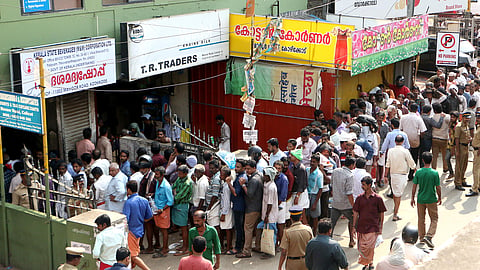

Here we go again! Stirring up a heady debate on liquor policy, the Kerala Beverages Corporation (Bevco) has yet again put forward a proposal to launch online liquor sales in the state.
According to the proposal, the aim is to increase sales and, in turn, revenue. The launch, it notes, will also help considerably reduce the serpentine queues in front of current outlets.
There, of course, will be restrictions. Only those above the age of 23 can avail themselves of the service, and proof of age must be provided ahead of delivery. Purchase volumes too will have limits as in the case of physical outlets.
According to Bevco CMD Harshita Attaluri IPS, several online delivery platforms, including Swiggy, have expressed interest in tying up with the corporation. But the Kerala government clearly does not share the enthusiasm.
A senior Bevco official says this is not the first time such a proposal has been put forth. During the pandemic, the state government also rejected a similar bid. “That’s when we launched a system where you book online and collect the liquor from stores without standing in line. That site is still active,” he adds.

Notably, Bevco has proposed launching an app to make pre-booking more seamless. The idea of online sales, the official says, arose primarily because Bevco currently does not have enough stores in the state to meet demand.
There are only 282 Bevco outlets in Kerala, along with 30 Consumerfed stores. Compared with the 4,000 outlets run by the Tamil Nadu State Marketing Corporation, this figure appears staggeringly low.
“Online delivery of alcohol is already available in cities
such as Bengaluru and Mumbai. It is also available in states like West Bengal and Odisha,” the official says.
Writer N S Madhavan says the idea is relevant in today’s world. “As the market changes, every company has to follow new trends. Now it is online sales. That’s how I look at it,” he says, adding that the new proposal will also create jobs.
He adds that there will be added benefits: the winding queues in front of outlets will get shorter, and perhaps issues such as public drinking and drunk driving may reduce.
“The government has rejected the proposal mainly because this is an election year. Otherwise, this is indeed the practical next step for Bevco, not something revolutionary,” says Madhavan.
Not all are on the same page. Psychiatrist K Sudarsan, for one, believes online delivery will lead to an increase in alcohol consumption in the state. “One consequence is that drinking within families and among women will rise,” he says.
“The more accessible it is, the more people will use it. This is not just about revenue. The mental and physical health of our people should be the priority. Even if rules exist, loopholes will soon emerge.”
For Adithya M, a techie who has worked in Bengaluru, the idea of liquor delivery is not new. “There, they have a considerable number of outlets as well as home delivery. Many people order online. Paying delivery charges often works out better than going all the way to the store. In a way, it saves money and time,” she says.
Freelance artist Arun (name changed), who works as an office assistant, says the news about the proposal reminded him about losing a friend in a road accident. “He drank at a bar and drove back home. If this option existed, perhaps he would have ordered liquor to his home,” he says.
“Though I do not drink, I feel this is a good proposal. We should stop generalising drinking as a social evil. After all, it’s the government that’s selling booze. Why this hypocrisy?”
According to media professional Manuel (name changed), this moral high ground is why the much-needed modernisation of Bevco remains stagnant. “Online sales are, simply speaking, good for business and customers,” he says.
“It ensures that the consumer is not mistreated. Currently, for a corporation that rakes in huge revenue, the condition at most outlets is shoddy. Indifferent or rude customer service, long queues, no air-conditioning, no ventilation…. Can any other business house thrive with such conditions? Here, Bevco does so because they have a monopoly. People who buy booze pay a lot of taxes. They certainly deserve better customer experience.”
Fashion designer Elzaba Ipe echoes the same sentiment. “The proposal sounds great. All they need to ensure is a fool-proof system to ensure there is no misuse,” she says.
President of Progressive Techies Anish Panthalani, who does not drink, says those who want to drink will anyway do so, so let them do it in comfort. “Instead of making them stand in queues and drink, and then walk back or drive home, why not let them buy it online? As everything is available online these days, why not alcohol? I don’t think consumption will exponentially rise. Of course, there should be checks and balances — put a limit on volumes, and ensure children don’t get access. Then it is fine,” he says.
Autorickshaw driver Jobin Joseph also backs the idea, though it will hit his “additional pocket money”. “I know many people who pay me double the trip charges to buy and deliver bottles at their places,” he laughs.
“Similarly, there are many who splurge on ‘parcel’ from bars to avoid queues at outlets or because they missed the closing time deadline due to work schedule. Online delivery will certainly help such people.”
Sneha Suhasini, a software engineer, says as long as alcohol is not declared illegal, there should be no reason to deprive consumers of online facilities. “Moreover, many women feel scared to visit liquor stores. Online sales will be helpful to them, and others who find it difficult to visit outlets, like the elderly or people with disabilities,” she adds. “The customer, after all, should be the king.”
With inputs from Parvana K B