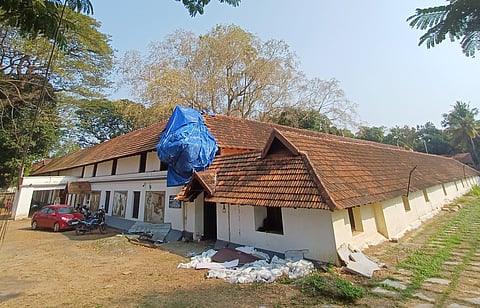

The Central Archives, standing solemnly in Kottakkakam within the historic East Fort of Thiruvananthapuram, is more than just a repository of documents — it is a living chronicle of Kerala’s past. The building, constructed in the style of an ancient Roman courtyard house, has a rich and layered history.
“The fort is believed to have housed the Nair brigades, and the Fort Hospital was established to treat the Nair sepoys stationed there. This suggests it once served as their barracks,” says historian M G Sasibhooshan.
“The brigade eventually succumbed to the British policy of the subsidiary alliance, leading to its disbandment, with the final blow coming during the tenure of Velu Thampi Dalawa. With the Sree Padmanabhaswamy temple and palaces like Kuthiramalika and Krishnavilasom requiring protection, the permanent deployment of a small army within the fort (Kottakkakom) was a strategic necessity.”
For a brief period in history, the fort also functioned as a prison, adds the historian.
In 1887, it was repurposed as the Central Vernacular Records Office before being transformed into the Central Archives in 1962.
The Archives house records from the princely state of Travancore, including census records, education codes, and documents from various departments such as education, revenue, and judiciary, dating from the 15th to the 19th century.
“Among its most prized possessions is a collection of over a crore palm-leaf manuscripts, meticulously preserved using traditional methods. These manuscripts, inscribed in scripts like Grantha, Malayanma, Vattezhuthu, and Kolezhuthu, provide invaluable insights into Kerala’s administrative, socio-cultural, and economic history. It has 700-year-old palm leaf collections with about 80 lakh to 1 crore leaflets which throw light into the history of Kerala,” says Uma Maheswari, history enthusiast and the curator of the world’s first Palm-leaf Manuscript Museum that functions out of the facility now.
Famous personalities like Ulloor S Parameswara Iyer, Sooranad Kunjan Pillai, and actor Sathyan worked at this place, Uma adds.
A significant part of the collection includes the ‘Mathilakam Rekhakal’, historical documents once housed in the Sree Padmanabhaswamy temple. These records detail royal decrees, temple administration, and pre-settlement land revenue systems, offering crucial historical context. The foresight of the Travancore rulers in maintaining such meticulous records has allowed historians to reconstruct an authentic narrative of Kerala’s past.
“Digitalisation of these records is ongoing. A part of it got digitised in 2017 in collaboration with C-DIT, more will be done in the upcoming years. Writing of the same script varies from person to person which makes it difficult to comprehend the script,” says Parvathy S, director of the archives.
It is on the ground floor of the Central Archives that the Palm-Leaf Manuscripts Museum function, featuring eight thematic galleries: ‘History of Writing,’ ‘Land and People,’ ‘Administration,’ ‘War and Peace,’ ‘Education and Health,’ ‘Economy,’ ‘Art and Culture,’ and ‘Mathilakom Records’.
The exhibits include ancient documents on land ownership, tax records, appointment orders of officials, laws, military records, and treaties. Visitors can explore Kerala’s historical development through display boards, feature videos, QR-code systems, and interactive installations.
The museum’s ‘War and Peace’ section is particularly notable, containing palm-leaf records that recount historical incidents such as assassination attempts on Anizham Thirunal Marthanda Varma, battles, and revolts. The ‘Education and Health’ gallery highlights the contributions of Travancore rulers and missionaries in shaping Kerala’s education system. Meanwhile, the ‘Economy’ section showcases manuscripts related to land measurement, taxation, and trade policies.
“Looking ahead, the Kerala government has planned an International Archives and Heritage Centre in Kariavattom to further enhance preservation efforts and expand archival research. The construction is ongoing on the Kariavattom campus. If timely provided the fund, the construction will be completed in less than two years,” says Parvathy.
