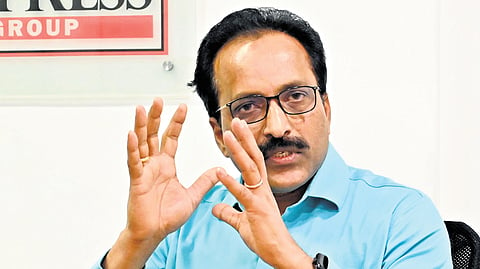

S Somanath, a former ISRO chairman, is an interesting combination of scientific spirit and spirituality. It was under his leadership that India successfully landed Chandrayaan-3 on the moon in 2023. He is also credited with taking forward ISRO’s Aditya-L1 and Gaganyaan missions. Post retirement, he is serving as a Vikram Sarabhai Professor at ISRO, distinguished visiting professor at the IISc and a cabinet rank advisor to the Andhra Pradesh government.
Somanath shares with TNIE India’s journey in the space sector, the crucial role played by ISRO in Operation Sindoor, and the possibility of life elsewhere in the universe.
Excerpts
ISRO was established in 1969. How advanced are we now?
We are capable of designing and launching rockets from indigenous launch pads as well as make and launch satellites of any size. We are however much behind in the scale of operations, that is investments, number of rockets and satellites. While the US spends $50 billion for space programmes a year, and Russia and China around $20 billion, India spends only about $1.8 billion. On the technology front, we are on par. We landed Chandrayaan on the Moon’s south pole – no small feat. We need to now shore up our investment and scale of operations.
What was ISRO’s role in Operation Sindoor?
Our imaging capability was fully utilised. Conflict or not, we image neighbouring countries continuously. We collect data on constructions in border areas, the terrain, whether new villages are being constructed or defence establishments being set up. Such images are collected through satellite tracking. This includes friendly and non-friendly countries. Because satellites roam all around the earth, we can take pictures of the US, Russia, China, or any other country. They can take ours too.
Do we have a tie-up with NASA?
Regarding scientific data, it’s an open data policy. Data of all scientific missions are deposited in our science data centre. Scientists from all countries can access it. But this doesn’t apply to strategic data, which is not shared with anyone.
Space capability is unique. Are there attempts by other countries to hinder our progress in the sector?
We foresee possible hindrances. We try not to depend on another country for products that are absolutely necessary and that’s where indigenisation or Atmanirbhar Bharat comes in. This doesn’t mean we won’t import anything at all or that everything gets manufactured here. Over the past 50 years, we have created facilities to manufacture complex materials on varying scales in different parts of the country.
Can you take us through the transformation process of our space sector?
Earlier, there was no industrial base to support large-scale manufacturing for space missions. ISRO did all the production by sourcing from suppliers. That has changed. Today, more than 450 companies across India contribute to space-manufacturing. In the past six years, around 200 companies that can design, engineer and even launch components and entire rockets independently have emerged. A strong investor-ecosystem is also emerging to support these ventures as a viable, long-term investment. What’s truly transformative is that these companies are no longer limited to catering to ISRO alone. They have entered the global market.
Is GoI working towards enabling private players like SpaceX to operate alongside ISRO?
That’s precisely the direction of our space policy. The Centre’s plan is to build a vibrant private space ecosystem where Indian companies can develop, manufacture, market and launch their own space technologies. Historically, ISRO has done everything from R&D (research and development) to manufacturing to launch operations. We’ve now decided ISRO will increasingly focus on R&D while routine operational manufacturing and launches can be gradually transferred to the private sector. Over time, the policy will create a vibrant ecosystem where companies like ‘desi SpaceX’ can thrive.
Which was the most satisfying moment in your career?
Without a doubt, the GSLV Mk III project. I joined ISRO just as it was being envisioned. In 2002, I wrote the project report and estimated the cost. By 2014, I was the project director overseeing its successful development. That rocket went on to launch Chandrayaan-2 and Chandrayaan-3.
On a mission day, what does the chairman go through?
We take a bath, have breakfast, and happily go and do the launch (laughs)!
There’s an assumption ISRO scientists work sleepless nights before a launch. Is that true?
Why should we? Yes, a launch is a 24x7 activity. But we work in shifts. Everyone knows their role like clockwork. We have countdown books and detailed protocols built over decades. The protocol is in our DNA. It’s been refined over the years through practice, failure, and success. We have a sequence of work for three months. The project director is responsible for that. Then there are mission directors, vehicle directors, launch-operations directors. The process runs smoothly whenever a launch happens.
Even so, isn’t there a huge expectation from the chairman?
If so, it’s due to the specialty of that post. It’s not the chairman alone who works. Thousands work behind the scenes.
Who gives the final go for the launch?
There’s no such person. It’s teamwork. Notionally, the mission director may give the go. The chairman has no role in it. He just sits in the terminal and watches things unfold. Those in the lower rung take the call. Only if they have a situation, do seniors get involved. If the vehicle develops deviation in path, there is no need to seek chairman’s consent to destroy it. The person responsible has full authority to do that.
Does fear of failure linger over each mission?
In each mission, there are possibilities of failure or success. Our job is to enhance the possibility of success and reduce that of failure. Material defects too matter. If an equipment fails, another equipment can do the job. But correcting everything is impossible.
Your mental frame after a mission failure…
I was part of the PSLV project. We had assembled the rocket in six months, and when the rocket failed, we checked the launch pad. All we could see was smoke and dust. I felt an emptiness in my mind. A complex rocket failed due to a minor error. But we decided to get it right the next time. The incident wasn’t demoralising. Rather, it made us determined. We never cry over failures.
Did the spy case affect ISRO?
It was capable of affecting motivation. But our seniors involved in the PSLV project... G Madhavan Nair, R V Perumal, S Ramakrishnan... did not give us time to think about it. I don’t think the allegation that the spy case delayed the development of our own cryogenic engine is true. I was sure it was a baseless case.
You’re a scientist and also a believer. How can the two go together?
Who said that? I am not a believer. I don’t believe in anything, so please don’t bracket me in the believer category.
But you are credited with making an obscure temple in Thiruvananthapuram famous...
I go to temples. A temple is part of culture. I go there not to see God or pray. I go there for its culture. It’s part of my spiritual process.
What’s your spiritual process?
I’m an enquirer. I’ve read and understood a lot but it’s still incomplete. I have many questions before me, the answers to which are difficult to find. But I need to find them. There’s still no clarity on many things even as a scientist. To me, spirituality is a deeply personal matter. Where I go, what I do, what I experience, what I seek to know... these are entirely my own.
What are the limitations of science?
I’m not fully aware of all its limitations. There may be several. My scientific knowledge is based on what I’ve read and experienced as an engineer. Even with my limited knowledge, I know the process of knowing is very complex. If you are a rationalist, you can just seek knowledge. But that process alone isn’t complete. I think one should have scientific knowledge acquired through reading and thinking. The other is an inquiry to understand yourself. I am in that process now (laughs).
Poojas are done at nuclear power plants before launch...
Pooja is part of our culture. You are free not to follow your culture but one should remember that each one of us came via the culture of our family, society, and nation. One can question it but negating it is not the right thing to do. When we live in a society, one cannot impose one’s wishes on others. When someone performs pooja, I don’t see the need to speak against it. So I stand alongside and participate.
Isn’t it contradictory to believe that hanging green chillies and lemons on rockets will protect them?
Those who do such poojas hail from a particular background. Such poojas put their minds at ease. What we need to see is whether it (pooja) harms or affects societal harmony. If it does, you should intervene. Some say such things shouldn’t be done in a government office. You should remember it’s people who work in offices. You cannot ask someone to behave like machines once they enter an organisation. Some place idols in their offices. It’s part of their culture.
Do you think an intervention is needed if it contradicts science?
When do beliefs contradict science? These are misconceptions. Scientific process is proof-based. When there is no proof, it is called belief. To believe, one doesn’t require evidence. I’m not a believer. I haven’t believed anything just because I was told. I’m someone who keeps enquiring and discovering. I negate nothing. I don’t deny that I may get something out of a temple visit.
A lot of people go there... they believe there is some power. I haven’t seen any power so far. I don’t know whether I’ve ever received something I specifically asked for. I haven’t seen God till now. But that doesn’t mean I’ve become someone who can deny the existence of God. All I can say is I don’t know. And so, I’m trying to find out.
Your views could be interpreted differently…
Possibly. But I speak from experience because I’ve spent a lot of time trying to understand it. We’ve had great sages like Buddha. But what did he really achieve? What he started eventually turned into a traditional religion. Even those who came after him couldn’t change the world in any fundamental way.
What I understand is that their experiences were intensely personal. I wish to reach that level of insight one day. We may or may not reach that level, it doesn’t matter. It is possible but not transferable to another person. Those who tried to change the world have only failed. What happened after the emergence of Sri Ramakrishna Paramahamsa, Swami Vivekananda, Jesus Christ…
Isn’t there a problem in using symbols of one particular faith in a multi-religious society?
The problem arises when we fail to respect other faiths. It’s belief that creates conflict. Any kind of belief is dangerous. The moment you start accepting what’s written in books or told by gurus as absolute truth, without question, you fall into a trap. Each one of us has the ability to think independently. So why worry unnecessarily?
You don’t believe science provides all the answers?
Definitely not. Science hasn’t reached that point yet. It might in the future, and when that happens, I’ll be open to changing my view.
But science is a journey, isn’t it?
Yes, and this (spirituality) is also a journey. Maybe they’ll meet at some point. I don’t know. Even with all the progress, we still don’t have all the answers.
Do you mean to say that science is one of the paths, not the only path?
Science is the path, there’s no doubt about that. As a scientist, I must say science needs to advance. It’s part of a continuous process of enquiry. There will be phases of progress and even stagnation. Over the past 300 years, we’ve gained immense understanding about the universe, ourselves, and life.
Can science and belief coexist?
You’ve used the word belief. Belief doesn’t really coexist with science. But the human drive to enquire and understand realities beyond the scientific... that’s something different. Humans explore different paths and that exploration has led to all kinds of insights and philosophies. Some say the idea of God came from fear. For others, it may have emerged from a genuine desire to understand the unknown. That kind of exploration is unique to humans. I’m not here to negate that ability or say any such path is wrong. All I’m saying is it’s a path. Like science, it’s also a journey. I don’t know much about that path but I acknowledge its existence.
Nowadays, we hear scientists discussing ‘Pushpaka Vimanam’ in scientific forums...
It’s not my fault if they present ‘Pushpaka Vimanam’ in scientific forums. We can certainly ask for references supporting those claims. Just having those references doesn’t prove that the ‘Pushpaka Vimanam’ actually existed. We won’t find a description of the Pushpaka Vimanam’s construction or technology that aligns with our current scientific understanding.
How is India’s traditional scientific temper?
I have never understood what people mean by scientific temper.
The advancements India has made in science... are these from ancient times?
If not in India, where else do you think it was? Where else in the world did the earliest scientific thought process begin? At one point in time, India was the seat of education. We had a university system where students from central Asia and even Europe studied here. It was a society with tremendous knowledge in metallurgy, material science, architecture, medicine, finance, and reasoning.
We often look up to the West...
Europe and central Asia went through some kind of dark ages. It was a period of war between religions. When religious leadership became weak and political leadership came up, Europe escaped. That’s the importance of political leadership. It should always be strong and be above other forms of leadership.
There are many imaginative concepts like UFO and aliens. Is there a possibility of life anywhere else?
Possibility is very high. The Earth’s age is around 4 billion years. Life happened here at least 3.5 billion years ago. How was Earth formed? From stars that exploded… from their stardust. There are billions of earths that have been formed thus in the universe. All of them have almost the same structure. Life can happen anywhere. But did it continue, has it become the evolved life of today? Man is just 80,000 years old, whereas this universe has existed for billions of years. In my opinion, everything has life. Even this universe has.

What’s the status of Gaganyaan now?
There are thousands of tests to be completed this year. By the end of the year, an uncrewed Gaganyaan mission will be carried out. The rocket assembly started last December. Crew module preparation is progressing. Astronaut training is over. The delay was due to the rocket assembly. Shubhanshu Shukla’s travel to the International Space Station is part of the training. India’s manned mission is scheduled for 2027.
There’s a conspiracy theory regarding manned missions to the moon. In 1969, man landed on the lunar surface. A total of 12 people did so till 1972, but not a single manned mission happened after that...
We need to first understand why men were sent to the moon. It was part of a power struggle between Russia and the US. Russia was the first to send man into space. The US then had to come up with a majestic move to get the upper hand... a manned mission to the moon. After a few such missions, the glamour was lost. Questions started arising on the need for such missions. About 30% of US revenue was already being spent for space missions. Their government hence cold-shouldered it and decided not to give more funds. Only after 25 years did they realise how it helped America advance technologically.
Is there a renewed interest towards the moon?
The Earth needs an outpost. If there are any issues on Earth, like a catastrophe, we need a safe space to accommodate us for a couple of years. Once the Earth becomes habitable again, we can return. That’s a possibility. There’s a strategic intent too. In the coming years, wars can be controlled via the moon. Equipment can be positioned on the moon to watch the Earth. Position navigation timings, like GPS, can be done in a moon-based manner. There are also exotic ideas like moon-mining. I think all countries have started trying to own the moon as part of power expansion.
There was a period when such interest wasn’t seen...
Going to the moon used to be a costly affair. Now with technological advancement and lower production cost, expenses have come down. Space has been democratised. Many countries have developed the ability to set up space stations.
Space tourism is emerging as a major concept...
There are two sides to this. If people who can afford to spend money are ready for such an experience, there’s nothing wrong in using technology for the same. Those who are ready to spend crores for a seat, let them go. But don’t be under the misconception that it constitutes actual space exploration (smiles).
You are a cancer survivor. Would you mind sharing your fight for survival?
I was diagnosed with colon cancer in the large intestine. After detailed investigation, surgery and chemotherapy were done. I have been in remission for 1.5 years. When we first realise it’s cancer, we are shocked... how serious it is, how long it will last, whether I will live or not... all such thoughts. Doctors told me not to worry. I simply accepted it.
They say you fought your way through it. On the day of Aditya-L1 launch, you made sure to be present...
Cancer was detected on the day of Aditya-L1 launch. It was detected in the morning. I went for the launch, after which I got a detailed investigation done. When I got cancer, I felt satisfied. People may not believe it, but I think life needs experiences. When I underwent chemotherapy, the experience proved invaluable. I can now tell everyone that it’s not a disease to fear.
TNIE team: Cithara Paul, Anil S, Unnikrishnan S, Aparna Nair