
Mattancherry has been constantly evolving since its inception. However, not all changes this heritage township witnessed have been positive, especially when they come at the cost of erasing its historical and cultural importance.
Adheena Ashfaque, a resident and techie, noticed the alarming rate at which Mattancherry and Fort Kochi have been transforming in recent years. “One day you see a building, and the next week there will be no trace of it,” she says.
To keep track of what little is left, Community 40, a five-member heritage and culture collective, has begun conducting monthly visual documentation walks across Mattancherry and Fort Kochi. They aim to record the area’s recent history before it vanishes completely.
The name Community 40 comes from the 39 communities that inhabit Mattancherry; the extra ‘one’ represents those who have joined hands to preserve it, she explains.

The collective plans to conduct twelve such walks in total, one each month, and has already completed three. “Each walk begins with an introduction to the area. The documentation process is not limited to just photography. You are free to choose your medium,” Adheena explains.
The third edition of the walk took place around the Mattancherry Dutch Palace, led by Adheena herself. Before we began, she asked us to notice a few things — the tiles, the bright paints, or Mattancherry colours as she called them, and the people.
We were given the choice to explore either the Palace Road, home to diverse communities such as the Konkanis, Gujaratis, Tamils, Jains, Mappilas and Kutchi Memonis, or the Bazar Road that connects Mattancherry and Fort Kochi. I chose the latter, using photography as my medium.
Signs of change were everywhere. The little shops on the way to Bazar road had mismatched roofs, one half covered in asbestos sheets, the other in traditional Kerala tiles, while the building behind sported modern tiles, a visible symbol of transformation.
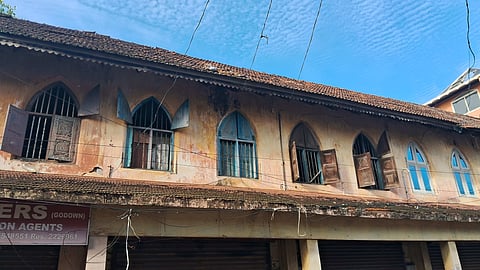
Except for a few autos that passed by occasionally, Bazar Road was quiet that Sunday morning. As I walked, I noticed how the old buildings struggled to stand the test of time. Newer, flashier structures loomed nearby, almost mocking their existence.
An old warehouse with a spice shop attached had walls layered with paint peeling in yellow, white, blue, and peach tones. You could almost count the number of times it had been refreshed over the decades.
Further along were the windows Adheena had mentioned. Some multicoloured, others intricately detailed, different sizes, belonging to the same building. Such variety was common until a few years ago. These fixtures were collected from dismantled ships, a culture of recycling that came naturally to the locals.
Everywhere, there were traces of fading grandeur—blue-painted gates with motifs, trusses jutting from walls, worn window sills bearing hints of different architectural styles, and fading art deco elements replaced by monotonous modern façades.
We regrouped for the final leg near the Dutch Palace, and head to Jew Town as Adheena narrated,“Mattancherry was formed after the floods destroyed the Muziris port and the silt collected in the area, created a natural harbour. The Jews settled in Kerala after this period, during the trade boom when merchants from Arabia, Persia and Rome, frequented its ports.”
We paused by the once-bustling Pepper Exchange, now merely a dying monument, before heading to a café run by a young Gujarati serving his community’s snacks. The walk ended at an old spice warehouse, gudham, once the docking site for trading ships. From the roof, we could imagine the bustling harbour that once was. Beside it stood the ruins of a temple, its story, like many others here, lost to time.
The walk wasn’t heavy on details; it offered a slow and reflective way to explore. Interested participants can register and document in any medium— photography, sketching, or writing. At the end of each walk, participants share their work in a common drive. When all twelve walks are completed, Community 40 plans to host an exhibition showcasing these collective memories.
The next walk is scheduled for November 23. For more details, contact: 73560 76616.