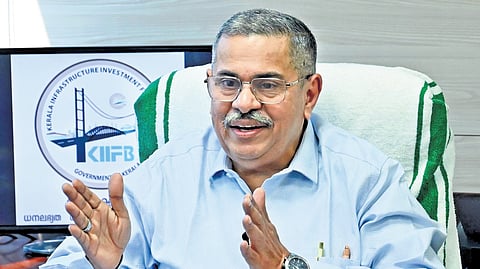

A taekwondo black belt and a long-distance runner, he’s someone who dared to take on an all-powerful Pranab Mukherjee — Union finance minister then — during his tenure in Securities and Exchange Board of India (SEBI). Former chief secretary KM Abraham, who made a mark as a financial expert and anti-corruption crusader, has many feathers in his cap.
As Kerala Infrastructure Investment Fund Board (KIIFB) completes 25 years, one of its architects and current CEO talks about his vision on Kerala’s development, fight against powerful corporates, and his love for endurance sports. Excerpts
We are having this conversation in the backdrop of the 25th anniversary of KIIFB. Though it was formed in 1999, the real transformation happened after 2016. Can you tell us about it?
In 1999, I was secretary (resources) in the finance department, working under Vinod Rai, who later became the CAG (comptroller and auditor general). That was a time we went through a huge financial crisis, not just us but other state governments too. So, we proposed an idea to access the market and mobilise resources, and that money was to be used to run the treasury. I was assigned the task of drafting the Act. The assembly passed the Act unanimously and it was a proud moment for all of us as everyone was together foreseeing Kerala’s progress.
Can you tell us about the decision to revive KIIFB in 2016?
It lay dormant till the LDF government under Pinarayi Vijayan came to power in 2016. I was then the principal secretary (finance). Through the vision of Thomas Isaac, then finance minister, KIIFB was outlined as an instrument for the state’s developmental activities.
He presented the plan beautifully in the budget. When the proposal was made, it was only a dream. He stated that KIIFB would execute projects worth Rs 50,000 crore. He (Isaac) entrusted me with the task of revising the Act. We redrew the Act. Radical transformations were made. The learnings from 1999 were also included.
What were those?
When we borrowed money for infrastructure purposes, the money was put into the treasury. The treasury does the liquidity management. When a bill is presented, it is serviced by paying from the funds lying in the treasury. This is how all governments, including the Centre, function. Money is fungible. But that means funds borrowed for infrastructure never reach the sector as intended. That lesson of 1999 bothered us. So, when the Act was amended in 2016, a firm decision was made that this shouldn’t happen. Now, can KIIFB funds be used for, say, paying welfare pensions? No. KIIFB funds can be used only for infrastructure development and infrastructure-enabling activities.
Did your experiences with SEBI help you in this regard?
During the 2008 Lehman crisis in the US, I had the opportunity to watch how the financial crisis played out in India. We issued several orders and made interventions to maintain the sanctity of the market. The learning is that when we build an institution, unless we ring-fence it properly to protect it and ensure transparency, the institution will collapse. A Fund Trustee and Advisory Committee was incorporated — a committee with three eminent members. The government can appoint the committee but cannot dismiss it.
Wasn’t there a plan to revive KIIFB during Oommen Chandy’s term as CM?
Yes, there was. An internal committee was formed under the Planning Board vice-chairman. A paper was prepared on assessing modern markets. The thought was that we could raise up to Rs 25,000 crore from the market. The idea was to fund commercially viable projects such as toll roads and industrial parks. But the real transformation happened in 2016, when Chief Minister Pinarayi Vijayan and Thomas Isaac decided to intervene decisively in building public infrastructure, regardless of whether immediate returns came or not.
Can you tell us about the mandated revenue stream for KIIFB via fuel cess and a portion of motor vehicle tax?
On the implementation side, we wrote into the Act that proceeds from the petroleum cess and a portion of the motor vehicle tax would come to KIIFB. We started cautiously — 20% of motor vehicle tax in the first year, increasing to 50% in a staggered manner. This was to ensure the government could withstand the impact. That was the first transformation. The second was financial — every Rs 1 borrowed by KIIFB is explicitly and implicitly guaranteed by the government.
Has KIIFB achieved its goals?
The declared objective of KIIFB is to invest in infrastructure. If you look deeper, KIIFB might appear as a mix of projects — roads, water, schools, colleges, etc. But that isn’t what it truly is. I’m speaking of KIIFB post-2016. We shouldn’t confine KIIFB to just an infrastructure-building body. We should see it in the backdrop of ‘Nava Keralam’. For an average Malayali, ‘Nava Keralam’ isn’t a new term. We’ve been hearing it since childhood. KIIFB is an important tool to achieve that objective. So, KIIFB is what the people in power want it to be — that is the first thing we need to understand. So, to answer your question: have we achieved the objective? We are continuously achieving it. Miles to go before we can say we have reached the goals.
Can you elaborate?
In development, just like in nuclear physics, there’s the concept of critical mass. Development cannot be achieved unless we attain a certain criticality. For instance, we build a college — but just by building it, we cannot say higher education has grown. Two colleges won’t help us reach that criticality. In nuclear science, unless the fissile material is packed to a certain density, energy production won’t happen. Or like in our traditional kitchens where the stove lights only if enough air is blown. I believe KIIFB is that fire. We built 44,500 smart classrooms, which helped us continue classes during the Covid pandemic.
But not many people, especially the public, are aware of KIIFB’s work...
Though we are doing 1,190 projects with an outlay of Rs 90,520 crore, only a third have been completed. Others are either in the implementation stage or being designed. So, Kerala is yet to see KIIFB’s full contribution. We need to understand that the best of KIIFB is yet to come. The next area where we expect a quantum jump is higher education. In primary education, we have achieved critical mass, and now we need to sustain quality and ensure access for the poorest.
Can you tell us about the projects implemented?
I strongly believe today’s investments in science, technology, and higher education will determine Kerala’s future. Investments in other areas improve services, but investment in human capital is different. Now, almost all universities have translational research centres that help researchers turn lab discoveries into real-world applications. Similarly, centres of excellence — like MG University’s Centre for Nanotechnology, the Thanu Padmanabhan Centre for Astrophysics in Thiruvananthapuram, and the Centre for Neuro-Degeneration and Brain Health at CUSAT — are major steps forward. Two centres deserve mention: the Centre for MicroBiome in the Life Sciences Park — a KIIFB-funded project — and the Centre for Nutraceuticals. We’ll soon see how these centres contribute to Kerala’s socio-economic transformation.

How will you respond to the allegation that KIIFB functions as a parallel government?
You need to understand how we take up a project. We don’t randomly decide one day to take up a project. Most KIIFB projects have their origin in the state budget. There’s a rigorous process involved for the rest. For KIIFB to take up a project not mentioned in the budget, the department concerned must approve it. The department, meanwhile, needs the cabinet’s clearance.
Over a period, won’t KIIFB become a burden to the government? Also, what if the liability is too high for it to repay?
A probabilistic assessment is that we are on a robust path. Things may go wrong only if you overload KIIFB. KIIFB liability should not and will not go beyond the limit. The fidelity certificate embodies that the KIIFB has the money to repay for the next six months. It is impossible to overload KIIFB unless we do it profligately.
Why didn’t KIIFB opt for loan funding in the JICA water supply project, which would have been cheaper, while it explored masala bonds which are said to be costlier?
JICA (Japan International Cooperation Agency) provides money in foreign exchange. They provide loans at 3% or 2.5%. But we should consider hedging costs. If the hedging cost of foreign exchange is considered, it would be somewhere between 5.5% and 6%. When we add interest, it would be 9%. That is one disadvantage. Another disadvantage is that it can be sourced only through the Government of India window. Third and important limitation is that it is not multi-sectoral. If JICA funds a water supply project, we cannot utilise some of the money for another project. KIIFB has a multi-sectoral focus.
What are KIIFB’s revenue generating projects? Questions are being raised over KIIFB’s long-term sustainability…
There are industrial parks. There’s a transgrid project done for the KSEB. They save on distribution costs and make repayment to us from it. There are more projects like that. But they constitute only 20% of the portfolio. KIIFB’s future is in revenue earning projects.
Was there a proposal to levy toll from KIIFB-funded roads?
There was a discussion and there are possibilities. But toll is not under consideration at the moment. In future, governments in power may opt for that.
KIIFB is facing severe criticism from the Opposition. Is it possible that a future government will shut KIIFB?
Normally, such a thought wouldn’t arise, as all governments want the betterment of the state. Think about the genesis of the Act behind KIIFB. It was passed unanimously. Think about the feeling behind that.
So, you think no sensible government would opt for an exit?
It is my 100% belief. If it happens, that will be the blunder or tragedy of the century.
Much like KIIFB, K-DISC is a game changer, but their activities haven’t been publicised much…
K-DISC is a hotbed of intellectual activities. In 2017, the CM said we should have an institution that can provide a futuristic direction. That’s how it started. K-DISC has exciting possibilities, but things happen behind the scenes. K-DISC will be a game changer in the next five years.
You were handpicked by A K Antony to implement the challenging modernising government programme (MGP). It had huge potential, but was dropped due to a lack of political will…
It was a difficult phase. A lot was invested. Chief secretaries and secretaries were involved in MGP. We got a lot of grassroot-level support. But, unfortunately, MGP was seen as a project of ADB (Asian Development Bank) compelling us to do certain things.
V S Achuthanandan, the then Leader of Opposition, strongly opposed MGP and even said those who support the ADB loan would end up in jail…
(Smiles) He didn’t say they will be jailed… rather, they will get a slap on the face (laughs).
Later, the same VS became CM and was reluctant to relieve you and even opposed your appointment to SEBI. What caused his change of mind?
(Smiles) It was a difficult situation for me because my appointment to SEBI got delayed. By then, VS had become familiar with my work. I met the CM several times, requesting to be relieved since my career depended on that decision. I still vividly remember when I met him once. I was a bit emotional and complained: “You relieve everyone, but not me.” VS, who was generally considered reserved, got up from his chair, held my hand, and said, “To relieve you is unlike relieving others.” I value that as the greatest recognition I received in my 43-year career — especially coming from Achuthanandan sir.
Your tenure at SEBI earned you many accolades, but also some very powerful enemies, including Reliance and Sahara…
A significant issue that came up was the prevalence of benami transactions. The lawyer representing these cases claimed there were two crore investors. But when we investigated, we found that the majority of these so-called investors were actually benami — in other words, it was black money circulating under the guise of legitimate investments. Sahara was the largest case.
We have heard that the Centre received the highest fine in the Sahara case. How much was it?
Yes, the fine was Rs 24,000 crore as per our order. However, only Rs 10,000 crore could be realised, as Sahara was unable to pay the entire amount. Had the government’s mechanisms probed deeper, several underlying systemic weaknesses could have been identified and addressed.
You had a confrontation with Pranab Mukherjee, the then finance minister…
I felt that the integrity of SEBI was being compromised to an extraordinary degree. There was a deep concern that this wasn’t in the best interest of the public system. That concern led me to raise the issue. When I decided to write to the Prime Minister, it wasn’t an easy step. One has to be extremely cautious in such matters — after all, he was in charge of SEBI. It was an agonising moment for me. I kept asking myself whether I should send such a letter? But if I was convinced that the system was compromised, then what should I do? That’s why I finally decided to write the letter. Of course, the letter triggered disciplinary proceedings against me. But when it reached Manmohan Singh, he noted that there was nothing unlawful about an officer writing directly to the PM.
Why didn’t you go to Pranab Mukherjee directly?
Protocol would have required that, but that’s precisely why the concept of a whistleblower exists. The whole idea behind whistleblowing is that the whistleblower needs to be protected. When the system itself is compromised, you can’t rely on the usual hierarchy to fix it.
You are a recipient of IIT Kanpur’s Satyendra Dubey Award, a rare honour, for officers known for their integrity. But you have faced vigilance probes and even a CBI enquiry… isn’t that ironic?
Integrity always has a price. In my case, the price was a bit heavy. It created some hard times, especially for my family. I investigated cases that came before me. In some of those cases, I had to mention certain prominent persons, and that created some backlash.
How did the government respond when the disproportionate assets case came up?
Two people defended me in the assembly — one was CM Pinarayi Vijayan and the other was (former Chief Minister) Oommen Chandy. When Oommen Chandy raised the issue of an honest officer being targeted in the assembly, the CM said that he shared the same opinion.
Do you think Jacob Thomas, who initiated the vigilance probe, had any personal grudge against you?
I don’t know. He once considered me a friend. But when a raid is conducted in a house, there’s no need to take its measurements. If the vigilance asks the municipality, they will immediately provide the map and details. That house is in a colony, and if they had asked the society secretary for the details, they would have got them. There was no need for such a raid — it was a public show.
Coming back to KIIFB, there was criticism about the KIIFB audit. What is its audit mechanism?
We follow all necessary requirements for a high-value debt entity. We have a quarterly audit by an audit committee consisting of independent members. Before that, there’s a statutory audit. Then we have a risk-based audit and internal audit.
The government announced big welfare measures recently. How feasible are these at a time of fiscal stress?
A majority of these are already announced projects. Shouldn’t we fulfil those? Liquidity management is a fine art. There is fiscal stress. It’s primarily due to restrictions even for capital expenditure. But within the fiscal stress, liquidity can be managed by controlling and rescheduling expenditure and tapping revenue earning resources to the maximum.
Can we justify freebies at such a time?
I don’t agree with the term freebies. I view this as economic empowerment of families. When we give women Rs 1,000 as pension, she will spend it wisely for family and children. Women empowerment is one of our proclaimed objectives.
Anonymity is said to be one of the three pillars of civil service. But many of our current officers are social media stars...
There’s such a tendency. In fact, anonymity is a kind of defence. It isn’t an abdication of responsibility. When major government projects come up, can an officer claim that he’s the force behind them? It is neither ethical nor factual.
You are into martial arts and taekwondo…
My passion for martial arts began from college days. I got a 2nd Dan. Let’s see whether I can get a 3rd Dan after retirement (smiles).
You are also a marathon runner…
I enjoy running. I like long-endurance sports.
TNIE team: Kiran Prakash, Cithara Paul, Rajesh Abraham, Anil S, M S Vidyanandan, Vincent Pulickal (photos) Harikrishna B (video)