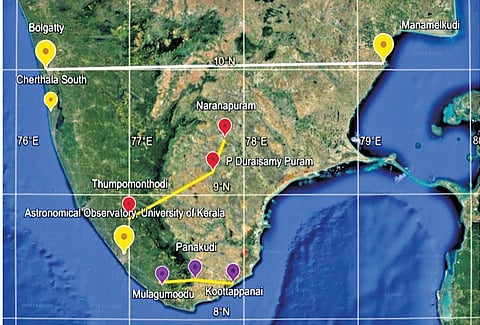

THIRUVANANTHAPURAM: The location of the magnetic equator -- the constantly shifting imaginary line around the Earth where the magnetic field lines are horizontal -- is crucial for navigation and modern-day communications. But not many would be aware that when preliminary scientific studies on the concept were being conducted in the 19th century, the Travancore Observatory, established by the erstwhile Travancore kingdom, had carried out the first ground-based mapping of the magnetic equator in India in 1839.
The location where the magnetic equator passed in India was then identified as Bolgatty, in Ernakulam. This, along with other valuable contributions of the observatory in the field of geomagnetism, finds mention in the research paper titled ‘162 years of rendezvous with the magnetic equator by the Travancore Observatory’ published recently in the Indian Journal of History of Science.
The Travancore Observatory, established in 1837, is now known as the Thiruvananthapuram Astronomical Observatory and functions under the Kerala University (KU).
Ironically, while no records of the observatory’s findings are available in India, over 40 publications brought out by the institution, in which the crucial studies figure, were unearthed by researchers from libraries in Scotland and Germany.
The research team was led by Prof R Jayakrishnan, the present director of the Thiruvananthapuram Astronomical Observatory and head of the department of physics, KU.

“The first map of the magnetic equator in India was published with the joint efforts of the then director of the Travancore Observatory, John Caldecott, and T G Taylor of the Madras Observatory. Besides Bolgatty, the duo found in 1839 that the magnetic equator was also located at Manamelkudi in Pudukkottai district, Tamil Nadu, in the east coast,” said Jayakrishnan.
In 1859, John Allan Broun, the second director of the Travancore Observatory, reported to the British Association for Advancement of Science that he observed the magnetic equator (dip zero) to be in Cherthala, Alappuzha.
In 1921, the observatory recorded the dip zero to be located in Thiruvananthapuram. These findings proved that in India the magnetic equator was shifting southwards.
“Compiling data from the 1839 to 1941 editions of the observatory’s almanac sourced from Scotland and Germany, we found that the institution closely recorded the movement of the magnetic equator over those 98 years,” said Jayakrishnan. The findings could have been of immense value to scientists across the world who were conducting studies in the domain, he pointed out.
The findings of the observatory could have cemented the concept of a “migrating magnetic equator” and provided valuable proof for the ongoing geomagnetic reversal phenomenon by which the magnetic north and south poles would swap places.