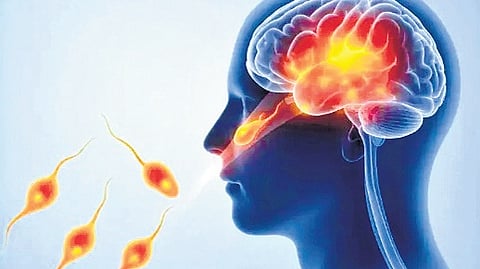

KOCHI: After the northern and southern regions, central Kerala has reported its first case of amoebic meningoencephalitis. The disease was confirmed in a Lakshadweep native, who is working at Edappally in Ernakulam, on Friday. The patient is currently is undergoing treatment at a private hospital in the city.
“The health condition of the patient is satisfactory,” said an official with the Ernakulam District Medical Office. According to the official, the first two test samples of the patient had returned negative, while a third microscopic test confirmed the disease.
Amoebic meningoencephalitis, a rare central nervous system infection caused by free-living amoebas found in freshwater lakes, has claimed 33 lives in the state so far this year. The disease develops several days after exposure to contaminated water sources and may cause death within one or two weeks of infection, mostly because of its rapid onset and delayed diagnosis.
Emphasising the importance of preventive measures in this scenario, Indian Medical Association (IMA) Kerala State Research Cell convenor Dr Rajeev Jayadevan said that people should avoid getting water into their nasal passages as the amoeba uses the nose as a shortcut to enter the brain. “Nobody should intentionally introduce water into the nose. People who develop symptoms of the condition should seek medical attention immediately and share any possible exposure history with their doctor,” he said.
He also linked the higher number of cases reported in Kerala to the state’s enhanced diagnosis protocols. “Among six lakh cases of brain infection reported across India every year, a small percentage are caused by amoebae. More cases of amoeba are being identified in Kerala because our healthcare system conducts additional tests in cases where brain infection is suspected,” he added.
Kerala has reported 153 cases so far, with most detected in the Kozhikode, Malappuram, Thiruvananthapuram, and Kollam districts. Of these, 65 cases and 12 deaths were reported in October. The first case of this year was reported in February, with the Kozhikode and Malappuram districts recording a sharp surge in August and September.
Meanwhile, the state health department has initiated a multi-district field study with the cooperation of the National Institute of Epidemiology (NIE), Chennai, to investigate the causes of amoebic meningoencephalitis (amoebic brain fever), focusing on Kozhikode district in the initial phase.
SYMPTOMS
Fever
Vomiting
Headache
PREVENTION
Do not wash your face or bathe using stagnant water
Ensure water does not enter the nose
Stay hydrated and keep surroundings clean
