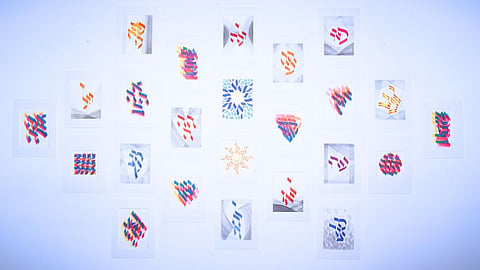

The third edition of the International Calligraphy Festival of Kerala (ICFK 2025), steered by KaChaTaThaPa Foundation in association with Kerala Lalithakala Akademi, began with much aplomb in Kochi on Thursday.
The four-day event, held once again at the Durbar Hall Art Gallery, remains the only festival in the country dedicated exclusively to calligraphy, and hence boasts, like usual, the participation of big names from across India and abroad.
TNIE paid a visit ahead of the exhibition’s inauguration to check out the many works on display and learn about the history of this craft and Kerala's tightening embrace of it.
“The festival is a perfect avenue for the people here to learn about calligraphy,” says Narayana Bhattathiri, the force behind ICFK, as he gave us a tour. A noted calligrapher with over four decades of experience, he splits his time between conducting workshops and classes, and the promotion of this craft by way of similar exhibitions.

“I’ve seen first hand the spike in interest. People are now more appreciative about calligraphy. Until only a few years ago, only a small clutch of people really paid attention to this craft or even knew about it. That’s changed significantly in the past half a decade,” says Narayana, stopping short of heaping the credit entirely onto the festival.
The festival was, no doubt, a big catalyst for this appreciation in interest and has, since its inception, grown to accommodate more than just an exhibition. Indeed, on its sidelines, there’s workshops, discussions, demonstrations and lectures, with a throng of the young and the old, all in rapt attention.
This year is particularly interesting with the addition of a fashion show, a unique show blending calligraphy-inspired attire with stage presentation, and a pen show, offering collectors and enthusiasts a rare opportunity to explore a variety of pens (and even buy a few). Prices fall between Rs 50 and Rs 5 lakh.
“Another highlight is the institution of the G Vivekanandan Memorial Award for excellence in script-based art displayed at the ICFK each year,” says Narayana. It includes a cash prize and citation, before finding us a quiet corner to discuss the history of calligraphy.
But what is calligraphy? “Well, your dictionaries define it as ‘the art of producing artistic, stylised or elegant handwriting or lettering. But of course, like it is in the case for all art forms, definitions don’t define the practice. It is so much more,” Narayana explains.
Before the advent of the printing press, he continues, this was how people knew what was at play. Both around them and elsewhere in the world. So it was important that they be legible to read, thus introducing a skill aspect to what is otherwise just ‘writing’.”
As time passed, these writings transcended their function into the territory of art, and several names stood out. “The arrival of the printing press and its subsequent evolutions pushed calligraphy into a niche for a long time. Later, it found a resurgence on social media,” he adds.
But even when calligraphy was at its zenith, Kerala, and even South India, remained oblivious to it as ‘a form of art’, Narayana explains. “Our scripts were mostly written on palm leaf manuscripts, which has an inherent limitation. I.e. you can’t do certain strokes as it would tear the leaf. Which is in part why several of our Malayalam letters are round or oval in shape,” he says.
And by the time the craft made inroads in this region, the printing press had long found a foothold, thus relegating calligraphy to what Narayana describes as “poster works”.
But according to the artist, calligraphy is so much more, and he is thankful that the craft is seeing a resurgence. “I say this often, and much to the anger of several artists. Calligraphy has even a one up over painting,” Narayana says.
Elaborating further, he adds, “Painting artworks have colour, a style and a message. Calligraphy has these three and another element: lettering.” This, he says, holds the viewers attention for ever the slightly longer. Some lean on this aspect of calligraphy to make it political. And it has been used to such masterful effect in politics, especially in Kerala.
Interestingly, Narayana’s youthhood is filled with several instances of him being called on to lend his calligraphy skills to make politics of that time lively. “But of course, calligraphy accomplishes more than that… It is, as is the case for any art, how we use it, and is shaped by (and shapes) religion and spirituality, culture, etc.,” he says.
While heaps of praises came Narayana’s way then, hardly anyone recognised this ability of his as an art. It was not until 2017, he recalls, that he found his way in calligraphy. “I was attending a camp held in Pune which was attended by calligraphers from across India.
“That was indeed a turning point,” recalls Narayana. “It opened my eyes to the potential of this craft, and I began working to promote it. This festival is one vehicle to achieve that goal.”
Like the printing press, the advent of AI has come as a prickly thorn, but Narayana is unfazed. “I don’t think it will affect calligraphy much. Especially given how the work infuses a lot of lettering, most of which are in regional languages,” he says.
By evening, the gallery was indeed buzzing as people thronged to the venue to behold the strokes, the colours and the letters that told, among many things, that art is what we make of it.
The exhibition concludes on October 5.
Beyond the exhibition
* Workshops, discussions, demonstrations and lectures on art, communication, cinema
* Sculpture, painting and contemporary art forms will be on display
* Calli-Fashion Show: a unique show blending calligraphy-inspired attire with stage presentation
* The India Pen Show: an exhibition and sale of pens
* Music and dance performances inspired by calligraphy
Artists @ ICFK 2025
Guests include Michel D’Anastasio (noted Hebrew calligrapher), Kim Jin-Young (South Korea), Brody Neuenschwander (UK), Dang Hoc (Vietnam), and Masoud Mohebbifar (Iran).
Eminent Indian figures included Padma Shri awardee Achyut Palav, designer of the Indian Rupee symbol D Udaya Kumar, Sanskrit scholar Santosh Kshirsagar, former IIT Mumbai professor G V Sreekumar, Parameswaran Raju, NID faculty member Tarun Deep Girdher, and many others.