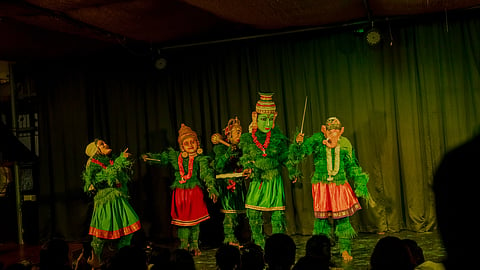

In a small, warmly lit terrace in Vennala, near Edappally, the air carries the pulse of Kerala’s folk past. Rhythms from another era rise into the balmy evening, as masked dancers and ritual songs transform the intimate space into a stage for trance of the rustic kind.
We are at Thudippu Dance Foundation, a multi-disciplinary art training centre, where Kummattikkali and Thumbithullal are being staged under the guidance of veteran artist and Folklore Academy awardee Sukumaran T G, along with his troupe ‘Sukumaranum Sangavum’ from Evannur in Thrissur.
Thudippu’s founders, Anjali and Ponnu, both trained in classical art forms such as Mohiniyattam and Bharatanatyam, envisioned the space as more than just a venue for teaching and performing mainstream art. They sought to make it a platform for underrepresented community artforms.
Organised quarterly, the foundation has, over the past year, showcased Chavittu Natakam, Kaikottikali, and Fugdo — a dance of the Kudumbi community that migrated from the Konkan region to Kerala.

“It was historian Bony Thomas sir who connected us to the Kudumbi community. This time, friends from the Folklore Academy connected us with Sukumaran sir and his troupe,” shares Anjali.
Kummattikkali is a masked dance tradition prominent in south Malabar and central Kerala. In Thrissur, where it thrives, dancers don painted wooden masks and costumes woven from grass to transform into gods, demons, and mythical figures.
Moving from house to house, they bless families with their presence. The Palakkadan version of the form, according to Sukumaran, is more ritualistic.
Costumes are integral to the spectacle. Traditionally crafted from braided parpataka grass (Indian fumitory), they are now often substituted with ramacham (vetiver), a practical shift necessitated by scarcity.
Masks, once made from areca palm bark, are today mostly carved from wood, making them sturdier, longer-lasting, and more detailed.
Deities such as Shiva and Vishnu, figures from the Mahabharata and Ramayana, and the ‘Thalla’ (a witty, old motherly figure) are commonly portrayed. Each comes to life painted in bold hues.
According to Sukumaran, once behind the mask, dancers maintain a ritual silence as the accompanying singers narrate the myths and legends in verse.
A signature feature of Kummattikkali is the ‘aarpo cheer’ after each song, drawing performers and audience into a shared sense of celebration.
While Kummattikkali thrives on masks and myths, Thumbithullal finds its power in rhythm, trance, and collective engagement. Traditionally performed by women seated in a circle, the performance centres on the ‘Thumbi’, who holds a tuft of thumba flowers and sings verses that gradually build in intensity.
As the tempo rises, the Thumbi sways into a trance, pulling singers and audience into a shared rhythm. Sukumaran’s troupe, which has no women performers, adapts the form by having men take on the roles. “The important thing is to keep the art alive,” he says, hoping more women will come forward to learn and perform it.
Notably, the troupe Sukumaran now leads was founded in Evannur nearly 90 years ago by Padinjarethala Govindan. Training remains open and informal.
“We usually begin with four or five singers. As we move from house to house during a performance, more people join in. By the end, the number can go up to 40, including children and curious passers-by. That’s the beauty of it: the art itself pulls people in,” Sukumaran smiles.
Folk arts, he adds, are never static. “They evolve with time. Materials change, roles adapt, and songs acquire new tunes. Our goal is to ensure they are not forgotten,” he says.
Those who are truly drawn to the songs and rhythms often return for future performances, gradually becoming regulars. In this way, participation and curiosity transform into belonging, keeping the troupe and the artform alive.
At Thudippu, Sukumaran’s performance stayed true to this participatory spirit. He invited the audience to join in, and some eagerly took part, adding their voices to the chorus and becoming part of the living tradition.
And that’s exactly what Anjali and Ponnu strive for. To carry forward unique art traditions of the land, through the people.
“Kerala is culturally rich in terms of the variety of community art forms we have here. Many of them are on the verge of dying because they lack patrons,” notes Anjali.
“But on the other side, some artists have dedicated their lives to promoting and nourishing their community art forms. We thought about how we could help them, and this is what led to this initiative.”
According to her, it is a sad reality that some artforms have already vanished without a trace. “We do not wish the same to happen to others. We want to bring these art forms to the forefront for an audience who has never seen them before.”
The duo are modest about their role. “We only wish to support them in whatever means possible by us,” they say. “As a gesture of gratitude, we raise funds for the artists who perform under this initiative. Guests can contribute after the shows purely on voluntary basis.”
Anyone interested can attend these shows free of cost. All one needs to do is register in advance once the quarterly events are announced via social media handles of Thudippu.