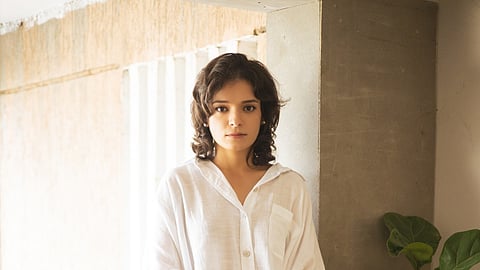

Back in college, Maalavika Manoj — better known by her stage name Mali — stumbled upon a newspaper article about Parekh and Singh. The pastel-suited duo from Kolkata had just begun catching international attention, and to a young student in Mumbai, they seemed impossibly cool.
“I remember thinking, wow, lucky guy,” she says of Nischay Parekh, then studying at the Berklee College of Music, USA. Their music felt like proof that indie pop from India could stand tall on a global stage.
Fast forward to today, and Mali finds herself singing alongside Parekh on his latest release, Location. For the Mumbai-based artist with roots in Kerala, it’s a full-circle moment.
The New Indian Express spoke to Mali about her creative process, her evolving sound, and the quiet discipline behind it all.

You first came across Parekh and Singh in college. What does it feel like now to be singing with Nischay on Location?
It’s such a full-circle moment. I read about Nischay back in college — he was at Berklee then — and I remember thinking, wow, lucky guy. Their music felt like proof that indie pop from India could stand tall globally.
This song itself has had quite a journey. The first version was from 2020, when he submitted it for music school. Since then, we’ve tried different versions, even performed it live once or twice, almost shot a video… It’s been through all of that before finally reaching people now.
Your own music often looks inward, drawn from emotion. Location feels more outward, about place. Did that open something new for you?
Yeah, that makes sense. My songs usually come from the internal — emotions, states of mind. This one’s anchored in places, in the external world. And even though I didn’t write it, when you live with a song long enough, you internalise it. You start to feel its world. So I think some of that perspective will naturally seep into what I write next.
How has your sound changed since your early days with Rush?
You don’t like the same things at 30 that you did at 20. Your interests, your subjects — they change. It’d be hard to keep writing about teenage angst or heartbreaks when you’ve outgrown that space. For me, the evolution’s been natural. I’m enjoying showing that shift, and honestly, I like surprising people.
What can listeners expect from your next album?
It’s in the works and should be out next year. I’ve written about nine songs so far, and I’m working closely with Keshav Dhar, who’s producing. I first demoed them on my own, and now we’re refining them together. Next, I want to jam with the band — see how the live energy shapes the tracks before returning to the studio. It’s a slow, patient process, but that’s what I love about it. You see the songs grow.
The artist’s life can be solitary. How do you stay creative in that space?
It can get siloed, yeah. That’s why I gave myself a concrete goal — to finish the second album next year — and worked backwards. I spent June and part of July just demoing alone, letting the songs simmer. If you take them to a producer too early, everything either sounds amazing or terrible, and you lose perspective. That alone time helps clarify what the song really needs.
You also handle the admin side of being an artist. How do you balance that with creativity?
It feels like doing one and a half jobs. In a single day, I might record for an ad, prep for a rehearsal, then attend a meeting about visuals. Plus, there are spreadsheets, website renewals, all of it. Switching between those roles is what’s draining. If you were just doing music or just managing, it wouldn’t feel so heavy. But as an independent artist, you wear both hats.
Streaming and AI have reshaped the music landscape. How do you see it now?
When I was on Spotify’s On the Radar in 2020, around 50,000 songs were uploaded daily. Now it’s more like 120,000 — and not all by humans. We’ve already had a phase where music became so polished it felt plastic — and that’s what AI can replicate best. What’ll stand out in the future are things that feel human: real instruments, live rooms, even small living-room performances. That intimacy will matter most.
When people leave your shows, what kind of connection do you hope they walk away with?
I never want anyone to feel my show was overhyped. It is what it is. My favourite thing is when someone comes along with a friend, not knowing what to expect, and leaves saying, “Whoa, I’m going to listen to all your songs.” That’s when I know the music spoke for itself.
And on the tougher days — when impostor syndrome hits — what keeps you going?
Every artist has impostor syndrome. On those days, I remind myself of three things I’ll always be proud of, even when I’m older. Sometimes I’ll open Spotify for Artists and see five or ten people listening right then — maybe at three in the morning, somewhere in the world. That’s such a hopeful feeling. It means the songs are travelling even when I’m asleep.
Your family roots trace back to Kerala. Has exploring that history changed your sense of self as an artist?
I’ve always been into genealogy and family history. I’ve interviewed relatives, done a DNA test, and traced my ancestry. I’m sketching a story about matriarchal women in Malabar a hundred years ago — women who didn’t know the word for it but were true feminists. I’m not sure yet if it’ll become a book, a show, or a film. But digging into those stories grounds me, and I’m sure it’ll find its way into my music.
When you’re not making music or tracing history, what keeps you grounded?
Gardening, definitely. I know people joke because “Mali” means gardener in Hindi, but I just love plants. I’ve got ladies’ finger and chilli plants, and I check on them every day. Seeing a bud one day and a bigger one the next — it’s like writing a song. You add a verse, a hook, and slowly it becomes whole. Cooking too — I don’t do it often, but I enjoy it. Music, gardening, cooking — they’re all patience games.