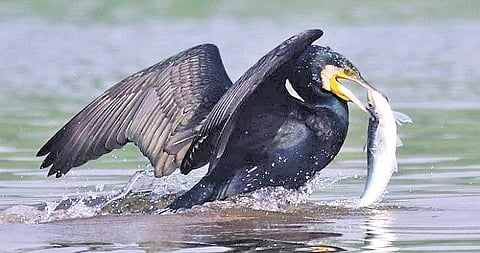

KOLLAM: In what is the first such evidence, researchers have found synthetic fibres in the droppings of Indian cormorants and Oriental darters, both common fish-eating birds of Kerala’s wetlands. The study was conducted at Vembanad lake, a Ramsar site and the country’s largest brackish water ecosystem that supports thousands of resident wetland birds.
Led by zoologist Sarlin Pathissery John and Sandie Morris, the study detected five major types of plastic polymers — including polyethylene, polypropylene, and polystyrene — in the bird droppings. Using advanced spectroscopic analysis, the team found microplastics in every single sample. These polymers are commonly used in carry bags, fishing gear, and packaging materials.
The team adopted a non-invasive sampling method, collecting droppings from nests and roosting trees. On average, the Indian cormorant’s faeces contained 3.32 particles of microplastic per gram, while the Oriental darter’s had 2.27 particles per gram. Fibres were the most common form, indicating pollution from synthetic textiles and discarded fishing lines in the lake’s waters.
“The presence of plastic fragments in bird faeces reflects the pollution profile of the region. Runoff from Alappuzha’s urban areas and fishing activities is carrying microplastics into the lake. The faecal samples show that urban waterbirds are not just victims of this pollution but also vectors that spread it through their droppings,” the study noted.
Sarlin — lead author and head of zoology department at the Fatima Mata National College, Kollam — told TNIE that the findings reveal the extent to which plastic has infiltrated Kerala’s wetland ecosystems.
“We are witnessing the full scale of plastic pollution in Vembanad lake. Waste discarded from towns and fishing activities enters the river, is consumed by fish, and then by birds. Through their droppings, the particles return to the environment, creating a deadly loop,” she said.
Sarlin also warned of public health implications, urging stronger plastic waste management. “Both humans and birds depend on the same aquatic sources for food. We fear that microplastics could be moving through shared food webs. These particles can cause hormonal and physiological changes in birds, but more conclusive studies are needed. Despite efforts to curb single-use plastics, current measures are inadequate. Stronger policies are essential to control plastic waste in our lakes,” she added.
The co-author, Sandie, is a chemical engineering student of Government Engineering College, Thrissur. Their findings were published in the peer-reviewed journal Environmental Challenges Elsevier, with the research carried out under the aegis of the Fatima Mata National College and the Kollam Birding Battalion.
