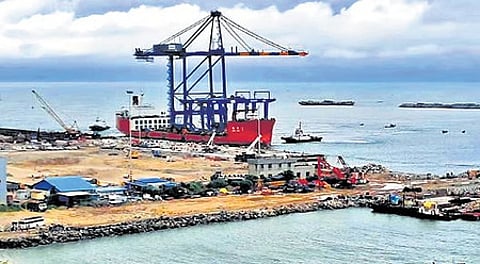

KOCHI: Kerala is in danger of losing the early advantage from the Vizhinjam port — one of the few in the world capable of handling ships carrying 3.5 lakh tonnes — if it fails to unlock thousands of acres of idle plantation land for industry and infrastructure. Despite the state spending nearly Rs 7,000 crore to Rs 8,000 crore on the project without a rupee of Central viability gap funding, development around the port has been slow.
Unless Kerala builds townships, logistics parks and industrial corridors to support the port, the economic spin-offs may well flow to neighbouring Tamil Nadu, which is already preparing to tap its benefits.
At the Vision 2031 conference in Kochi on Monday, Finance Minister K.N. Balagopal sounded the alarm and stirred a debate. He said Vizhinjam’s promise went far beyond docking massive vessels; it demanded a complete transformation of the region’s infrastructure and economy.
“All vibrant economies in the world are port-driven,” he said. “What is built in Pune reaches Mumbai’s JNPT; what is built in Haryana travels 1,500 km to Gujarat or Mumbai for export. Kerala must be able to do the same — from Vizhinjam to Kasaragod — within four hours.”
The minister urged that the state’s vast, underutilized plantation tracts, especially around Vizhinjam, be opened up for non-polluting industries and value-added agriculture.
“There are more than 10,000 acres of plantation land lying idle. These are rubber estates that people have stopped tapping. Why can’t we use these for warehouses, godowns or electronics assembly units?” he asked. The minister said Kerala must explore new crops like rambutan and dragon fruit, which can fetch farmers Rs 2 lakh to Rs 3 lakh per acre, and tap the export market for cut flowers and leaves.
“The idea is to start a discussion,” Balagopal said. “I am saying this only for debate and discussion. This is my personal thinking, not the thinking of the government or the Left Front.” He argued that plantations, already treated as industries under the Land Reforms Act, can support non-polluting commercial activity without harming the environment. “Land is not our problem — using it wisely is,” he added.
Balagopal’s second suggestion — equally provocative — focused on education. With 35 per cent of engineering seats lying vacant and school enrollments plunging from 6 lakh in Class 1 a decade ago to just 2.86 lakh last year, he said Kerala should consider opening its colleges to students from other states. “Right now, only students who appear for the Kerala entrance examination are eligible for admission here. Why can’t we relax that rule and allow others to study in our colleges?” he asked. “If 20,000 to 25,000 students come here, it will create an economic ecosystem of its own — hostels, food delivery, ride sharing — everything will grow around it.”
Experts have echoed Balagopal’s call for bold reforms. Srikumar Chattopadhyay, retired scientist at the Centre for Earth Science Studies, said Kerala’s first land reforms of 1963 had achieved social justice, but now the state needed ‘Land Reforms 2.0’ to unlock large areas for productive use. “The first reforms brought equality; the second must bring productivity,” he said.
As Chief Minister Pinarayi Vijayan prepares to inaugurate the next phase of the Vizhinjam International Port on November 5, the discussion sparked by the finance minister strikes at the heart of Kerala’s development paradox — a state that built one of India’s most advanced ports but may still watch its economic tide flow elsewhere.
