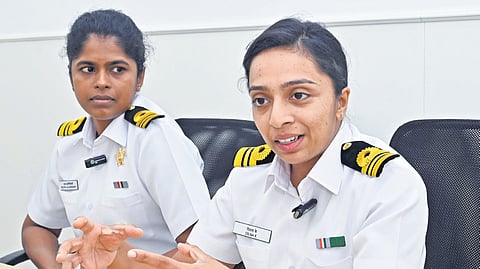

On October 2, 2024, two women Navy officers — lieutenant commanders Dilna K and Roopa Alagirisamy — embarked on an extraordinary mission of circumnavigating the globe on a sailboat. This eight-month journey, part of the Navy’s Sagar Parikrama expeditions, saw the duo navigate over 21,600 nautical miles (approx. 40,000km) without any external assistance, relying solely on wind power.
When their vessel, INSV Tarini, reappeared on the Goan horizon on May 29, Lt Cdr Dilna and Lt Cdr Roopa became the first from India to circumnavigate the globe in double-handed mode (involving two sailors).
In a breezy interaction with TNIE, the officers open up about their historic voyage, the midsea challenges, oceanic philosophy, ‘naari shakti’ in the Armed Forces, and more
Wat inspired you to join the Armed Forces?
Lt Cdr Dilna K: I used to be active in sports when I was young. My father was in the Army. After retiring, he joined the NCC (as a trainer), and he made me join too, saying I lacked discipline. I loved it from the start. I didn’t want to return from my first camp. That’s also when I started meeting officers in uniform, both men and women. By the time I was in Class 8, I had made up my mind that I would join the defence forces.
Lt Cdr Roopa A: My father was in the Air Force. He encouraged me to join the NCC during college. So, like Dilna, I met many Navy officers through NCC activities. That’s where the motivation began.
Your branches in the Navy?
Lt Cdr Dilna: I am from the Logistics cadre. I joined after my BCom in 2014.
Lt Cdr Roopa: I am in the Naval Armament Inspection cadre. I handle the inspection of naval guns and missiles.
Did you expect to be sailing at all when you joined?
Lt Cdr Dilna: Not at all. I knew I would be in logistics, which is mostly desk work. I was actually scared of water and heights. In fact, I used to get punishments for skipping sailing classes during my time at the Academy! But as someone interested in sports, I loved adventure. So when a senior informed me that there was a sailing opportunity, I signed up for it without even the slightest hesitation. The first time I sailed was in 2018. I started with a small boat in Mumbai. I had no clue about the technicalities. I stood when I shouldn’t have, the boom hit my head, I fell, and the boat capsized. That was my introduction to sailing.
Lt Cdr Roopa: The same is the case for me as well. I had never sailed before. The first time, I did not like it much. I kept wondering why anyone would do this. Like Dilna, I, too, capsized a lot! About 10-15 times a day. When you fall into the water, the sail covers you, and for a few seconds, it feels like you’re going to die. It was terrifying but addictive. I kept going back every day. Sailing felt like a calling.
From capsizing to circumnavigating the globe, what was the evolution process like?
Lt Cdr Dilna: After our selection sortie in 2021 (from Goa to Kochi and back), we underwent three years of training. We started with theory in Kochi, studying weather, navigation, communication, and then moved to Goa, where we sailed on small boats, then larger ones. We did expeditions from Goa to Mauritius, to Port Blair, and then Cape Town to Brazil and back (Cape to Rio race). For six months, we were at sea. There were a lot of mentors to assist us, including Captain Dilip Donde (retd) sir and Cdr Abhilash Tomy (retd) sir.
How did your rapport develop?
Lt Cdr Dilna: We trained together from 2021, spent most of our time at sea, so we got to know each other’s strengths and weaknesses. Teamwork became instinctive.
Could you outline the mission, the stops and rules?
Lt Cdr Dilna: This edition of Navika Sagar Parikrama (fourth) was just the two of us, sailing around the globe in double-handed mode, in a small 17-metre boat, INSV Tarini. We did it with four stops. The first stop was Australia. The second was New Zealand. The third was Port Stanley, an island near South America. The fourth was Cape Town. At all four stops, we participated in interactive sessions and outreach programmes.
Lt Cdr Roopa: We had to start and finish in the same port, which was Goa. We had to sail at least 21,600 nautical miles, the circumference of the Earth at the equator. We had to cross the equator twice. We were not to use the engine, except in emergencies or while entering and leaving harbour. And we had to pass the three great capes, Cape Leeuwin in Australia, the Cape of Good Hope in South Africa, and Cape Horn in South America.
What was in your mind at the start?
Lt Cdr Roopa: We had mixed feelings. We were going on a big journey, leaving everyone behind. Even though we were prepared to face anything. We were going into unknown territory, where anything can happen at any time. I even thought that everyone would have forgotten me by the time I returned. Because you are out for eight months — out of sight, out of mind. But it was the opposite. I was a changed person, but everything else at home was the same. I found it difficult to fit in. That is the irony of what this kind of voyage does to people.
Lt Cdr Dilna: I still remember, one week before departure, I was running a lot of things through my mind. There was curiosity and anxiety. You cannot even predict a day at sea. Our families and friends were there to cast us off. The belief the entire nation had in us… it was a huge responsibility. We had to meet the expectations. But as we sailed out, we left all our tensions behind on the shore. That was a huge relief.
How did your families respond?
Lt Cdr Dilna: When I volunteered, my mother, sister, husband… everyone was scared. Though it took some time to convince them, they were very supportive. I had to convince them. My mother knew I was going to do something monumental.
Lt Cdr Roopa: My mother did not speak to me for two weeks. My family stopped talking to me. My aunt and uncle called for counselling, asking if something was wrong, why I wanted to go around the world. My uncle, who was in the merchant navy, cautioned: ‘When you come back, you will not be the same person. It will change you, so think before you decide.’ In the end, my parents backed me as they realised the mission would make me really happy.
What changes did you notice in yourself after the voyage?
Lt Cdr Roopa: Primarily, the way you look at things changes. You don’t get direct answers in the ocean. You go through a situation again and again, until you change your perspective. That is the only option. There is none to blame, no other way. With this perspective, naturally, you start looking at things differently once back on land.
Lt Cdr Dilna: There are a lot of changes. One may not be able to list them at once. At sea, things are never smooth. We have always heard ‘change is constant’. Now we truly believe it. People change, situations change. I understand that now. I have also learned how to be happy with small things.
What’s tougher: the turbulence of the sea or the mind?
Lt Cdr Roopa: Both are difficult to manage. But we realised that even the worst storms end after 72 hours. Cdr Abhilash Tomy used to tell us this. It teaches us about the impermanence of life. Both good days and bad days, they don’t last forever. At sea, our moods were in sync with nature. When the weather was bad, so were our moods. When there was no sun for many days, that reflected on us too. When it was sunny, we were in good spirits.
Lt Cdr Dilna: At the end of the day, acceptance is key. That’s what we realised.
How was the experience at Point Nemo, the most remote point in the ocean?
Lt Cdr Dilna: It was the highlight of our voyage. It is a place where no one is near you. We wanted to go there. The mission route was about 100 miles away from Point Nemo. Our charted route did not pass through that exact point, but we wanted to go, so we re-routed and went.
Could you describe the experience sailing in the sea at night?
Lt Cdr Dilna: You see the moon’s reflection on the sea, the Milky Way, shooting stars crossing the sky. On pitch dark nights, you cannot see anything in front. Your belief in the boat builds slowly. At first it is unsettling, later you find there is texture in the dark. You hear only the sea and the wind.
What was your sleep routine?
Lt Cdr Roopa: During normal weather, we would take turns… five to six hours. When the weather was rough or during storms, both of us stayed awake.
Doesn’t the sleep cycle disruption affect you?
Lt Cdr Roopa: A lot. During the 14-day break that we had, we could not sleep at night. Daytime went in local programmes and boat maintenance. There was no set routine on the shore. We had headaches. I think we became ‘land sick’. By the time sleep settled, it was time to sail again. Throughout the eight months, our sleep cycle was disrupted. It did affect decision-making at times.
Lt Cdr Dilna: Sleep is vital. We had a sleep psychologist who checked our sleep patterns. He told us to do sleep banking when we go ashore, and to try Yoga Nidra. Though we could not follow it fully in practice, the tips helped.
How did you handle loneliness or isolation?
Lt Cdr Dilna: During festivals like Onam and Vishu, we thought of home and felt sad, but it was not a problem. We were happy at sea.
What personal items — such as music, books, coffee — did you take on the journey?
Lt Cdr Dilna: I like listening to music. I also love just looking at the ocean, the waves. I do not know how much time I spent doing that. The beauty is inexplicable. I had downloaded some films, but we did not get time to watch them. The weather was rough after crossing the equator.
Lt Cdr Roopa: I like coffee, books and music. I carried a portable espresso machine, the kind you take on hikes. I took a lot of books, but I barely got time to read. I read one or two books in those eight months, bit by bit. My phone went into the sea in Australia. Everything that I had downloaded was lost. I got a new phone, but I could only download about 10 songs. I listened to those on repeat for eight months. Even now, when I listen to those songs, I go back to my moments in the voyage.
Food on board?
Lt Cdr Roopa: We had supplies from the Defence Food Research Laboratory of India (DFRL): MREs (meals, ready-to-eat), freeze-dried. You just heat the packet and eat. To get an Indian touch, we had chicken tikka, chapati, chicken biryani.
Lt Cdr Dilna: In the mornings we usually had boiled eggs, bread or an omelette. We ate only twice a day, morning and before sunset. In the evening we had the major meal. Roopa likes rice and quinoa. I like chapati, so I ate rotis from DFRL. We had no fridge or AC to store fresh food on the boat. If we took fresh vegetables and fruits from a port, they would not last long, so we would use them first. After that, we would switch to chocolate.
What about water?
Lt Cdr Roopa: We stocked bottled water. For cleaning vegetables and other things, we used seawater.
What were the moments of triumph and beauty on the journey?
Lt Cdr Dilna: Sunsets and sunrises. The sky had so many colours. We saw many seabirds, albatross of different types and colours. Flying fish jumped into the boat, sometimes hitting our faces. That can be painful. Once, a squid came aboard. We saw whales and dolphins. The dolphins swam with us.
What were the diplomatic and cultural events arranged at each stop?
Lt Cdr Roopa: We started from Goa on October 2, 2024. The first stop was Australia. They acknowledged our journey, announced it in the Parliament of Western Australia. We visited several colleges and schools. Meeting Indians there felt like home.
Lt Cdr Dilna: The second port was New Zealand. The highlight was the traditional Maori welcome. New Zealand is beautiful.
Lt Cdr Roopa: Next was Port Stanley, a small island with a population of about 3,500. We met 45 Indians. They formed a WhatsApp group named Indian Penguins to facilitate the event of meeting us. It is still active. We also saw real penguins there.
Lt Cdr Dilna: Our fourth stop was Cape Town, our favourite. We did detailed maintenance and shared our experiences with the Indian community. Then we returned to Goa.
How does sailing culture in India compare to elsewhere?
Lt Cdr Roopa: In the West, there are boats everywhere, three to four hundred in a marina. People sail on weekends. Getting support for our boat was easy. We wish India too nurtures such a culture.
What can the next generation learn from the sea?
Lt Cdr Roopa: The new generation can learn from the raw courage of our fishermen. They do not have much modern equipment, they are just out there. Nowadays, on social media, you see people travelling to the mountains. Mountains calm people, give perspective on the enormity of life. We can get the same feeling from the sea. People should stop seeing the sea as something distant. See it as an extension of home. Stop looking from the shore’s perspective. Go out and live there. Belonging will come. But, of course, it starts with facilities and affordability. Cost is a big issue.
It is often said the ocean’s enormity can make one more humble…
Lt Cdr Dilna: At Cape Horn we desired to go close, as we had done at Point Nemo. We were confident. After all, we had sailed halfway around the world. We wanted to click selfies there, and planned to round it in the morning. We were just 20 miles away, but had to drop that idea. The weather was not condusive. We returned to basics. It was a humbling experience. You cannot conquer the sea.
Is being a woman remain a barrier in defence? Is there a cultural barrier?
Lt Cdr Roopa: The Armed Forces give us equal opportunities. But when it comes to something adventurous, like extreme sailing, yes, as Indian women, we do carry cultural baggage. It’s not always completely up to you. When it is, you might lose something. You might lose family support or someone because of a decision not shared. But in defence, there’s complete equality. From the academy onwards, we train together. Today, there are equal standards of physical fitness. And honestly, I feel there are now more opportunities for women, thanks to policies like ‘Nari Shakti’.
Your voyage featured in one of Prime Minister Narendra Modi’s Mann ki Baat addresses…
Lt Cdr Dilna: It was a proud moment. The story reached people across the country. It encouraged many to take up sailing or at least see it as something possible. Through Mann Ki Baat, we shared our experiences. When we visit schools, colleges, or academies, people approach us with curiosity: how to join the Armed Forces, how to start sailing.
Lt Cdr Roopa: I was elated when the prime minister spoke to us. We felt deeply responsible while speaking, knowing so many were listening. Because of that, our story reached further than we could have imagined.

Do you miss the sea? Any moment you would want to relive?
Lt Cdr Roopa: The last leg, from Cape Town to Goa. Everyone kept asking, “How does it feel?” I didn’t know what to say. If I said I was sad, they would ask why. I realised I had to enjoy every moment, every sunrise and sunset, because it was ending. Every moment at sea was worth it, even the difficult ones. The sea has a way of erasing pain. Only the beauty stays in your memory.
Lt Cdr Dilna: I would relive October 2 (2024), the moment we cast off from Goa. I had the entire eight months ahead, one goal in sight, and full focus. That was a moment of pure purpose. I would relive it just to tell myself: it’s all okay.
What’s next?
Lt Cdr Dilna: To prepare myself, physically and mentally, for the next big challenge.
Lt Cdr Roopa: I am waiting for the next opportunity, just like I was four years ago. I already miss the momentum.
Your message to young girls who want to join the Armed Forces?
Lt Cdr Dilna: The concept of fear exists because of inexperience, not incapability. People fear things they haven’t tried, not because they can’t do them. The way to overcome fear is through action, to muster the courage to try. Whether in sailing, sport, or everyday life, act upon it. That’s how you grow.
Lt Cdr Roopa: You don’t always get what you want easily. You have to grab opportunities, give your 100 per cent. You must be willing to take risks. Only then can you step out of your comfort zone and truly learn.
TNIE team: Anil S, Ronnie Kuriakose, Shan A S, Aswin Asok Kumar Vincent Pulickal (photos)