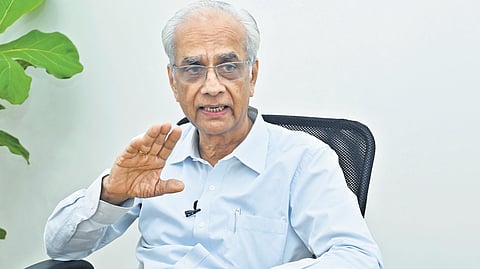

Former Chief Secretary K Jayakumar probably has had the longest tenure in Sabarimala in different capacities, including as special commissioner and chairman of the HC-appointed high-powered committee. One of the key driving forces behind the tagline ‘Kerala - God’s Own Country’, he is a rare combination of poetry and bureaucracy.
A multifaceted personality, he is a Sahitya Akademi Award-winning poet, versatile lyricist, accomplished administrator, and an acclaimed painter. In a free-wheeling conversation, Jayakumar tells TNIE that the Travancore Devaswom Board has structural problems and explains what needs to be done to protect the sanctity of the hill shrine.
Excerpts
You had a long tenure at Sabarimala in different capacities. What’s your take on the current controversy over the missing gold?
My long tenure at Sabarimala has helped me understand the developmental trajectory and the structural weaknesses in its totality. The current controversy doesn’t surprise me. There are structural problems in the (Travancore Devaswom) Board. As a functional entity, the board should be more professional. The staff needs training. The system has to improve and information technology should be applied. We can plug the loopholes in Sabarimala by minimising manual interventions.
Sponsorship-related issues led to the recent controversy...
Sponsorship is a good thing. But how we channelise sponsorships is important. Who should a prospective sponsor meet? Ideally, we should have a system under which terms and conditions are fixed, like the deliverables by the sponsor and the privileges he’d get. TDB’s dealing with sponsors is amorphous. Systems should be objective, with an officer in charge of sponsorships. Middlemen arise because TDB doesn’t have such a system. Sabarimala can be managed well, if there’s an objective and professional system in place. A lot of people would be ready to make contributions to Lord Ayyappa if the money is used well.

What are the other administrative weaknesses you noticed at Sabarimala?
The temple cannot be run like a government office, as it deals with customs and traditions. Devotees are often impulsive and emotional. We should have the machinery to handle all these. There should be dialogue with devotees, objectivity, and transparency. There’s definitely a need to modernise the board’s administration. I hope this crisis will turn out to be an opportunity for modernisation. The board should become efficient through process re-engineering, inducting new people; the general administrative level should be raised.
A core question is whether the state is required to administer temples…
The Travancore Maharaja was the administrator of all these temples. When the princely rule ended, all such temples except the Sree Padmanabhaswamy Temple (in Thiruvananthapuram), was handed over to the government through a covenant. The covenant says the government shall not directly administer temples. Instead, a board representing the devotees was to be formed, which would hold authority over temple affairs. This covenant is still upheld in letter and spirit. The government isn’t directly involved in temple administration; its role is limited to appointing board members.
But there are campaigns claiming that the government siphoned off money from Sabarimala…
There’s a widespread misinformation campaign that money from TDB temples is spent for other things by the government. It is aimed at polarisation and to create confusion. Government does not take a single paisa from the board. It’s impossible as well. The board cannot even withdraw its fixed deposits without court permission. Claims of fund diversion by the government are entirely baseless and malicious.
Many conspiracy theories are being floated in that regard...
They are mere conspiracies. In fact, the government provides financial support to Devaswoms. During my tenure, I introduced a dedicated budget head for the Sabarimala master plan and allocated Rs 10 crore. Beyond that, we neither take money from Sabarimala nor provide additional funds. Such a claim is entirely false. Even during the counting of offerings, strict protocols are followed to prevent any form of theft or misappropriation. The government does not take a penny from Sabarimala.
Does TDB use revenue from Sabarimala to support other temples?
Yes. A significant portion of the board’s revenue comes from Sabarimala. Only a handful of other temples – like Chettikulangara and Malayalapuzha – generate enough income to sustain themselves. The salaries of Devaswom employees are largely funded by Sabarimala.
There were discussions about creating a Sabarimala Trust, similar to the Padmanabhaswamy Temple Trust...
Establishing an autonomous trust for the temple could severely impact TDB’s financial stability. Any new administrative mechanism must be relevant and meaningful, with a distinct identity. It should offer functional autonomy while preserving the board’s rights over the temple’s revenue. Running Sabarimala costs approximately Rs 100 crore annually. Appointing a senior officer and implementing a standardised framework could significantly improve the management of Sabarimala.
Isn’t it the Devaswom Board’s responsibility to ensure the quality of products distributed from temples, like sandalwood paste?
Absolutely. The board bears full responsibility. Temples are run using devotees’ money and it’s the board’s duty to uphold their trust. They must ensure the sanctity and quality of offerings. Devotees should hold the board accountable.
There are demands for greater government control over temple administration. What’s your view?
I believe these demands are related to future development needs, which require coordination between departments like PWD and forest. To my knowledge, neither this government nor any previous government has sought direct control over temple administration. It wouldn’t be possible anyway—it would violate the covenant that governs temple management. The master plan sets a vision for 2040, which is ambitious and challenging. Executing it sustainably is even harder.
Is the disappearance of gold—unnoticed since 2019 and only surfacing in 2025—a failure of the system?
Yes, it reflects a systemic failure. Since it’s a matter under judicial review, I won’t comment. What surprises me is how something as valuable as gold was taken out of the temple. It belongs to Lord Ayyappa. Why wasn’t it repaired on-site? Both the court and temple manuals clearly state that no items belonging to Ayyappa should be removed from the premises.
How effective is the audit system?
I’d prefer not to comment as it’s under scrutiny by multiple agencies.
Can the public access information about temple assets?
Each temple has a thiruvabharana commissioner responsible for ornaments and jewellery, which are stored in secure chambers. Whether these assets are audited or stock-verified regularly, I can’t say. That’s what I refer to as systemic failure. There should be annual stock verification for such precious items.
Some board members privately complain that excessive court interference curbs the board’s autonomy...
Autonomy doesn’t mean sovereign power. Institutions are always bound by checks and balances. There’s no merit in that argument. Court monitoring provides necessary supervision — it isn’t judicial activism. The Hindu Religious Endowments Act, which came after the covenant, defines the court’s role. It has the legal authority to audit temple assets, which is why it intervenes in places like Guruvayur. The courts are fulfilling their legal obligations. Judicial supervision is beneficial—without it, things could deteriorate further.
Who’s responsible for the 2019 lapse?
My question is: why was the item allowed to be removed from the site?
Can the administrative office alone be held responsible?
Nobody suddenly decides to take gold from Sabarimala. There must have been a conspiracy.
How could it happen without the board’s knowledge?
I don’t know. It wasn’t robbery—it was taken out as if it were legitimate. There must have been a process behind it. When intent is bad, consultation becomes conspiracy.
When the board takes a decision, can a commissioner record his objections?
The Act is a bit vague on this aspect. You have to empower the office of the executive officer, who is the trustee of the faith of crores of people. We have to elevate the office to a higher level. Elevating the system means bringing in professionalism.
How transparent are the kanikka (hundi) offerings?
It is transparent as it doesn’t go to anyone’s pocket but is sent through a conveyor belt which nobody tampers with. It heads straight to the counting centre.
A vigilance officer had said bundles of notes were taken to Thiruvananthapuram...
(Dismissively) What all people say! These are many stories for which there is no evidence. The basis of your questions hints there’s a ‘dharmic’ flaw or a deterioration of values. The flaw in public and administrative morality that has affected other sectors has affected TDB too. We should focus on how we can check this systemically.
Can the example of Tirupati be emulated in Sabarimala?
That’s possible. But there are many problems. Mindsets and attitudes need to change. Tirumala has been a model for many years. Pilgrims’ comfort is taken care of; they are fed as guests of Lord Venkateswara. But in our temples, our ‘annadanam’ has a ‘take it or leave it’ attitude. It is a question of the attitude of Malayalis. The board alone cannot be blamed.
But can we compare Sabarimala, a hill shrine located in the forest, to the Tirupati temple?
There’s no comparison at all. Maintaining Sabarimala is a big issue. We should remove the defects using the master plan. That’s why we made Nilakkal a base camp. We have a huge parking complex and accommodation facilities there.
Sabarimala has a unique character. Devotees climb uphill, facing hardship with devotion. There are attempts to convert it into more of a tourist centre…
It shouldn’t be. That’s the challenge of implementing the master plan that envisages convenience to pilgrims and respect for the environment. It’s a forest shrine and therein lies its power. We can’t agree to anything that upsets the forests. If that happens, the very character of the shrine is lost. We should in fact plant trees to compensate for the deforestation that happened earlier.
There’s a suggestion to keep Sabarimala temple open round the year. Is that practical?
It’s better not to interfere with customs and ritualistic practices.
Recently, there was a plan to relocate ‘bhasmakkulam’. Is that part of the master plan?
It has more to do with customs rather than the master plan. As per vastu shastra, ponds should be located on the north-east side. But here, it’s on the north-west side – astrologically, not ideal. Many thantris have mentioned this.
The shrine comes within the Periyar Tiger Reserve. What kind of construction is allowed in such a sensitive location?
Within the 67 acres, we have some freedom to carry out construction, but we cannot cut trees.
Will the offices of thantri and melsanthi be relocated?
Yes, they have to be relocated. It’s a shrine. There shouldn’t be any residential area there. The same applies to the executive officer’s residence too. The master plan too suggests the removal of residential buildings around the shrine.
Are we looking at aesthetics too?
The high-powered committee has a role here. We should maintain architectural consistency and follow height regulations. The master plan covers zoning and architectural uniformity. I think around 25% of the master plan has been completed so far.
What’s causing the delay?
There may be delays due to resources. Sponsors haven’t done much to implement the master plan... they are willing to give money to Ayyappa but not to set up facilities for devotees. There are interested parties. If we handle this professionally, we will get donations. We need a professional toolkit to negotiate with sponsors. There should be a clear procedure to select sponsors.
Will these controversies affect the trust of sponsors?
We have to wait and see.
What kind of system would you suggest to handle sponsorship?
A manual for sponsorship is required to remove middlemen and to ensure transparency, thereby allowing those who have money to come forward. We should objectify the deliverables to the sponsor.
What’s the system followed currently?
Now, everything’s done in an informal manner. Even the court insists that nothing be given formally and that everyone be treated alike. I think there should be no space for subjective interpretation. If I am a donor, I should be entitled to certain privileges. If the court doesn’t permit it, we should try to convince the court. If we ensure transparency, there’ll be no issue.
What’s your take on special darshan?
Ayyappan doesn’t encourage it. There are many temples which allow special darshan; I don’t agree with it.
Was it right to limit the virtual queue?
I don’t know much about it. The desirability of virtual queue should be revisited. There are certain cases where we have to give some privileges to people like senior citizens or VIPs. All these are currently done informally. There’s nothing wrong with including the donor too. I personally don’t prefer any kind of discrimination before Ayyappan.
A majority of Devaswom Board employees reportedly belong to a certain caste…
None of these are legal. Other than the normal reservation criteria in government, Devaswom Boards don’t have any additional reservation. According to law, only the reservation policy followed by the government is applicable.
What about ‘ooranma’ rights?
That’s only in the Malabar Devaswom Board. It is very limited in Travancore Devaswom Board. Koodalmanikyam also falls under the Malabar Devaswom Board, where the ‘karayma’ people have certain rights. But these aren’t legally tenable once a board is formed. We have to convince them that if there is a law in the land, it is applicable to all.
You were one of the most popular collectors in Kozhikode. People still talk about your tenure there…
Becoming a district collector is an opportunity, as you have more freedom. I had a bit more freedom at the time, as the collector was in charge of the corporation too. I got a go-ahead from the then Chief Minister K Karunakaran. I did things which I felt Kozhikode needed. It was a time when Vaikom Muhammed Basheer, Thikkodiyan and M T Vasudevan Nair were active. The friendship and support they extended were a great endorsement of the sincerity of purpose.
Speaking of MT, the lyrics of the song ‘Chandanalepa Sugandham’ were asked to be rewritten multiple times...
It took many days. I see it as a sign of MT’s care for me, as he wanted me to write the best lyrics possible. MT is a perfectionist. From MT, I understood a great artist’s sense of benchmark. He would always say, ‘You can do better.’
You were instrumental in starting IFFK, and also played a key role in branding Kerala as ‘God’s Own Country’…
When we thought about organising the film festival, the KSFDC didn’t have money. But we managed to get sponsorship, and the first film festival was held in Kozhikode. Later, the government took it up in the third year through the film academy. It was P A Sreenivasan who brought me into tourism. I wanted Kerala to make an impact and thought of bringing a splashy advertisement campaign. I’m happy that I was actively involved in coining the tagline ‘God’s Own Country’.
Your father (M Krishnan Nair) was a filmmaker who directed three chief ministers – MGR, NTR and Jayalalithaa. But it’s said he didn’t want you to enter cinema…
My father never saw cinema as a bad thing. Many youngsters then used to come into the world of glamour like fireflies and fade away. He didn’t want his children to end up like that. My father said he wasn’t banning me from films, but was asking me not to hamper my education. After I joined IAS, I started writing songs. He encouraged me. He directed three chief ministers. He was a humble man and never realised the magnitude of that achievement.
In which songs did the visualisation do justice to your lyrics?
I think a majority of the songs did not do justice to the lyrics. The song ‘Sooryaamshuvoro Vayalpoovilum’ was portrayed in a relatively better manner... the euphoria has been captured in the shots.
You’ve also directed a movie...
Yes, ‘Varnachirakukal’. If I make a movie, it will have a social bearing. If the right kind of producer comes around, I might make a movie. I am not bothered about age. (Laughs).
Have you ever fallen into political red-tapism, given the scope for clashes between politicians and bureaucrats?
There’s no need for it. Do what is right. Some people may not like what you do because your right may be somebody’s wrong.
Recently, you spoke against the tendency of ‘one-size-fits-all’ being imposed upon us...
Yes. I recently wrote a poem against this. If we cry, all of us are to cry the same way: one nation - one cry, one nation - one laughter. I may not be an activist. But if somebody has the patience to dwell on my poetry, it’ll prove rewarding.
You’ve donned many roles and had an illustrious career. Which one do you cherish the most?
I am essentially a poet (smiles).
Do you see yourself as a bureaucrat who is a poet or a poet who is a bureaucrat?
That is a big predicament I face. Poetry is your very being. I have written film songs and have held high-profile bureaucratic positions, but the stamp of IAS poet is more or less a permanent fixture on me. I don’t mind. I am someone who was a poet even before I became an IAS officer.