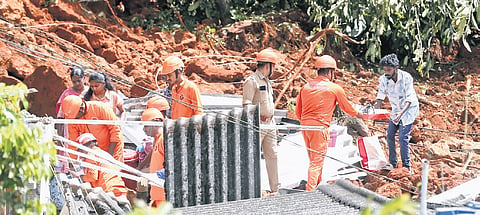

KOCHI: Following the mudslide on the Kochi-Dhanushkodi National Highway that claimed a life and destroyed eight homes near Adimali, experts are pointing a critical finger at National Highways Authority of India (NHAI) contractors.
They cite unscientific construction practices, particularly aggressive slope-cutting during the volatile rainy season, that are heightening the risk of landslips.
The government has ordered a temporary halt to all work on the crucial NH 85, till further notice.
‘Error in excavation’
Geologists contend that the fundamental error lies in the method of excavation. Instead of adhering to established safety protocols, contractors are widely engaging in sheer vertical cutting, sometimes up to 20 metres, without providing essential stability features. The standard practice requires creating steps, known as benches, to manage the slope.
“They should have ideally indulged in slope cutting with benches, rather than vertical cutting,” says Dr Sajin Kumar K S, assistant professor, geology department, Kerala University.
Benching is vital for adding stability to the hillside, as it reduces the probability of the slope giving way. Contractors, however, are often observed deferring protection measures to the very end — cutting slopes vertically and then merely covering them with a thin layer of shotcrete, a pneumatically projected concrete coating.
“The soil on the state’s slopes — a relatively young 10,000 to 15,000 years old — lacks proper cohesion with the ancient 250 crore-year-old rock base beneath. Vertical cutting essentially removes the natural support, destroying the soil’s equilibrium,” Dr Kumar said.
Made worse by rainwater
The situation is exacerbated by rainwater, which seeps into the newly exposed vertical cuts, adding mass and pressure.
Experts caution that quick-fix solutions like retaining walls are also prone to failure due to immense pressure from water or poorly compacted soil accumulating behind them. When the soil fails, the hard rock beneath is often exposed, providing visible evidence that the soft top layer has simply given way.
Residents blame unscientific excavation
Idukki: Residents of Laksham Veedu Colony in Koompanpara said unscientific excavation of soil led to the massive landslip on Saturday. The steep 40-ft ridge behind their settlement was carved out during the NH expansion, making the slope unstable, they said. “We alerted the officials concerned several times.
Cracks had started appearing weeks ago,” said Shaiju, a resident. A revenue department official confirmed that the area had shown signs of soil movement earlier. Water Resources Minister Roshy Augustine, who visited the site on Sunday, admitted that the landslip was connected to the NH work. “A detailed inquiry will be conducted and strict action will follow,” he said.
