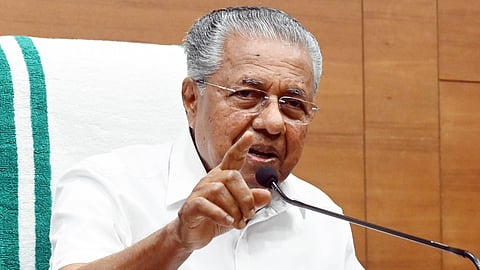

KOCHI: Chief Minister Pinarayi Vijayan’s surprise announcements on Wednesday, a sweeping welfare package that many are already calling a mini-budget, have set off a fresh debate over the state’s fiscal resilience. The slew of measures, including a hike in welfare pensions and honorariums, may offer relief to millions, but they also raise a pointed question: Can Kerala afford it?
The package is massive in scope. The government has raised the monthly welfare pension to Rs 2,000, benefiting around 62 lakh people. Honorariums for ASHA and Anganwadi workers have gone up by Rs 1,000. In a first-of-its-kind measure, all women, including trans women, from poor households aged between 35 and 60 will receive a Rs 1,000 monthly pension. Another Rs 1,000 monthly grant will go to five lakh youths enrolled in skill development programmes or preparing for competitive exams.
Finance Minister K N Balagopal described the decisions as “carefully considered and fiscally responsible”, asserting that the government has factored in financial implications. “We have deliberated deeply on the fiscal front. The government is confident of delivering on these promises,” he told mediapersons in Thiruvananthapuram.
Yet, economists are split on whether Kerala’s coffers can handle the added weight. Conservative estimates place the annual outlay for the new measures at around Rs 18,000 crore, roughly a 10% jump in revenue expenditure. Welfare pensions alone could account for Rs 13,000 crore.
“This looks like a mini-budget without matching revenue sources,” said Rudra Sensarma, professor of economics at IIM Kozhikode. “While it brings welcome relief to households in an inflation-hit state, much of the package adds new recurring commitments. Unless the next budget focuses sharply on revenue mobilisation, Kerala risks slipping into an unsustainable fiscal hole.”
Sensarma suggested that the government might need to consider “tougher fiscal options” such as raising lottery prices, hiking excise duties, revising user charges for transport, and monetising PSU land to restore fiscal balance.
But Prof K N Harilal, economist at the Centre for Development Studies (CDS) and head of the State Finance Commission, believes Kerala’s fiscal position is stronger than it appears. “The worst is behind us,” he said.
“The last few Finance Commission reports were severely unfavourable to Kerala, but we have managed to stabilise the situation. If the Centre provides even minimal justice in transfers and grants, the state can easily sustain this welfare and development momentum.”
Harilal pointed out that Kerala’s share of central transfers in total revenue receipts is only 25%, compared with the national average of nearly 50%. “When we spend Rs 100, we get only Rs 25 from the Centre,” he noted.
“Despite this, we have implemented the pay commission, completed major projects like Vizhinjam Port and the national highways, and brought down our fiscal and revenue deficits.”
Indeed, the numbers back his claim of slow recovery. According to the latest CAG report, Kerala’s own tax revenue rose 3.28% in 2023-24 to Rs 74,329 crore, while non-tax revenue grew by 8.12%. The state’s share of central taxes and duties also saw a 19% rise. However, grants-in-aid from the Centre plummeted by 56%, pulling down total revenue receipts by 6.21%.
Harilal argues that Kerala’s approach — balancing welfare with infrastructure investments — remains sound, provided that the central government does not adopt a “hostile stance” and the upcoming 16th Finance Commission treats the state fairly.
“Our revenue mobilisation capacity is improving. With modest central support, we can meet additional obligations and sustain ongoing development works,” he said.
Kerala’s finances, battered in the early years of the LDF government by the pay commission payouts, GST compensation loss, and a halt in revenue deficit grants, have gradually found firmer ground. The government managed to hold back part of the DA arrears to create fiscal space while keeping big-ticket projects on track.
Four years on, the situation looks less dire. But with welfare expansion now at full throttle, the state’s ability to keep the fiscal deficit under control will depend on how effectively it can mobilise fresh revenue — and how generously New Delhi chooses to treat it.
ASHA workers to get S1,000 hike
T’Puram: The cabinet has approved an increase of D1,000 in the monthly honorarium of ASHA workers. According to the announcement, a total of 26,125 ASHA workers across the state will benefit from the hike. The move is expected to cost the government an additional D250 crore annually. The cabinet has also decided to clear all pending arrears owed to ASHA workers.
Women’s Security Scheme
A new pension of Rs 1,000 per month for women (including trans women) from poor families not already covered under any welfare pension. A total of 31.34 lakh women aged 35-60 from AAY (yellow card) and PHH (pink card) households are the beneficiaries
‘Connect to Work’ Scholarship for Youth
K1,000 per month for youth (18-30 years) with annual family income below I1 lakh. 5 Lakh students who have completed Plus Two/ITI/Diploma/Degree and are pursuing skill courses or preparing for competitive exams
Kudumbashree ADS Operational Grant
19,470 Area Development Societies (ADS) under Kudumbashree to receive K1,000 per month as an operational grant
Annual cost: K23.4 crore
Revised, increased benefits
Social Welfare Pension: From K1,600 to K2,000 per month
Annual cost: K13,000 crore
DA/DR for government employees & pensioners: An additional 4% hike from November salary/pension
11th Pay Revision arrears: 3rd and 4th instalments to be paid within this
fiscal year.
Honorarium hike
Anganwadi workers/helpers: K1,000 per month (66,240 beneficiaries)
Literacy Mission instructors: K1,000 per month
Midday meal cooks: K1,100 per month
Pre-primary teachers & ayahs: K1,000 per month
Guest lecturers: Up to K2,000 per month
Rubber subsidy
Minimum support price for rubber increased from K180 to K200 per kg from November 1
Additional financial approvals
Pending pensions for construction and Anganwadi Welfare Boards to be cleared
Scholarships: SC/ST/OBC/post-matric/pre-matric students
K303.8 crore total
Fishermen’s children: K25 crore
Khadi workers & institutions: K44 crore (income support), K58 crore (rebates)
Mixed marriages assistance: K77 crore total (SC/ST/general)
Wild animal attack compensation: K16 crore
Health support: Cancer, leprosy, TB patients to get timely financial aid
KMSCL:K914 crore for uninterrupted medicine supply
Supplyco: K110 crore for market intervention dues
Road repair projects:K1,000 crore to be released by Dec 31
Social Security Mission arrears: K146.48 crore (for various welfare schemes)
Pravasi Welfare Board Pension: K70 crore
