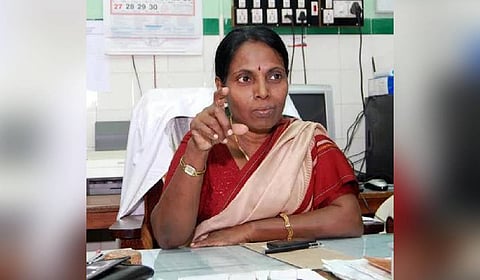

KOZHIKODE: When most people shudder at the very thought of a mortuary, Dr Shirley Vasu spent over three decades inside one, unravelling mysteries from silent bodies, giving justice to victims, and shaping the future of forensic medicine in Kerala . On Thursday, the state lost this pioneering figure when Dr Vasu, 68, collapsed at her home and could not be revived despite being rushed to Kozhikode Government Medical College Hospital.
The cremation will be held at the Mavoor Road crematorium at 4 pm on Friday in the presence of her family, former colleagues and many other people who respected her personality and profession.
With her passing, Kerala bids farewell to its first woman forensic surgeon, a woman who turned cultural stigma into strength, dedicating her life to science and justice.
A legacy of firsts
Born in Thodupuzha in 1956, Shirley Vasu carved her place in history at a time when women were rarely seen in forensic medicine. She completed her MBBS from Kottayam Medical College in 1979 and earned her MD in Forensic Medicine from Kozhikode Medical College in 1984.
She began her career in 1982 as a tutor in Kozhikode Medical College, gradually rising through the ranks as Assistant Professor, Associate Professor, and later as Head of the Forensic Medicine Department.
Over time, she led forensic departments in Kozhikode, Thrissur, and Pariyaram medical colleges, and finally served as Principal of Thrissur Medical College in 2014. Until her passing, she was heading the forensic department at KMCT Medical College, Kozhikode.
In a male-dominated discipline, Shirley not only broke barriers but became a mentor to hundreds of medical students, many of whom today are practising forensic experts across the country.
The woman behind high-profile cases
Dr Vasu’s name is etched in Kerala’s criminal justice history for her role in some of the most sensational and sensitive cases. She conducted the post-mortem of Soumya, the young woman brutally assaulted and murdered on a train in 2011, a case that shook the conscience of Kerala.
Earlier, she handled the Chekannoor Maulavi disappearance case, one of the state’s most debated mysteries. Her expertise was sought in numerous controversial deaths and mass tragedies, from train accidents to bus fires, where she pieced together stories hidden in fractured bones and fading tissues.
Recognitions and global footprints
In 1995, she was awarded a World Health Organization (WHO) fellowship for advanced training — a recognition that broadened her horizons and connected her with international forensic practices. She also received specialised training in the UK on handling atrocities against women and children, as well as forensic pathology related to terrorism cases, working alongside Scotland Yard experts.
Her accolades include, Justice Fathima Beevi Award (2017) — Kerala government’s prestigious Vanitha Ratnam Award, and Devi Award (2016) by The New Indian Express for professional excellence.
She published extensively in national and international journals and authored the book ‘Postmortem Table,’ which offers rare insights into her professional experiences.
Strength in face of stigma
In Kerala, where even attending funerals is often burdened with cultural taboos, Shirley’s choice of career was nothing short of radical. She often spoke of how her profession forced her to live differently, keeping an outdoor bathroom at her house to “leave the mortuary behind” before stepping into her home.
Her family, husband Dr K Balakrishnan, and children Nandana and Nithin, rarely discussed her work at home. Yet, they stood by her as she quietly carried the weight of thousands of deaths on her shoulders. Her husband always remembered her conversation that working in a mortuary always makes you humble. “You lose arrogance. You aspire to live a clean life.”
A teacher who shaped generations
Shirley was not just a professor of forensic medicine but a guide who emphasized compassion alongside clinical accuracy. Her students recall her saying: “An autopsy is not just about the cause of death. It is about restoring dignity to the person who has died.”
During her career spanning more than 40 years, she performed nearly 20,000 autopsies and taught hundreds of medical students, many of whom continue her legacy in India and abroad.
Naseema Abdul, one of her many students from Kozhikode told TNIE, “From her first investigation of skeletal remains in the early 1980s to handling the Soumya murder case decades later, Dr Shirley Vasu’s journey was one of grit, brilliance, and service.”
“She was more than a doctor for us, she was a voice for the voiceless, a mentor for the next generation, and a symbol of women breaking barriers in science. As one of her former students, Dr Shirley taught us that the dead can speak. It is up to us to listen,” Naseema said.
