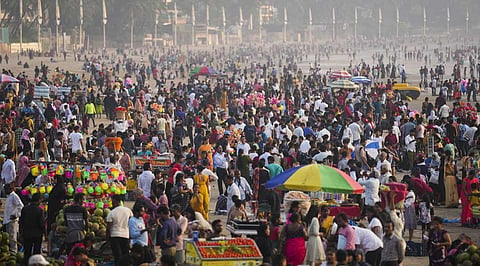

THIRUVANANTHAPURAM: With fertility rate declining, India is facing up to a challenge that Kerala had confronted over three decades ago. The latest report from the Sample Registration System showed that in 2023, the nation’s overall fertility rate dipped to 1.9 from the preceding year's 2. It also revealed that the total fertility rate (TFR) for rural India touched 2.1, which is the replacement rate — where one generation replaces itself, thereby leading to population stability.
Since 1971, Kerala’s fertility rate has shown a steady fall in comparison to the country’s rather gradual decline. In that particular year, TFR for India and Kerala were 5.2 and 4.1 respectively. A decade later, in 1981, the national fertility level stood at 4.5 whereas Kerala’s rate slumped to 1.8. By 1991, Kerala recorded below-replacement fertility, 1.8, while the national average stood at 3.6.
The initial phase of low fertility has a demographic dividend, which Kerala enjoyed until 2011, said Anil Chandran S, an assistant professor with the department of demography, Kerala University, and general secretary of the Indian Association for the Study of Population (IASP).
"The decline in birth rate results in a larger proportion of working-age people compared to their dependents including children and the elderly. This is a window of opportunity, though temporarily, for economic growth. India has been leveraging this benefit since the turn of the century and might continue to do so for the next two decades,” Anil told TNIE.

In the coming years, India will face the issue Kerala is currently facing: lower proportion of working-age people who will have to take care of a much higher proportion of dependents, children, and the elderly, he pointed out. "Again, the rate of decline won’t be uniform across all states. A slower decline in fertility will see longer demographic dividend. Kerala leveraged it for around 40 years," Anil said.
According to Finance Minister K N Balagopal, Kerala is addressing the issue of ageing population through a multi-pronged approach.
"Our elderly population now is around 17 per cent, which is comparable to some of the European countries. Over the next 10 to 15 years, it could be as high as 25 per cent of our total population," the minister said.
Balagopal had announced two initiatives — 'New Innings' and 'Healthy Ageing'— in the 2025-26 budget to make the state old-age-friendly. The first one is an entrepreneurship scheme and the second a healthcare scheme for senior citizens.
"The state is providing a monthly pension of Rs 1,600 to nearly 26 lakh elderly persons. The proposed Kerala State Policy for Elder Persons, 2025, and the recently-formed Kerala State Senior Citizens Commission, a first of its kind in India, will ensure welfare and protection of senior citizens," he added.
While Kerala is far ahead of its counterparts in geriatric and palliative care, there is scope for improvement, felt Dr M R Rajagopal, palliative care pioneer and founder of Pallium India.
"The recently launched Kerala Palliative Care Grid should be implemented effectively so that it makes meaningful changes. As per the State Palliative Care Policy, all medical colleges should have palliative care divisions. But except two, other government medical colleges are yet to have this wing. The policy also calls for training government doctors in palliative care,” Dr Rajagopal said.
He said Kerala can make a sea change in the lives of bedridden people if it emulates the Tamil Nadu government’s ‘Makkalai Thedi Maruthuvam’, a scheme for free home delivery of medicines to the aged.
"In Kerala, palliative care nurses visit bedridden patients at least once in a month. They can be entrusted with this responsibility," he added.