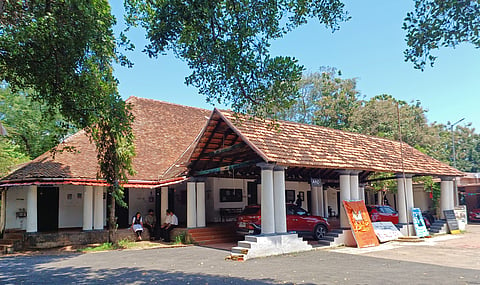

Away from the clamour of the city, yet right at its very heart, stands a place that no page of Thiruvananthapuram’s history can leave behind. One of the oldest law colleges in the country, it has lived not just as an institution of learning, but as a space where freedom, friendships, art, politics, and countless passions have found a voice.
Shaded by greenery, the spacious campus at Barton Hill occupies the historic Highland Bungalow, once the residence of Walthew Clarence Barton, the first chief engineer of the PWD. Here, learning was never just from textbooks.
The campus has shaped generations, its spirit carried far beyond the gates. From its corridors walked out men and women who became leading lawyers, judges, teachers, artists, and visionaries.
Now, marking 150 years, Government Law College, Thiruvananthapuram, resembles a matriarch who has seen it all, still alive with purpose, still guiding generations to dream, fight, and create.
A brief history
The story began in January 1875, when the Travancore Government sanctioned a ‘law class’ at His Highness’ College, enabling students to take the Madras University Law Examination.
W E Ormsby, Barrister-at-law, then a judge at the Sadur Court of Travancore, was appointed professor of law, and he opened the class that February. By 1894, it grew into ‘His Highness Maharaja’s Law College’.
The college was first affiliated to Madras University, later brought under the Travancore High Court, and with the formation of the University of Travancore in 1938, shifted under university control.
In 1949, it moved briefly to Ernakulam, but returned to Barton Hill in 1954. The postgraduate course was launched in 1962, and the five-year LLB in 1984–85. Today, it is a permanent institution under the state government.
Justice C S Rajan, an alumnus of the college, points to the college’s long-held prestige: “At that time, there were only two law colleges in south India — one in Madras and the other in Thiruvananthapuram.
Eminent lawyers from the High Court were directly appointed as principals here. Well-known civil lawyer E Subrahmanya Iyer and the famous criminal lawyer Malloor Govinda Pillai served as principals of the college.”
For Sindhu Thulaseedharan, dean (faculty of law), University of Kerala, the heart of the college remains its teachers. “The campus is very special to me. What stood out the most was the sincerity of the teachers,” she says.
“The close connection we shared with our teachers not just deepened our bond with the campus but also shaped us in many ways. It was their dedication that inspired many of us to choose the teaching profession.”

The college today
At present, the college offers five-year LLB (two batches), three-year LLB (one batch), and three batches of LLM, along with nearly 45 PhD scholars. Unlike most government law colleges in Kerala, which have just one law professor, this campus has six professors.
Principal Bindumol V C, herself an alumna, says, “The main vision of the college is to remain accessible to all, while maintaining the highest standards of quality.”
The campus is home to 850 students, ranging in age from 17 to 65. It has an active NCC unit, opening pathways to the armed forces as well as legal and public services. Skill development programmes, interdisciplinary studies, and a placement cell keep the institution in step with contemporary needs.
For over two decades, the Moot Court Society has trained students in advocacy, research, and legal writing, while the Legal Aid Clinic provides free services to underprivileged communities.
Run by students under faculty supervision, the clinic has become both a training ground and a channel for social commitment.
The college’s cultural presence is equally vibrant. “We engage with society, not just legally and academically but through arts and politics too,” says Sairam K, general secretary of the College Union. “We secured 7th place in the last Kerala University Kalolsavam, and students actively participate in national youth festivals.”
Notably, much has changed in student demographics. Assistant Professor Saleena U says, “When I was studying here, there were only 15 female students. Today, girls make up almost 60 per cent of the students. In postgraduate courses, nearly 90 per cent are women.”
Saleena also highlights a long-standing asset: the library. “It is one of the finest law libraries in the state. It houses some of the most precious volumes in the country’s legal history,” she says.
Currently, eight judges serving in the Kerala High Court are alumni of the college, showing the institution’s steady presence in the state’s legal sphere. And, as part of its 150th-year celebrations, the college is planning to record and bring together all those who studied here under one roof.
“Since former students are now spread across the world, collecting their details is a challenging task. Yet, this remains a key goal of the 150th year celebration, which will reunite those who studied here, faculty, and current students, celebrate their achievements, and strengthen connections,” says Sairam.
Notable Alumni
Justice Fathima Beevi – First woman judge of the Supreme Court of India
Neelam Sanjeeva Reddy – Former president of India
C Achutha Menon &
P K Vasudevan Nair – chief ministers of Kerala
Padma Shri N R Madhava Menon – founder of National Judicial Academy and National Law Schools, and a member of the Law Commission
R Sankar – one of the architects of the Indian Constitution
J Cyriac Mathew and
J K K Mathew – Supreme
Court judges
Ramesh Chennithala and Thiruvanchoor Radhakrishnan - former ministers of Kerala
Rasool Pookutty – Oscar-winning sound designer
M R Hariharan Nair, former High Court judge
I studied at the college from 1965 to 1967. Many who enrolled were government employees, especially from the police or revenue services, since they had to clear a Criminal Judicial Test. A law degree gave them an exemption from that paper. We were fortunate to have excellent teachers. It was the encouragement of one such teacher that inspired my path to becoming a judge. During my studies, I received the Malloor Govinda Pillai Gold Medal for securing the highest marks in Criminal Law among all the law colleges under Kerala University.
A Sampath, former MP
I joined Trivandrum Law College in 1984 for the three-year LLB course, and later pursued my LLM as well. N K Premachandran, Kodikunnil Suresh, and I studied here during the same period. Later, in the 15th and 16th Lok Sabha, we were together in Parliament. I still remember moments from those days, like when classes began, we would sometimes jump out through the windows. Among all subjects, Constitutional Law was my favourite. I have now decided to institute a cash award, starting this year, for toppers in the subject.
Rajeev Nair, senior director - legal,
HP India (1989–94)
My memories trace back to a warm summer morning in 1989. Barton’s bungalow, with most of its fittings and fixtures intact, served as the college’s administrative office, with the office files lounging luxuriously in his favourite bathtub! Portraits along the classroom walls evoked the institution’s illustrious past, while the library and corridors brimmed with ideas, debates, and the hum of politics, culture, and art. For the diffident teenagers who walked in, those years became an initiation into confidence, resilience, and friendships that endure to this day.
K S Ajayakumar, former principal
I spent 30 years at the Law College Thiruvananthapuram — as a student, teacher, and principal. I was part of the centenary celebrations that happened in 1976. The then president of India, Fakhruddin Ali Ahmed, was the chief guest. Later, as a teacher, I was part of the 125th year celebrations. I was there again for the 140th anniversary. Now, I feel fortunate to witness the 150th year as well. For me, it is a legacy written into my life.
Justice K Babu, High Court of Kerala
I argued my first case there. Many leading lawyers came to teach us practical aspects of practising law. That spirit gave us the foundation we needed to grow as lawyers.