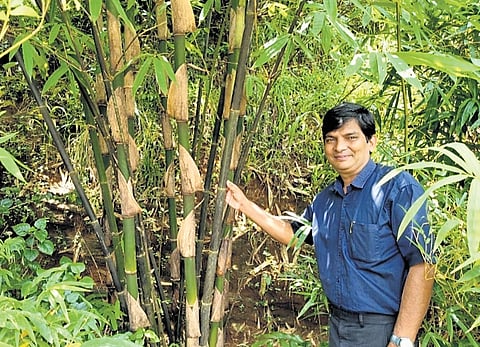

PALAKKAD: On a rocky stretch of land where even grass refused to grow, K C John chose to plant bamboo. What began as a small experiment has, in just six years, blossomed into a vibrant grove -- sixty varieties standing tall and swaying, transforming a barren acre in Palakkad into a sanctuary of shade, birdsong, and renewal. This is John’s world of bamboo at his home near Kalladikode in Palakkad district.
“Bamboo doesn’t demand much,” the 53-year-old says. “It can grow even on rock, as long as you’re willing to give it some care and time.” His acre of land now holds large varieties of bamboo -- from decorative clusters to tall, sturdy commercial species. The once desolate ground now hums with life, as birds and soil creatures have returned to the regenerated landscape.
For John, bamboo is both a livelihood and a way of living closer to nature. Alongside his wife Misha and children Joylyn (mechanical engineering student) and Jeswin (Plus-Two), he tends the grove with pride.
The family nurtures species like black bamboo, Buddha bamboo, bush bamboo, and anamula, among others – each chosen for its unique character or commercial value. John believes bamboo farming makes financial sense, too. With an initial investment of about Rs 1.5 lakh, he explains, an acre can hold nearly 400 plants, and the returns can start in just five years – potentially reaching several lakhs.
Compared with rubber, which requires a decade of nurturing before yielding consistent income, bamboo is less demanding. “This is not a crop of hard labour,” he says. “It’s a crop of patience.”
“I believe the public are still unaware of the possibilities of bamboo cultivation. In Kerala, we restrict ourselves to using bamboo for craft works.

Bamboo is more than just a plant; it’s a future resource. Its biomass can be turned into bioethanol, biogas, or bio-oil, making it a sustainable alternative to fossil fuels. As an energy crop, it can power electricity generation while acting as a remarkable carbon sink, absorbing large amounts of CO2 and helping fight climate change,” John explains.
He adds that bamboo’s promise goes beyond energy. “Research shows its fibres support healing of wounds and tissue regeneration, while its extracts carry antimicrobial and antioxidant properties, opening new possibilities in medicine and wellness. Fast-growing, renewable, and versatile, bamboo stands as one of the most powerful ally we have for sustainability and innovation,” he points out.
Through collaborations with The Bamboo Institute and World of Bamboo, John also shares his knowledge, helping others establish bamboo gardens and plantations.
What began for John as a simple trial on inhospitable ground has grown into a testament to renewal.
His one-acre grove now stands as a haven of green, offering shade, calm, and a thriving habitat where there was once only stone and silence. It is indeed a reminder that with patience and imagination, even the most barren land can be transformed into a sanctuary of life.