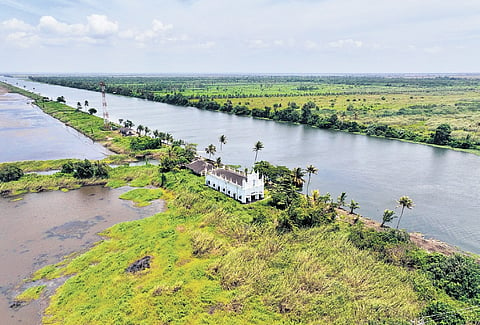

ALAPPUZHA: Chithira Palli, located on the banks of the Chithira paddy fields in Kuttanad, stands as an enduring symbol of human determination that helped eradicate poverty during the severe famine that followed World War II. The church and the reclaimed paddy fields surrounding it bear testimony to one of the greatest ecological and agricultural achievements in Kerala – farming below sea level.
The visionary behind this historic transformation was Joseph Murickan, fondly known among the people of Kuttanad as the ‘Kayal King’. His innovative leadership and collective effort with farmers, combined with the use of traditional knowledge and indigenous engineering techniques, made cultivation possible on vast stretches of marshy land lying below sea level.
By sourcing fertile mud from the lake and constructing strong outer bunds using coconut and arecanut wood, Murickan and his team converted waterlogged marshes into productive paddy fields. Their months-long hard work and farsighted planning enabled farming across nearly 2,000 acres initially, an agricultural marvel at the time, said B K Vinod, former member of Kainakary panchayat.
“Murickan’s vision led to the rebirth of thousands of acres of paddy land in Lower Kuttanad. Under his leadership, farmers created artificial polders by excavating fertile silt from the lake bed and building strong protective bunds before commencing cultivation.
As a symbol of his devotion to god, Murickan constructed the church on one side of the reclaimed land; it stood as a landmark,” Vinod said. “The driving force behind the Herculean task was the famine of the 1940s, which also severely affected Travancore. In response, the then ruler of Travancore, Chithira Thirunal Maharaja, decided to significantly increase foodgrain production. Kuttanad, already a major agricultural region, was identified as key to this effort,” he said.
Murickan, a prominent landlord in the region, proposed reclaiming lake areas for cultivation, pointing out that fertile marshy soil was continuously deposited by the Pampa, Achankovil and Manimala rivers. He argued that farming could be carried out with minimal investment if nature’s challenges were properly managed. The king approved the proposal.
“Murickan and his team reclaimed nearly 2,150 acres of land in three major blocks, which were named Chithira, Rani and Marthandam, in the honour of the Travancore royal family. In 1940, the first crop was successfully harvested from the reclaimed land, marking the beginning of a major agricultural transformation in the state,” Vinod said.
This success paved the way for large-scale paddy cultivation in Kuttanad. The region today accounts for more than 30,000 hectares of agricultural land. After Independence, Kuttanad earned the title of the “Rice Bowl of Kerala”.
Beyond agriculture, Murickan also addressed the welfare of labourers involved in reclamation work. He created a 10-acre freshwater pond within the reclaimed land near Chithira Palli to provide drinking water. The pond continues to exist as a freshwater body in the middle of a brackish water lake, an engineering wonder achieved without modern technology.
