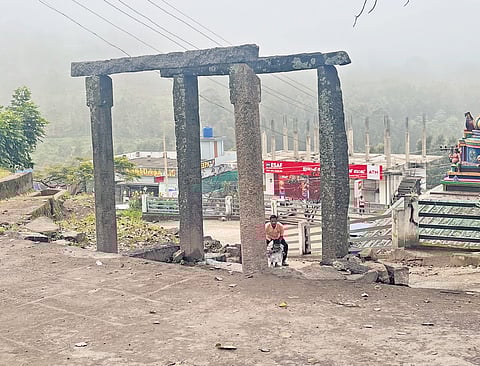

IDUKKI: It’s not just checkposts or signboards that inform someone that they have entered Idukki or are at some particular place. Some villages in the hilly region, like Anchunadu, have their own identifiers – Thalaivasal.
In Anchunadu, these centuries-old stone gateways continue to signify the formal entry point to the cluster of high-range settlements on the Kerala-Tamil Nadu border.
Tamil for ‘head entrance’, a Thalaivasal is a traditional village entry point built with four stone pillars capped by two cross stones. In Anchunadu, these structures stand as silent sentinels of history. Some bear ancient Tamil inscriptions and are flanked by idols of Karuppanna Swami, a guardian deity revered as the village ‘kaval daivam’.
According to village elders, the Thalaivasal system dates back nearly 500 years, to a time when Anchunadu was part of the Periyakulam taluk in present-day Tamil Nadu, before its merger into Idukki’s Devikulam taluk.
“Anchunadu once comprised a compact group of settlements – Kanthalloor, Keezhanthoor, Karayur, Marayur and Kottagudi (now in Tamil Nadu),” recalled T S Gunasekharan, a senior member of Keezhanthoor village. “Each village had very few houses then. The Thalaivasal functioned as the sole entrance and worked much like a checkpost, preventing outsiders from entering without the knowledge of the community,” he told TNIE.
As population grew and roads expanded, homes came up inside and outside the original boundaries. Multiple access points emerged, reducing Thalaivasal’s practical role.
However, the Thalaivasal remains central to village customs even now.
Important life events are ceremonially initiated only after passing through it.
“Brides and grooms pass through the Thalaivasal as a mark of respect to the entire village,” Gunasekharan said. During major events like the Mariyamman and Chithira festivals, processions are routed through the gateway to symbolically mark the commencement of celebrations.
In nearby Vattavada, where Jallikattu is still held during Pongal, bulls are released one by one into the arena through the Thalaivasal, from where trained, unarmed youths attempt to hold onto the animal.
Across Tamil-speaking regions, particularly in the Palani Hills, Thalaivasal has long signified the transition from the outside world into a protected community space. Often aligned with the street leading to the oldest house or that of the village founder, the entrance is traditionally guarded by deities such as Ayyanar or Karuppanna Swami, believed to safeguard the land and its people.