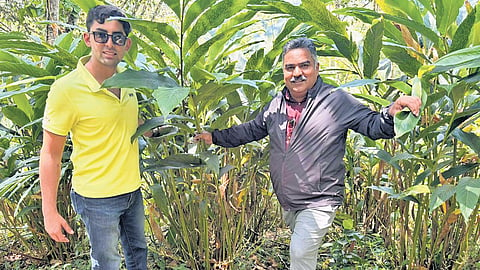

KOCHI: Last April, Stany Pothen — one of Kerala’s biggest cardamom planters — found himself deep in the hills of Guatemala, the world’s largest producer of the aromatic spice. For a month, he walked plantations, spoke to growers, and studied their methods. What he saw confirmed a growing global reality: the cardamom market is tight, and Kerala is quietly stepping into a moment of advantage.
“There’s a global shortage,” says Pothen, who also heads the Cardamom Farmers Federation. The brutal summer of 2024 hurt yields in India — and Guatemala too. Yet, despite being the world’s largest producer, Guatemala’s cultivation practices remain largely small-scale and dependent on rainfall. “Their systems are not as advanced as ours — especially irrigation,” he notes.
The result is visible in the market. With Guatemala’s output yet to recover — by some estimates down by as much as 40-50% — global inventories have tightened sharply. Prices have surged to Rs 2,500–2,600 per kg, a multi-year high that is now driving renewed optimism across Kerala’s cardamom belt.
For growers in Idukki’s three taluks — Udumbanchola, Peermade and Devikulam — the ‘queen of spices’ is suddenly the flavour of the season. Production this year has climbed anywhere between 30% and 70%, reversing last year’s slump when output had dropped from 22,869 tonnes in 2023-24 to 18,310 tonnes in 2024-25.The higher prices have also expanded the cultivated area to around 1.25 lakh acres, nearly doubling from earlier decades.
The boom is a reminder of the cyclical fortunes of spices. Six years ago, cardamom prices had touched an all-time high of Rs 5,000 per kg in June 2019, only to crash to Rs 900 by mid-2022. Now, with global demand firm — particularly from the Middle East and strong domestic consumption — Kerala’s growers are once again betting big.

But just as one spice rises, another continues its long slide.
Pepper — once Kerala’s ‘black gold’ — is struggling despite decent prices. The state that once dominated India’s pepper output has seen production fall steadily from around 45,000 tonnes annually in the mid-2000s to roughly 22,000 tonnes in 2024–25. Karnataka has overtaken Kerala, producing nearly 47,891 tonnes last year.
Older farmers recall a different era. N J Joseph, now in his seventies, remembers harvesting 20 quintals of pepper from just five acres in his farm at Kallarkutty, Idukki, in the 1980s. The following year, disease wiped out his vines. Over time, erratic weather patterns compounded the problem. Like many others, he shifted first to rubber — another crop now facing its own slow decline. The story of pepper’s retreat is not just about climate and disease. Policy, growers say, has played a decisive role.
Unlike tea, coffee, rubber or cardamom, pepper is not classified as a plantation crop under the Kerala Land Reforms Act. That means farmers are effectively capped at around 15 acres for large-scale cultivation. “This is a major constraint,” argues Pothen. In Karnataka, corporate estates integrated pepper vines into expansive coffee plantations, dramatically boosting output. Kerala’s regulations, he says, have kept large investors away.
Former Spices Board chairman V J Kurian recalls that several schemes were launched to revive pepper, including new varieties. But structural constraints remain. Requests to declare pepper a plantation crop — thereby exempting it from land ceiling limits — have yet to translate into policy change. An IIM Kozhikode study has even suggested loosening multi-cropping restrictions on plantations, but reform has been slow.
The contrast could not be sharper: cardamom drawing new acreage and investment, pepper losing ground despite strong export demand from the US, Russia and the EU.
And yet, Kerala’s identity is inseparable from both.
For centuries, traders from Rome, Arabia, Greece and China sailed to the Malabar Coast in search of these very spices. Pepper — then worth its weight in gold — made ports like Muziris legendary long before European ships appeared on the horizon. Vasco da Gama’s arrival in 1498 was driven by the same lure.
Today, the ships have been replaced by global supply chains, but the stakes remain the same. Cardamom is enjoying its moment in the sun. Pepper, battered by disease, changing weather and stiff land rules, is fighting to hold its place.
In Kerala’s hills, the old spice story continues — one queen ascendant, one black gold fading, both still shaping the land that once drew the world to its shores.