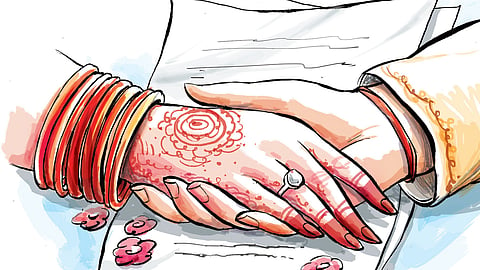

IDUKKI: What if dowry never assumed the magnitude of a social evil that has left individuals, families and even communities shattered?
While Kerala continues to grapple with dowry related harassment and violence, a small hill community in Idukki has quietly lived by a system where such strife is unheard of. In Anchunadu, dowry disappeared generations ago, replaced by a tradition that treats women with dignity, and not as a liability.
Anchunadu, a culturally distinct region comprising Marayur, Karayur, Keezhanthoor, Kanthalloor, and Kottagudi (now in Tamil Nadu), follows a marital custom that has turned the conventional dowry system on its head. Here, it is the groom who offers valuables to the bride’s family — as a gesture of respect and gratitude for consenting to give their daughter in marriage.
Speaking to TNIE, T S Gunasekharan, a senior community member from Keezhanthoor, explained the significance of the ritual.
As part of the wedding ceremony, the bride is offered a chalaka (traditional Tamil unit of measure) of rice, along with a baby goat. One chalaka equates to roughly 100kg of rice, underscoring the symbolic and material value of the offering.
“The rice symbolises sustenance and security,” Gunasekharan said. “It represents the assurance that the woman, who is considered the foundation of the household, will never be seen as a burden. By offering rice, the groom’s family acknowledges her worth and their responsibility to ensure her dignity and well-being. Since a woman is regarded as life itself, another life — a baby goat — is also offered.”
Community elders say the system, practised for decades since the existence of the community, has helped prevent domestic violence and marital disputes linked to demands for dowry. With no financial pressure placed on the bride’s family, the imbalance that often fuels dowry-related abuse simply does not arise.
Residents are quick to clarify that the practice is not a form of reverse dowry. “The dowry system is absent in our community,” said Sivakumar, a resident. “Parents who wish to give something to their children do so voluntarily, not based on any demand.”
Traditionally, the Anchunadu Vellalar community encouraged marriages within the community to preserve its customs and traditions. However, over the past decade, social change has been reshaping these practices. With younger generations moving out for education and employment, inter-community marriages have become more common. The earlier system also resulted in several men remaining unmarried due to a shortage of brides within the community.
Acknowledging these realities, residents — particularly in Keezhanthoor — have now decided to adapt. Inter-community marriages are permitted, reflecting a more open social outlook.
However, for those who continue to live in Anchunadu, traditional wedding customs remain firmly in place.
Dignity, not liability
The groom offers valuables to the bride’s family, as a gesture of respect and gratitude for consenting to give their daughter in marriage
The bride is offered a chalaka (equal to roughly 100kg) of rice, along with a baby goat
