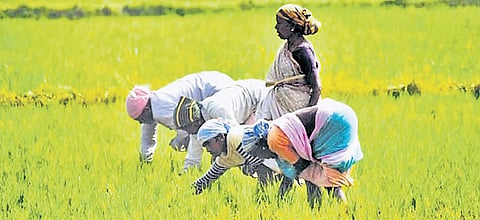

KOCHI: The KERA Nawodhan scheme launched by the agriculture department to improve food production and empower the farmers has ignited hope among the farmer community.
The scheme aims to enable cultivation on 30% of the 1 lakh hectares of fallow land through collaborative partnership between landowners and farmers. It will facilitate landowners and skilled farmers or investors to work together without any transfer of land ownership rights.
The `2,365.5 crore KERA (Kerala climate resilient agri value chain modernisation) project, implemented with financial and technical assistance from the World Bank, aims to transform the agriculture sector in Kerala by adapting modern technology. Nawodhan is an official component of the KERA project which opens up major commercial farming opportunities for investors, farmer collectives, agri-startups, and Non-Resident Keralites (NRKs) who have financial resources and agricultural expertise but do not own farmland. The loan component is `1,865 crore and the project will end in November 2029. The repayment will start after 6.5 years and the loan tenure is 17.5 years.
“KERA is a decisive step towards climate-smart farming, ensuring higher productivity with lower carbon emissions and stronger resilience to climate change. Through scientific collaboration with the International Rice Research Institute, KERA will modernise paddy cultivation and position the state as a leader in low-carbon agriculture, laying the foundation for a more secure and profitable future for our farming community,” said Agriculture minister P Prasad.
M Thomas, a resident of Pampampallam in Palakkad, said, “I have taken 3 acres of land for cultivation under the Nawodhan scheme and the agreement was signed in December 2025.
I am preparing the land for jasmine cultivation and expect to start harvesting flowers from June,” adding that scheme seems to be very promising and beneficial to the farmers.
Kerala Agribusiness Company (KABCO), a special agency set up by the state government to facilitate agri-business activities, will act as the third-party signatory to all service level agreements. It will provide end-to-end handholding support to all stakeholders, coordinate Nawodhan with other Union and state government schemes, and help participants with market linkages, product branding, and export opportunities as part of KERA Project’s value chain interventions.
According to KERA procurement officer Suresh C Thampi, 32 land owners and 226 farmers have registered under the project and 4,800 acres of land has been availed for the project.
“The project will help farmers to change the agricultural practices to cope up with the adverse effects of climate change and improve farm income. As an initial step, the agricultural land in Kerala will be divided into five climate zones. A study is being conducted to understand the impact of climate change on 20 major agriculture products. This will help the farmers evaluate the climate and select the crop to be cultivated each season,” he said.
A digital dashboard has been set up to share the study reports with the farmers.
Meanwhile, the Krishi Bhavans in the state will also be modernised, with 30 Krishi Bhavans being converted into Smart Krishi Bhavans in the first phase. As many as 20 soil testing laboratories will be modernised at `25.95 crore and a training centre will be established in Kazhakoottam at `10 crore.
Modern cultivation practices will be implemented in association with the International Paddy Research Centre. The project will implement alternate wetting and drying (AWD) on an experimental basis in the wetlands of Thrissur and Palakkad.
The first phase of the experiment has been completed in Mannuthy and Pattambi. Since paddy is a water intensive crop, the experiment will help to take up paddy cultivation in water stressed areas.
In addition, the government will bring together Farmer Producer Companies (FPC) and Agri Business Players (ABP) to ensure better marketing. The price of the farm produce will be fixed based on quality even before harvest. More than 125 companies and 65 farmer producer companies have come forward to join hands under the project.
To support the plantation sector, the government has also announced financial support for replantation. Rubber farmers will get `75,000 per hectare for replanting, farmers in Idukki will get `1 lakh per hectare for replanting cardamom and farmers in Wayanad will receive `1.10 lakh per hectare for replanting coffee.
KERA project: Kerala climate resilient agri value chain modernisation
Project estimate: L2,365.5 crore
World Bank loan: L1,865 crore
Project duration: 5 years
Repayment: After 6.5 years
Loan tenure: 17.5 years
